
When an engine loses power, the cause usually falls into one of four groups: not enough fuel, not enough air, weak spark, or a sensor or exhaust problem telling the engine to hold back. If it happens on the road, ease off the gas, turn on your hazards, and get to a safe place before you worry about why. Then have the car diagnosed, because a power loss that comes back tends to come back at a worse moment, like merging onto I-35E or crossing the President George Bush Turnpike.
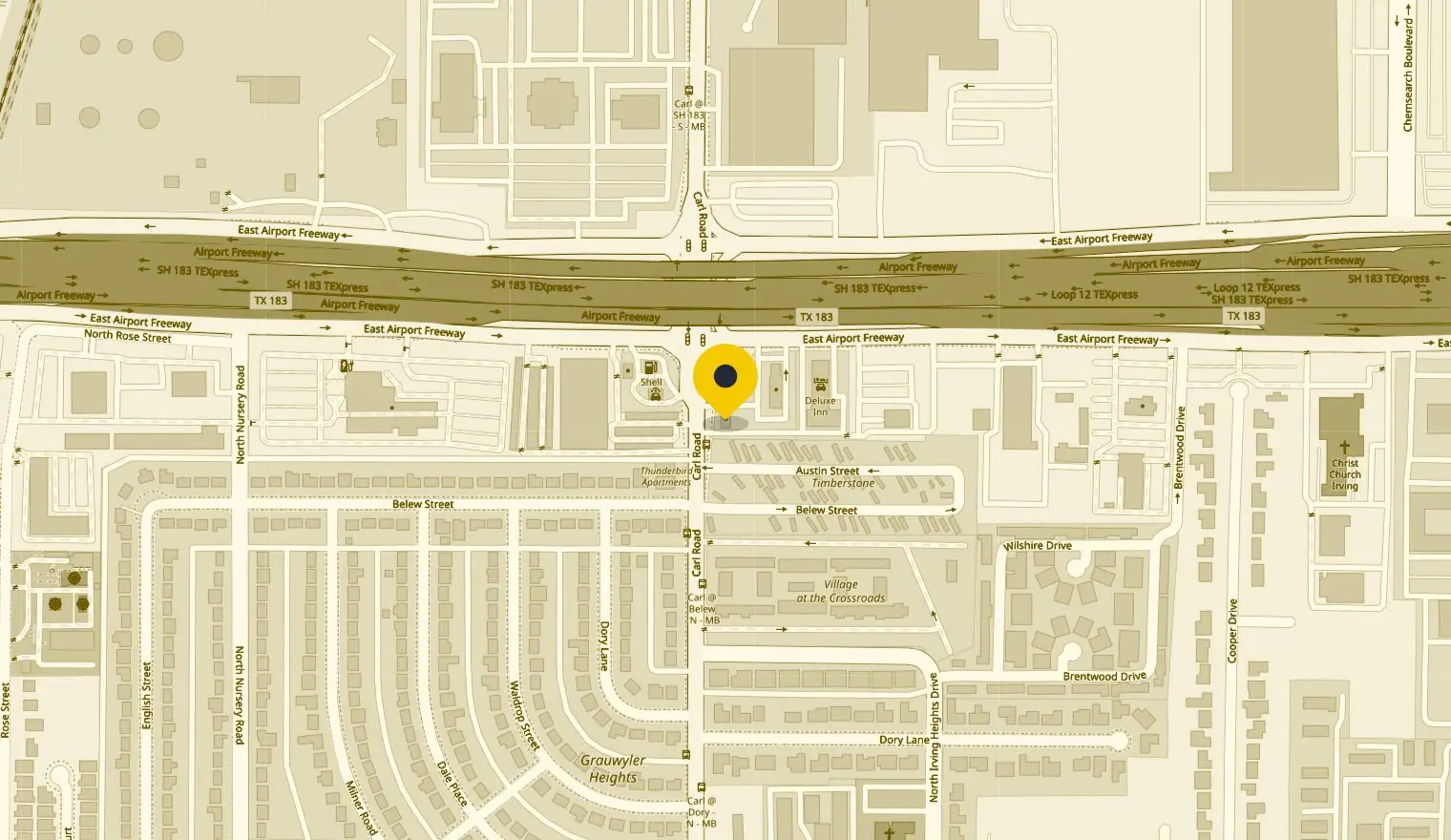
This guide explains what is happening under the hood in plain language, how to read the clues your car gives you, and what a proper diagnosis looks like. We are Kwik Kar Oil Change & Auto Care at 2100 Carl Rd, Irving, TX 75061, and this is how we think about the problem when a driver pulls in saying “it just ran out of steam.”
TL;DR
- Power loss almost always traces back to fuel delivery, airflow, ignition, exhaust restriction, sensors, the charging system, or the transmission.
- If the engine is cutting out or the car barely moves, signal, coast to a safe spot, turn on the hazards, and call for help rather than restarting repeatedly in traffic.
- An orange or red warning light together with power loss means the car should be looked at as soon as possible. A flashing check engine light or a red oil or temperature light means stop driving.
- Guessing at parts is expensive. A scan alone does not name the failed part, so diagnosis should include live data and physical checks.
- We can inspect the car, send you photos and video through a Digital Vehicle Inspection, and explain what we find before any repair.
Table of Contents
- What does it mean when an engine loses power?
- What should you do if your car loses power while driving?
- Why did my car lose power all of a sudden?
- What causes an engine to lose power when accelerating?
- Why does my engine shake and lose power at the same time?
- What if the power loss comes with a warning light, smell, or steam?
- Can a diesel engine lose power for different reasons?
- Does a hybrid lose power differently?
- How does a shop diagnose loss of engine power?
- Can regular maintenance prevent power loss?
- Our perspective: power loss is a symptom, not a diagnosis
- Get it checked at our Irving shop
- Does Texas inspection law affect a car that loses power?
- FAQ
- Sources
What does it mean when an engine loses power?
An engine makes power by burning a mix of air and fuel at the right moment, then pushing the exhaust out. Take away any one piece and you feel it in the pedal. Drivers describe it in a few different ways, and the description matters for diagnosis:
- The car feels sluggish or hesitates when you press the gas. That points toward fuel, air, or ignition trouble.
- The engine revs but the car does not speed up. That can be the transmission, not the engine.
- The engine shakes or stumbles. That is typically a misfire.
- The car goes into reduced power and will not rev past a limit. The computer may have detected a fault and limited output to protect the engine or transmission, often called limp mode.
- The engine shuts off completely. That is a stall, and it is a different (and more urgent) problem than gradual sluggishness.
The first thing we ask is which of those matches your experience, because the answer narrows the list quickly.
What should you do if your car loses power while driving?
Safety comes before diagnosis. AAA’s guidance for a breakdown is to use the vehicle’s remaining momentum to reach a safe place, turn on the emergency flashers if the car is inoperable, call for roadside assistance, and stay in the vehicle if getting out is unsafe.
Here is how that looks in practice:
- Stay calm and keep steering. If the engine stalls, the steering and brakes still work but take more effort, as one automotive repair resource explains. Press the brake firmly rather than pumping it lightly.
- Turn on your hazard lights and signal toward the shoulder or an exit.
- Coast to the safest spot you can reach. On a Dallas-area freeway, an exit ramp or a parking lot is far better than a narrow shoulder with traffic at 70 mph.
- Put the car in park and set the parking brake. Note what the dashboard says before you shut it off.
- Do not keep cranking the engine. Repeated restarts can drain the battery and, with a fuel or ignition fault, may make the situation worse.
- Call for help, and write down what happened: speed, whether the engine was cold or hot, which lights came on, and any smell or noise.
Those notes are useful. A power loss that happens only when the engine is warm, only under load, or only at a certain speed gives a technician a strong head start.
Why did my car lose power all of a sudden?
Sudden loss is usually electrical or fuel-related, because those systems can fail without much warning. AutoZone lists fuel-system problems, ignition faults, sensor issues, charging-system problems, vacuum leaks, timing-belt trouble, and contaminated fuel among the possible reasons a car stalls while driving. Here are the ones we see most often described by drivers.
A weakening fuel pump
The pump pushes fuel from the tank to the engine at steady pressure. As it wears, it may keep up at idle and cruising speed but fall behind when you ask for more, which is why the car may feel fine around town and then fade on a highway on-ramp. A Boston.com Car Doctor column from April 2024 lists a weak fuel pump, a faulty sensor, or a developing catalytic converter problem as possible reasons a vehicle suddenly slows and barely moves.
Ignition faults
Spark plugs, ignition coils, and on older vehicles distributor parts all create the spark that fires the fuel. When one fails, AutoZone notes, the engine can lose spark and stall. A single failing coil more often causes a misfire, where one cylinder stops contributing and the engine shakes and loses pull. If that sounds like your car, our guide on diagnosing a P0300 misfire code with live scan counters shows how a shop narrows it down.
Sensor problems
Modern engines rely on sensors to measure airflow, throttle position, and exhaust oxygen. If the mass airflow or manifold pressure sensor sends bad numbers, the computer may deliver the wrong amount of fuel. The car runs poorly, though nothing is physically broken. This is one reason the check engine light deserves attention even when the car still drives.
Charging system trouble
An engine needs electricity to run its ignition, fuel pump, and computer. If the alternator stops charging, the car runs off the battery until it cannot. Mechanicbase describes alternator problems and loose battery connections as causes that can leave a vehicle without enough electrical power to keep running. If you see the battery light, read our piece on what to do when the battery light is on while driving, and see the alternator failure symptoms to compare with what you noticed.
Accidental brake pressure
It sounds silly, but it happens: the Boston.com column mentions that unintentionally applying the brake while accelerating can cause temporary power loss. A sticking brake pedal or a dragging brake is worth ruling out, especially if the car also smells hot after a drive.
What causes an engine to lose power when accelerating?
If the car drives normally at a steady speed but struggles when you press harder, the engine is probably being starved of something it needs under load. AutoZone’s list for cars that will not accelerate includes a clogged air filter, a weak fuel pump, a restricted fuel filter, clogged injectors, worn spark plugs or other ignition faults, low compression, and a restricted exhaust or collapsed catalytic converter. Haynes makes the same point and adds that transmission trouble such as slipping can look like an engine problem.
A quick way to sort the possibilities is by how the car behaves:
| What you notice | Common suspects | What a shop checks |
|---|---|---|
| Hesitation or stumble on acceleration, shaking | Worn plugs, failing coil, dirty injectors | Misfire counts, plug and coil condition, fuel trim data |
| Fades at highway speed or going uphill | Weak fuel pump, clogged fuel filter | Fuel pressure under load |
| Weak pull, poor mileage, rotten-egg smell | Restricted exhaust or catalytic converter | Exhaust backpressure, converter condition |
| Engine revs up but speed does not follow | Transmission slip, low or burnt fluid | Fluid condition, road test, transmission scan |
| Rough running with a check engine light | Sensor or vacuum leak | Stored codes, live sensor data, smoke test |
| Power returns after the engine cools | Heat-related electrical or sensor fault | Test when hot, inspect wiring and connectors |
The table is a map, not a verdict. Two different faults can feel the same, and one fault can cause another. A neglected air filter, for instance, is cheap to fix but can hide behind more serious-sounding symptoms.
When the problem is the transmission, not the engine
If the engine speed climbs while the car barely picks up speed, or the shift is slow and harsh, look at the transmission. Our article on delayed engagement in a transmission covers the common causes, and our transmission and clutch service page explains what we can inspect. A transmission fluid check is often one of the first steps.
Why does my engine shake and lose power at the same time?
Shaking with weak acceleration usually means a cylinder is not firing properly. CarParts.com notes that spark plug or ignition coil problems can cause misfires, including under load. When the check engine light is flashing, the engine is misfiring badly enough that unburned fuel may be reaching the catalytic converter. Do not keep driving at highway speed in that condition. Our rough idle guide explains related shaking that shows up at a stoplight.
What if the power loss comes with a warning light, smell, or steam?
The dashboard and your nose are two of the best diagnostic tools you have. ACDelco’s maintenance guide lists orange or red warning lights, unusual odors or steam, hesitation, uneven running, shaking, and sluggishness as signs something needs attention, and advises service as soon as possible when a warning light turns orange or red. It also says oil-pressure and coolant-temperature warnings can require immediate action. AAA’s Car Doctor compares red warning lights to traffic signals that demand immediate driver action to prevent catastrophic damage, according to AAA’s breakdown article.
Here is how to treat the combinations:
- Power loss plus a temperature warning or steam: pull over and shut the engine off. Read our steps for an overheating engine.
- Power loss plus a red oil light: stop and do not keep driving. Our guide to low oil pressure explains why a gauge reading matters before you buy parts.
- Power loss plus a burning smell: see our checks for a burning oil smell.
- Power loss plus the battery light: reduce electrical load and head for a safe place or a shop.
- Power loss plus the ABS or brake warning: brakes are safety-critical, so get the car inspected before normal driving. See ABS light diagnosis.
- Steady check engine light with only mild sluggishness: it is usually safe to drive carefully to a shop soon, but not to ignore.
Can a diesel engine lose power for different reasons?
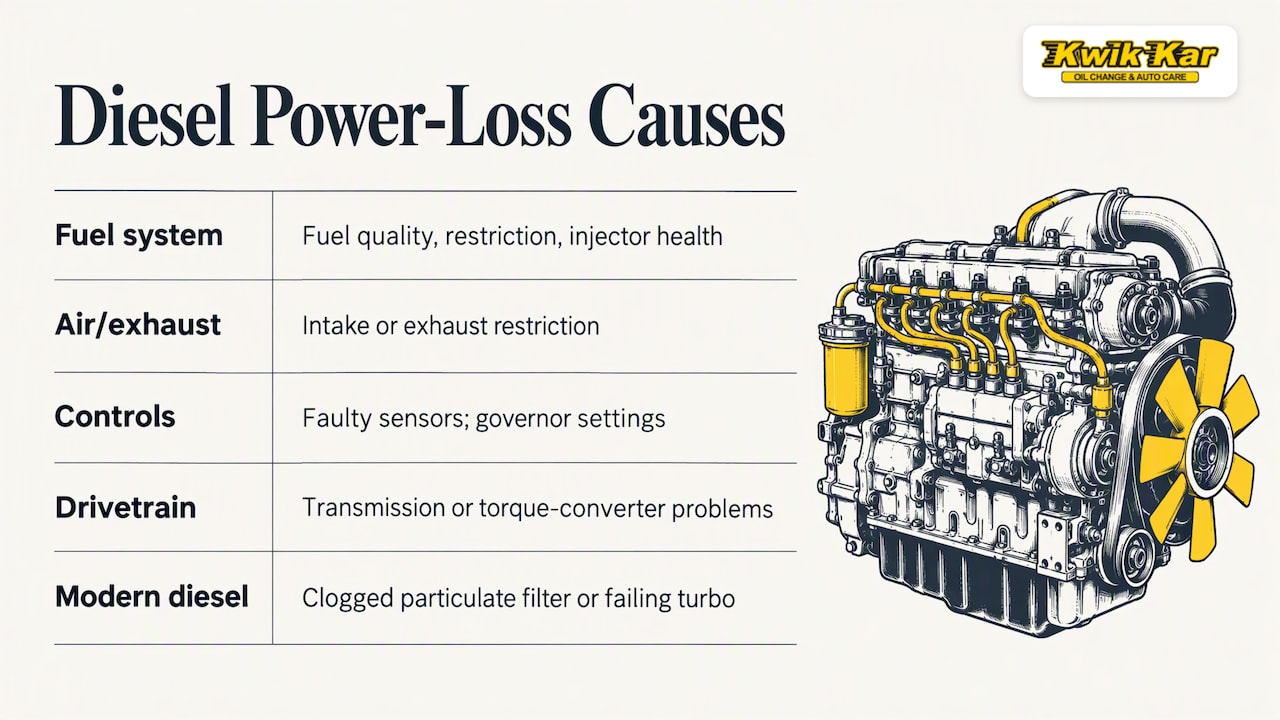
Yes. Diesel engines do not use a throttle plate to control airflow the way gasoline engines do. The U.S. Department of Energy’s diesel primer says they primarily control power by varying the amount of fuel supplied. That makes fuel quality, fuel restriction, and injector health especially important. IPD’s technical bulletin lists faulty electronic sensors, intake or exhaust restriction, fuel restriction, governor settings, transmission or torque-converter problems, and poor fuel quality as possible causes of diesel power loss.
In a modern light-duty diesel truck, a clogged particulate filter or a failing turbocharger can also reduce power, and the truck may enter a protective reduced-power mode. If you drive a diesel work truck for a business in Irving, Las Colinas, or Grand Prairie, tell us about it when you book. Our fleet maintenance programs are built around keeping vehicles on the road, and we ask about vehicle type, symptoms, and how the truck is used before we recommend a plan.
Does a hybrid lose power differently?
Hybrids add another layer. A fault can send the vehicle into reduced-power limp mode, and an electrical problem in a hybrid system can cut drive power. For example, Toyota’s 2019 safety recall K0K for certain 2018 to 2019 Prius c vehicles describes a DC-DC converter issue that may trigger warning lights, chimes, and messages before the vehicle loses motive power. If your hybrid shows several warnings at once, treat it as a safety matter, and check whether any open recall applies to your vehicle.
How does a shop diagnose loss of engine power?
A good diagnosis is a process, not a code lookup. A trouble code points to a system or a circuit, not always to a failed part. This is the order we generally follow:
- Listen to the story. When does it happen: cold, hot, uphill, at highway speed, after refueling? What did you see on the dash?
- Scan for codes and look at live data, including fuel trim, misfire counts, and sensor readings.
- Check the basics. Air filter, fuel filter where serviceable, battery and charging system, belts, fluid condition, and obvious leaks.
- Test the suspect system. That might mean fuel pressure, an ignition inspection, a smoke test for vacuum leaks, an exhaust restriction check, or a road test.
- Report what we found. Through a Digital Vehicle Inspection, we send photos, video, and technician notes to your phone so you can see what the technician saw.
- Recommend, then you decide. You approve the repair, or you take the findings and think about it.
If you want an idea of how diagnostic fees work, we wrote a piece on questions to ask before an engine diagnostic. Our engine diagnostic service page explains what is involved.
Can regular maintenance prevent power loss?
Not every failure can be prevented, but many are. AAA recommends periodic safety checks that include belts and fluids and, before road trips, a battery, starting, and charging system test. Beyond that, the items that most often tie to power complaints are:
- Spark plugs and ignition parts replaced at the interval in your owner’s manual.
- Air and fuel filters changed on schedule, especially in dusty or stop-and-go driving.
- Fresh oil at a sensible interval. See our guide to oil change intervals for modern engines.
- Battery and charging tests, which matter more in North Texas summers, when heat is hard on batteries. Our battery testing and replacement service covers this.
- Cooling system service, since an overheating engine will often cut power to protect itself.
- Factory-scheduled maintenance that follows what the manufacturer lists for your mileage.
Our perspective: power loss is a symptom, not a diagnosis
We see the same pattern again and again. A driver replaces a part someone suggested online, the problem stays, and the car arrives at our shop with a new part and the same complaint. Our view is simple: power loss is a symptom with many possible causes, so the first job is to find out which system is failing, and the second is to show the driver the evidence.
That is why our ASE-certified technicians start with your description and the data, and why we use Digital Vehicle Inspections. Seeing a photo of a worn plug or a video of a failing component makes a recommendation easier to trust, and it makes “no, you do not need that yet” easier to say. We would rather you leave with a clear plan than a bigger invoice than you expected. When a safety-critical issue is involved, such as brakes, overheating, or an engine that stalls in traffic, we will say so directly and recommend you do not keep driving it.
— Kwik Kar
Get it checked at our Irving shop
If your car is hesitating, shaking, or going into reduced power, bring it to us at 2100 Carl Rd, Irving, TX 75061. We look at fuel, air, spark, charging, and drivetrain, and you get the findings on your phone with photos and notes. Qualifying repairs are backed by our 24-month/24,000-mile warranty, and we are RepairPal certified and CARFAX Top-Rated. Start with our engine diagnostic service or see the rest of what we do on our website. If financing is relevant to a larger repair, third-party financing options may be available, subject to provider approval and terms.
Does Texas inspection law affect a car that loses power?
It can, in one specific way. Texas ended safety inspections for most non-commercial vehicles. The Texas Department of Public Safety says the changes took effect on January 1, 2025 under House Bill 3297, and that non-commercial vehicles no longer need a safety inspection before registration. DPS also says emissions tests are different from safety inspections, so eligible vehicles registered in emissions counties, including Dallas County, still need them. Qualifying commercial vehicles remain subject to applicable safety inspections.
Why this matters here: a car with a misfire or a sensor fault may set codes that keep its emissions readiness monitors from completing, which can complicate an emissions test. Our guide to readiness monitors that are not ready explains this. Check the DPS page or your county tax office for the current requirements for your own vehicle.
FAQ
Why does my car lose power only on hills or at highway speed?
Those are the moments when the engine needs the most fuel and air. A weak fuel pump, a clogged fuel filter, a restricted exhaust, or a worn ignition part can all keep up at light load and fall short when demand rises. A technician can test fuel pressure and exhaust flow under load to tell them apart.
Is it safe to drive a car that loses power?
It depends on the symptoms. If the engine stalls, flashes the check engine light, overheats, or shows a red oil or brake warning, pull over and call for help. A mild, steady sluggishness with no red lights may allow a careful drive to a shop, but it should not be put off for weeks.
Can a dirty air filter really make a car lose power?
It can contribute. A clogged air filter appears on AutoZone’s list of causes for poor acceleration, though it is rarely the whole story on a car with a severe complaint. It is an inexpensive thing to check, and we look at it during a normal inspection.
Do cars get slower as they age?
Some gradual loss is possible as parts wear, such as spark plugs, filters, and injectors, but a noticeable drop is usually a fixable fault rather than normal aging. If your car feels much weaker than it did six months ago, have it checked.
Does Kwik Kar Irving work on engines that lose power?
Yes. We diagnose power-loss complaints on cars, SUVs, and light trucks, and we serve drivers from Irving and nearby communities such as Las Colinas, Coppell, Euless, Grapevine, Grand Prairie, and Dallas. Call us at (469) 276-7337 to schedule.
Sources
- Car Doctor: What could cause a car to suddenly slow down? (Boston.com)
- What to Do When Your Car Breaks Down (AAA Northeast)
- What to do When Your Vehicle Breaks Down (AAA Club Alliance)
- Why is My Car Stalling While I Am Driving? (AutoZone)
- Why Won’t My Car Accelerate When I Push on The Gas? (AutoZone)
- Car Stalls While Driving (Pulscar)
- Car Shuts Off While Driving: 6 Causes (Mechanicbase)
- Chevy Truck Losing Power When Accelerating (Haynes)
- Diesel Power: Clean Vehicles for Tomorrow (U.S. Department of Energy)
- Common Engine Problems in Diesel Engines (IPD)
- Car Maintenance Knowledge Is Power (ACDelco)
- Safety Recall K0K (NHTSA)
- Vehicle Safety Inspection Program Changes Now in Effect (Texas DPS)