
If your transmission fluid is dark brown or black, smells burnt, or your vehicle has significant mileage of hard use behind it, change the fluid now. Dark or discolored fluid and a burnt smell are common warning signs of fluid that has broken down and can no longer protect your transmission. Whether you tackle it yourself or hand it to a shop depends on your transmission type, your comfort level, and whether your vehicle even has a dipstick.
Quick action checklist:
- Pull the dipstick (if your vehicle has one) and check fluid color and smell
- Look under the car for any active leaks or staining
- If fluid is pink or light red with no burnt smell and you have moderate mileage, you’re likely fine
- If fluid is brown, black, or smells burnt, schedule a drain-and-fill or full flush immediately
- If you hear slipping, harsh shifts, or whining, stop driving long distances and get it inspected
Cost snapshot: A drain-and-fill averages around $147 nationally; a full machine flush runs approximately $232. CVT services average closer to $298. European sealed systems or dual-clutch (DCT) services can push $500–$1,300 depending on the vehicle and labor involved.
Table of Contents
- How to do a transmission fluid change yourself (step-by-step)
- Drain-and-fill vs. flush: which service does your transmission actually need?
- When should you change your transmission fluid?
- How to choose the correct transmission fluid for your vehicle
- What does a transmission fluid service cost in 2026?
- DIY or professional service: how to decide
- What a professional shop actually does during a transmission service
- Common mistakes, troubleshooting tips, and preventative maintenance
- Key Takeaways
- Kwik Kar Irving handles your transmission service the right way
- Useful sources and further reading
- FAQ
How to do a transmission fluid change yourself (step-by-step)
Is this job right for you?
Before you grab a drain pan, be honest about your setup. A DIY drain-and-refill is reasonable if your vehicle has an accessible drain plug or a removable pan, a dipstick for checking level, and you’re comfortable safely lifting and supporting the car. Skip the DIY route if your transmission is sealed with no dipstick, your vehicle is under powertrain warranty, or you drive a CVT or DCT and haven’t done this before. Checking the fill level at operating temperature with the engine running and the gear selector cycled through positions is a step many DIYers underestimate.
Tools and supplies you’ll need
- Floor jack and jack stands (or drive-up ramps)
- Wheel chocks
- Drain pan (at least 2-gallon capacity)
- Correct transmission fluid for your vehicle (check the owner’s manual for spec and quantity)
- Funnel or fluid pump
- Torque wrench
- Socket set and ratchet
- New drain plug washer or pan gasket and filter (if doing a pan drop)
- Nitrile gloves and safety glasses
- Clean rags
- Sealable container for used fluid transport
Step-by-step procedure
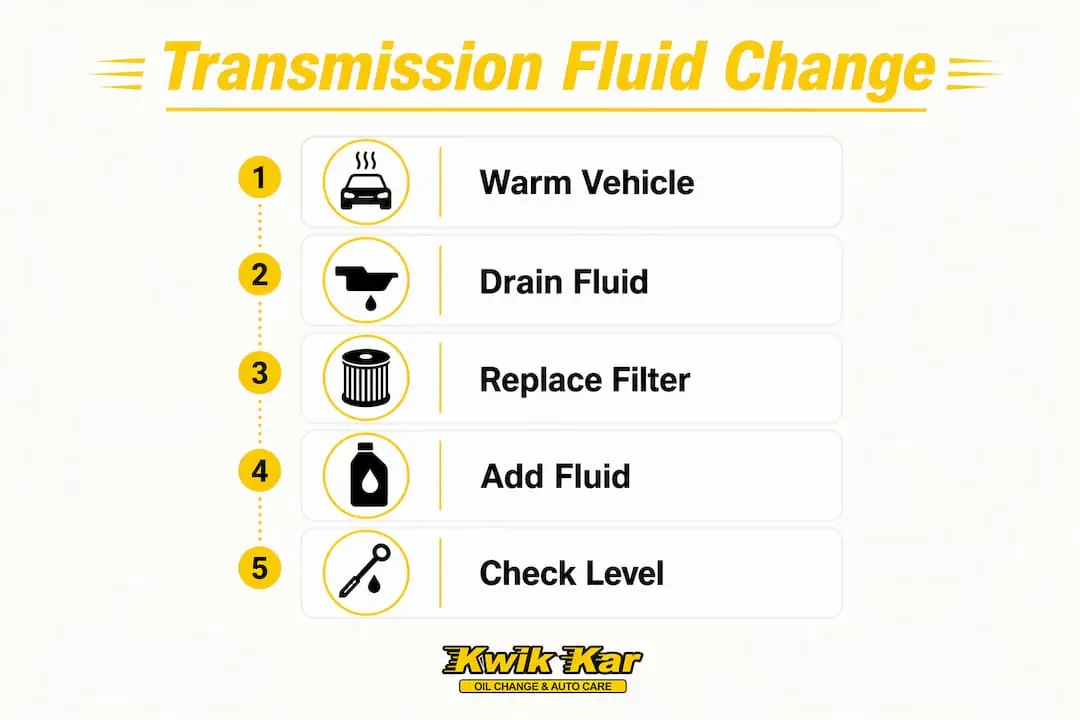
- Warm up the vehicle. Drive for 10–15 minutes to bring the transmission to operating temperature. Warm fluid drains faster and more completely.
- Lift and secure the car. Use jack stands, never just a floor jack. Place wheel chocks on the rear tires before lifting the front.
- Locate the drain plug or transmission pan. Consult your owner’s manual. Some vehicles drain from a plug; others require dropping the entire pan.
- Position the drain pan and remove the plug or pan bolts. Loosen the plug slowly. Fluid will flow fast at first. If dropping the pan, loosen bolts progressively and tilt the pan to control the spill.
- Let it drain completely. A pan drain removes roughly 30–50% of total fluid because the torque converter and internal passages retain the rest. That’s normal for a drain-and-fill.
- Clean the pan and replace the filter (if applicable). Wipe the pan clean, inspect for metallic debris, and install a new filter and gasket if your service calls for it.
- Reinstall the pan or drain plug. Torque to spec. Overtightening strips threads; undertightening causes leaks.
- Add the correct fluid. Pour in the manufacturer-specified quantity through the dipstick tube or fill port. Use a funnel to avoid spills.
- Start the engine and cycle through gears. With the parking brake on, move the selector through P-R-N-D and each gear range, pausing 3–5 seconds in each. This circulates fresh fluid.
- Check the fluid level at operating temperature. With the engine running and fluid warm, pull the dipstick, wipe it, reinsert, and read the level. Add fluid in small increments if needed.
- Road test and recheck. Drive 5–10 miles, then recheck level and inspect underneath for leaks.
Time estimate: 1.5–2.5 hours total, including warm-up and cool-down. Active work is about 45–60 minutes for a straightforward drain-and-fill; add 30 minutes if you’re dropping the pan and replacing the filter.
Difficulty: Intermediate. Easier than a brake job, harder than an oil change.
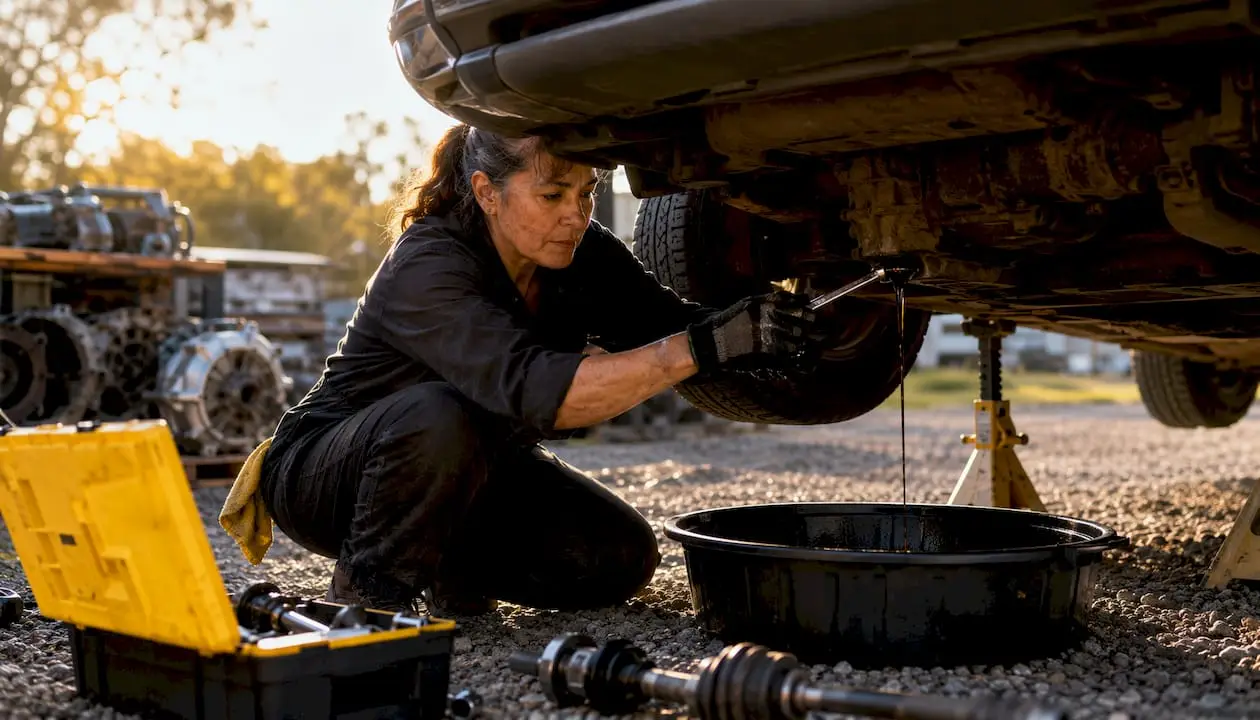
Safety reminders: Never work under a vehicle supported only by a floor jack. Wear gloves; transmission fluid irritates skin with prolonged contact. Let the vehicle cool slightly before reaching near the exhaust.
Disposal: Pour used fluid into a sealed container and drop it off at an auto parts store (AutoZone, O’Reilly, Advance Auto Parts) or a municipal hazardous-waste facility. Never pour it down a drain or on the ground.
Pro Tip: Always check the fluid level at full operating temperature with the engine running. Adding fluid to a cold transmission and calling it done is one of the most common DIY mistakes. Overfilling causes foaming, which destroys hydraulic pressure and can damage clutch packs within miles.
Drain-and-fill vs. flush: which service does your transmission actually need?
What each service means
- Drain-and-fill: Remove the drain plug or drop the pan, drain what flows out, reinstall, and refill with fresh fluid. This replaces part of the total fluid volume but not all.
- Pan drop with filter change: Same as above, but includes removing the pan, cleaning it, and replacing the internal filter and gasket. Better for contamination control.
- Machine flush: A flushing machine connects to the transmission cooler lines and exchanges nearly all fluid, including what’s trapped in the torque converter and passages. Replaces 90%+ of old fluid.
Pros and cons
Drain-and-fill:
- Lower cost and faster service
- Safer for high-mileage or poorly maintained transmissions
- Leaves a significant portion of old fluid behind
- Ideal when you’re doing regular, on-schedule maintenance
Pan drop with filter change:
- Adds filter replacement and pan inspection to the drain-and-fill
- Catches metallic debris before it circulates further
- Slightly more labor and cost, but worth it if the filter is overdue
Machine flush:
- Replaces nearly all old fluid in one service
- Best for transmissions that are regularly maintained and in good condition
- Higher fluid volume used (12–22 quarts vs. 5–7 for a drain-and-fill)
- Costs more in both fluid and labor
When a flush can backfire
A machine flush on a high-mileage transmission that has never been serviced can dislodge varnish deposits and metallic debris that were acting as a seal on worn clutch surfaces. The result can be immediate slipping or failure. If the fluid is very dark, smells burnt, or contains metallic particles, a gentle drain-and-fill is the safer first step.
For a transmission that’s been maintained on schedule and is otherwise healthy, a flush is a legitimate upgrade over a simple drain-and-fill. For a neglected unit at 150,000 miles, start with a drain-and-fill and reassess.
When should you change your transmission fluid?
Manufacturer intervals by transmission type
Intervals vary significantly by transmission design:
- Automatic (conventional): Typical service intervals range from moderate to high mileage depending on driving conditions
- Manual: Service intervals vary by manufacturer
- CVT: Service intervals also vary; check your manual
- DCT (dual-clutch): Service intervals depend widely on manufacturer recommendations
Many manufacturers label their factory-fill fluid as “lifetime.” Treat that claim cautiously: “lifetime” typically means the expected life of the vehicle under ideal conditions, not the real-world mix of towing, stop-and-go traffic, and summer heat most drivers put their cars through. Most experienced technicians recommend checking condition at 60,000 miles and strongly considering service by 100,000 miles regardless of the label.
Severe-service factors that shorten intervals
Excess heat is the primary driver of transmission fluid breakdown. Any of these conditions qualifies as severe service and shortens your interval:
- Towing a trailer or hauling heavy loads regularly
- Frequent stop-and-go city driving
- Operating in hot climates (Texas summers count)
- Frequent short trips where the transmission never fully warms up
- Off-road or mountainous driving
Warning signs that fluid needs attention now
Check these indicators of degraded fluid regardless of mileage:
- Color: Healthy ATF is bright red or pink. Brown fluid is aging; black fluid is overdue.
- Smell: A burnt odor means the fluid has oxidized and is no longer protecting internal components.
- Metallic flecks: Particles in the fluid indicate internal wear. This is a shop-now situation.
- Slipping gears: The transmission briefly loses drive, then re-engages.
- Delayed or harsh shifting: Noticeable hesitation or a clunk when changing gears.
- Fluid leaks: Reddish puddles under the car, especially toward the center or rear.
- Warning lights: A transmission temperature light or check engine light tied to a transmission code.
How to choose the correct transmission fluid for your vehicle
Getting the fluid spec right is not optional. Using the wrong fluid can cause immediate and catastrophic damage to clutch packs and internal components. Modern transmissions are engineered to tight tolerances, and the fluid’s friction properties, viscosity, and additive package are part of that design.
Where to find your vehicle’s spec
- Owner’s manual: The most authoritative source. Look in the maintenance or fluid specifications section.
- Under-hood label: Some vehicles have the transmission fluid spec printed on a sticker near the dipstick or fill port.
- Dealer service documentation: If you bought the car used and don’t have the manual, the dealer can pull the spec by VIN.
- Vehicle-specific forums: Useful for cross-referencing, but always verify against the manual before buying.
Common U.S. fluid categories
- Dexron VI / Dexron HP: Used in many GM vehicles and some others that specify Dexron compatibility. Dexron HP is the current generation for newer GM 8- and 10-speed automatics.
- Mercon LV / Mercon ULV: Ford’s current-generation ATF specs. Mercon LV is not backward-compatible with older Mercon V applications.
- CVT-specific fluids: Nissan NS-3, Toyota TC, Honda HCF-2, and similar OEM-branded fluids are engineered for the shear stability and friction properties CVT belts and pulleys require. A generic ATF in a CVT often causes belt slippage or failure within months.
- DCT fluids: Wet-clutch DCTs use a dedicated fluid (e.g., Getrag MTF, Pentosin FFL series). Dry-clutch DCTs typically use a gear oil, not ATF.
- OEM-branded fluids: BMW Lifetime ATF, ZF Lifeguard, Honda ATF-DW1, and similar products are formulated specifically for those transmissions. Substituting a “compatible” generic often voids the warranty and risks damage.
Pro Tip: When you bring your vehicle to a shop, ask them to document the exact fluid brand and specification used in the service record. If a warranty claim ever involves the transmission, that documentation matters.
What does a transmission fluid service cost in 2026?
DIY cost breakdown
For a straightforward drain-and-fill on a common automatic transmission:
- Transmission fluid: $8–$20 per quart, with most drain-and-fills requiring 5–7 quarts ($40–$140 in fluid)
- Replacement filter and pan gasket: $15–$60 depending on the vehicle
- Drain pan, funnel, and basic supplies: $20–$40 if you don’t already own them
- Disposal fee at an auto parts store: usually free
Typical DIY total: $60–$200, depending on fluid type and whether you replace the filter.
Shop price ranges
| Service Type | National Average | Typical Range |
|---|---|---|
| Drain-and-fill (automatic) | $147 | $75–$147 |
| Full machine flush | $232 | $147–$232 |
| CVT fluid service | $298 | $147–$298 |
| DCT fluid service | Varies | $147–$298 |
| European / sealed system | Varies | $500–$1,300+ |

National averages sourced from 2026 cost benchmarks. Regional variation is real: dealerships typically charge 40–60% more than independent shops for the same service.
Premium cases
European and luxury vehicles with sealed transmissions or fill-from-below procedures require specialist equipment and proprietary fluids, pushing service costs to $500–$1,300 or more. CVT and DCT services also run higher because OEM fluids cost significantly more per quart than conventional ATF.
Questions to ask any shop before you authorize service
- What fluid brand and specification will you use?
- How many quarts does this service require?
- Does this include a filter and gasket replacement?
- Will this service affect my powertrain warranty?
- Do you perform a test drive and leak check after the service?
Time estimates: A shop drain-and-fill typically takes 45–75 minutes. A machine flush runs 60–90 minutes. A pan drop with filter change adds 30–45 minutes to either.
DIY or professional service: how to decide
Decision checklist
Work through these questions before picking up a wrench:
- Does your vehicle have a transmission dipstick and an accessible drain plug? If no to either, this is a shop job.
- Is the vehicle under a powertrain warranty? DIY service without documented shop receipts can complicate warranty claims.
- Is it a CVT or DCT? These transmissions are especially sensitive to fluid spec errors and fill-level precision. Unless you’re experienced, leave them to a pro.
- Does the fluid contain metallic particles or smell strongly burnt? That’s a sign of internal damage that needs professional diagnosis, not just a fluid swap.
- Do you have the correct torque specs for the drain plug and pan bolts? Guessing damages threads.
- Is there an active technical service bulletin (TSB) for your transmission? A shop will know; you may not.
Risks of DIY errors
- Overfilling or underfilling: Both cause transmission damage. Overfilling creates foam; underfilling starves the pump.
- Wrong fluid: Even a “close” substitute can destroy clutch friction material in a CVT or DCT.
- Contamination: Dirt introduced during service circulates through precision hydraulic passages.
- Stripped drain plug or pan bolts: Aluminum pans strip easily. Repair is expensive.
- Improper level check: Checking cold instead of at operating temperature gives a false reading.
DIY mistakes in transmission service can lead to repair bills of $3,000–$8,000. That’s the real cost of getting it wrong.
When to call a shop, no debate
- You hear metallic grinding or whining from the transmission
- The fluid contains visible metallic particles
- There’s a major leak (puddle, not just seepage)
- The vehicle has an unknown service history
- The transmission needs a machine flush and you don’t have the equipment
- Warning lights are on and you need engine diagnostic scan-tool verification
For documented service records that protect resale value and warranty coverage, a shop receipt beats a DIY receipt every time.
What a professional shop actually does during a transmission service
The ASE-certified service process
A qualified transmission service at an ASE-certified shop follows a structured sequence, not just a drain and fill:
- Pre-service inspection: Technician checks fluid color, level, and smell; inspects for external leaks; notes any shifting complaints or warning codes.
- Fluid and filter replacement: Drain-and-fill or machine flush performed to the manufacturer’s spec, with the correct OEM-approved fluid. Filter and gasket replaced when the service calls for it.
- Torque to specification: Pan bolts and drain plugs torqued to the manufacturer’s value, not by feel.
- Leak check: After refill, the vehicle sits running while the technician inspects all seals and connections.
- Test drive: The technician drives the vehicle through all gear ranges to confirm smooth shifting and no abnormal behavior.
- DVI documentation: Photos, videos, and technician notes are compiled into a Digital Vehicle Inspection report sent directly to your phone.
Why credentials and documentation matter
ASE certification means the technician has passed standardized tests in their specialty area and maintains ongoing training. For transmission work specifically, that matters because professional identification of the exact fluid spec is critical. A technician who services dozens of different vehicles weekly knows the difference between Mercon LV and Mercon ULV, and why swapping them is a problem.
A Digital Vehicle Inspection doesn’t just document what was done. It shows you photos of your actual transmission pan, your actual fluid color, and any other issues found during the service. You’re not taking anyone’s word for it.
What Kwik Kar Irving includes in a transmission service
Kwik Kar’s ASE-certified technicians perform transmission fluid services with full DVI documentation, fluid spec verification, filter and gasket replacement when applicable, a post-service test drive, and a leak inspection. Every service record is documented for warranty and resale purposes. For vehicles needing more than a fluid service, the shop’s transmission and clutch repair capabilities cover the full range of repairs beyond routine maintenance.
Common mistakes, troubleshooting tips, and preventative maintenance
Mistakes to avoid
- Using the wrong fluid: The single most damaging error. Always verify the spec before buying.
- Overfilling: More fluid is not better. Foaming destroys hydraulic function fast.
- Skipping the filter change: A clogged filter restricts flow and accelerates wear. If the pan is coming off, replace the filter.
- Checking level cold: Transmission fluid expands significantly with heat. A cold reading is not accurate.
- Running a flush machine on a badly contaminated system: As noted earlier, this can dislodge debris that causes immediate failure.
Troubleshooting flow
If you notice symptoms after a fluid service, work through this sequence:
- Slipping or rough shifts: Check fluid level first. If level is correct, check that the right fluid was used.
- Whining or humming noise: Could be low fluid, wrong fluid, or a pump issue. Check level and fluid spec.
- Leaks after service: Likely an improperly torqued drain plug or pan bolt, or a damaged gasket. Tighten to spec or replace the gasket.
- Symptoms that don’t resolve: Stop driving and get a professional diagnosis. Continuing to drive a slipping transmission accelerates internal damage. In severe cases, transmission failure can render a vehicle uneconomical to repair.
Preventative maintenance tips
- Follow your owner’s manual interval, then shorten it by 20–30% if you tow, haul, or drive in stop-and-go traffic regularly.
- Use OEM-spec fluids every time. The savings from a generic fluid are not worth the risk.
- If you tow frequently, consider an auxiliary transmission cooler. Heat is the primary accelerant of fluid breakdown.
- Combine your transmission service with related driveline maintenance, such as differential service, to keep the full drivetrain on the same schedule.
Pro Tip: Keep a simple maintenance log in the glove box. Write down the date, mileage, fluid brand, and spec used every time you service the transmission. That log is worth real money when you sell the vehicle.
Fluid disposal
Pour used transmission fluid into a sealed, leak-proof container (an old fluid jug works well). Drop it off at any AutoZone, O’Reilly Auto Parts, or Advance Auto Parts location, all of which accept used fluids for recycling at no charge. Municipal hazardous-waste facilities are another option. Never mix transmission fluid with engine oil in the same container if you plan to recycle both separately.
Key Takeaways
Changing your transmission fluid on schedule, with the correct fluid, is the single most cost-effective thing you can do to extend transmission life and avoid costly repairs.
| Point | Details |
|---|---|
| Act on warning signs immediately | Dark, burnt, or metallic-flecked fluid means service now, regardless of mileage. |
| Know your service type | A drain-and-fill replaces 30–50% of fluid; a machine flush replaces over 90% of the old fluid. Choose based on transmission condition. |
| Match the fluid spec exactly | Wrong fluid can destroy a CVT or DCT within months; always verify against your owner’s manual. |
| Budget realistically | Expect $147 for a drain-and-fill, $232 for a flush, $298 for a CVT service, and up to $1,300+ for European sealed systems. |
| Kwik Kar Irving | ASE-certified technicians, full DVI documentation, and correct fluid spec verification on every transmission service. |
Kwik Kar Irving handles your transmission service the right way
Skipping the guesswork on fluid specs and fill procedures is exactly where a professional shop earns its cost. At Kwik Kar in Irving, TX, every transmission fluid service is performed by ASE-certified technicians who verify the correct fluid specification for your vehicle before touching a drain plug. You get a full Digital Vehicle Inspection with photos and technician notes sent directly to your phone, so you can see the condition of your pan, your filter, and your fluid before and after service.
Kwik Kar’s transmission services include drain-and-fill, pan drop with filter and gasket replacement, and machine flush options, all with documented fluid specs and a post-service test drive. Fleet managers can take advantage of Kwik Kar’s fleet maintenance programs to keep multiple vehicles on a consistent service schedule. Check the current service specials for pricing and discounts, or visit the full service menu to book your appointment. Every service record is documented for warranty and resale purposes.
Useful sources and further reading
These are the primary sources used for pricing data, service guidance, and technical points in this article:
- Kelley Blue Book: When Do I Need to Change My Transmission Fluid? — Practical overview of warning signs and general service guidance from a widely trusted automotive authority.
- AAA: How to Check and Maintain Your Transmission Fluid — Covers fluid spec importance, DIY risks, and professional service standards.
- Cars.com: Do You Really Need to Change the Transmission Fluid? — Detailed look at “lifetime” fluid claims, drain-and-fill vs. flush tradeoffs, and heat as the primary fluid killer.
- Transmission Fluid Change Cost Benchmarks (2026) — 2026 national average pricing for drain-and-fill, flush, and CVT services.
- How To Check Oil: Transmission Fluid Change Cost — Breakdown of what drives cost differences, including European sealed systems and DCT premiums.
- Your owner’s manual and dealer service documentation remain the authoritative source for your vehicle’s specific fluid specification, fill quantity, and level-check procedure. No online guide replaces them.
FAQ
How often should you change your transmission fluid?
Most automatic transmissions need service at intervals recommended by the manufacturer that often differ based on driving conditions. CVTs and manual transmissions have their own recommended ranges, which should be confirmed in the owner’s manual.
Do you actually need to change “lifetime” transmission fluid?
Yes, in most cases. “Lifetime” refers to the expected vehicle life under ideal conditions, and most real-world driving doesn’t qualify. Many technicians recommend checking condition at 60,000 miles and servicing by 100,000 miles regardless of the label.
What are the signs you need a transmission flush or fluid change?
Dark brown or black fluid, a burnt smell, gear slipping, harsh or delayed shifting, unusual whining noises, and visible leaks are all signs of fluid that needs attention. Metallic particles in the fluid indicate internal wear and require immediate professional inspection.
Can you change transmission fluid yourself?
Yes, if your vehicle has an accessible drain plug or removable pan and a dipstick for checking level. The job is intermediate difficulty and takes 1.5–2.5 hours. Sealed transmissions, CVTs, and DCTs are better left to a professional because fill-level verification requires operating-temperature checks and, in some cases, scan-tool confirmation.
How much does a transmission fluid change cost at a shop?
A drain-and-fill averages around $147 nationally; a full machine flush averages around $232. CVT services average closer to $298, and European sealed systems can run $500–$1,300 or more depending on the vehicle and required procedure. Kwik Kar Irving offers competitive pricing with full DVI documentation on every service.