Your check engine light (also called the Malfunction Indicator Lamp, or MIL) means your vehicle’s engine control module (ECM) detected a fault and stored at least one OBD-II Diagnostic Trouble Code (DTC). The light itself tells you nothing specific. The stored code does. Your first move is to read that code, either with a personal OBD-II scanner, a free scan at an auto parts store, or a visit to an ASE-certified technician like those at Kwik Kar Irving.
Here is what determines your next step:
- Steady light, no other symptoms: Drive cautiously to a shop or parts store soon. Not an emergency, but don’t ignore it.
- Steady light with rough idle, power loss, or smoke: Reduce speed, avoid highway driving, and get it checked today.
- Flashing light: Pull over safely and stop driving. A flashing CEL signals an active misfire that can destroy your catalytic converter in minutes.
Table of Contents
- What does the check engine light actually mean?
- Is it safe to drive? Steady vs. flashing lights explained
- What are the most common causes of a check engine light?
- What should you do right after the light comes on?
- How do mechanics and DIYers read diagnostic trouble codes?
- What do common check engine light repairs cost?
- Should you just reset the check engine light?
- How can you prevent future check engine lights?
- How does a professional shop like Kwik Kar Irving handle diagnostics?
- Key Takeaways
- Kwik Kar Irving gets your check engine light diagnosed right
- Useful sources
- FAQ
What does the check engine light actually mean?
Every passenger vehicle sold in the U.S. since 1996 uses a standardized OBD-II system. The ECM continuously monitors dozens of sensors across the powertrain and emissions systems. When a reading falls outside acceptable limits, the ECM stores a DTC and illuminates the MIL.
DTCs follow a consistent format: a letter plus four digits. The letter identifies the system (P = powertrain, B = body, C = chassis, U = network). The first digit distinguishes generic codes (0) from manufacturer-specific ones (1). A few examples worth knowing:
- P0420 signals catalyst efficiency below threshold, usually pointing to a failing catalytic converter or oxygen sensor.
- P0300–P0308 are misfire codes. P0300 means random/multiple misfires; P0301 means cylinder 1, P0302 cylinder 2, and so on.
- P0171/P0174 indicate a lean fuel condition, often from a vacuum leak or dirty mass airflow (MAF) sensor.
Stored codes come with freeze-frame data: a snapshot of engine conditions (RPM, load, coolant temp, fuel trim) at the exact moment the fault triggered. That snapshot is what a skilled technician uses to narrow down the cause fast. A pending code means the ECM detected a problem once but needs it to repeat before turning on the light. Both matter for diagnosis.
The light is a pointer, not a diagnosis. Two cars can show the same P0420 code for completely different reasons. Reading the code is step one; interpreting it correctly is the job of a trained technician.
Is it safe to drive? Steady vs. flashing lights explained
The single most important thing to know: a flashing check engine light is a different situation entirely from a steady one.
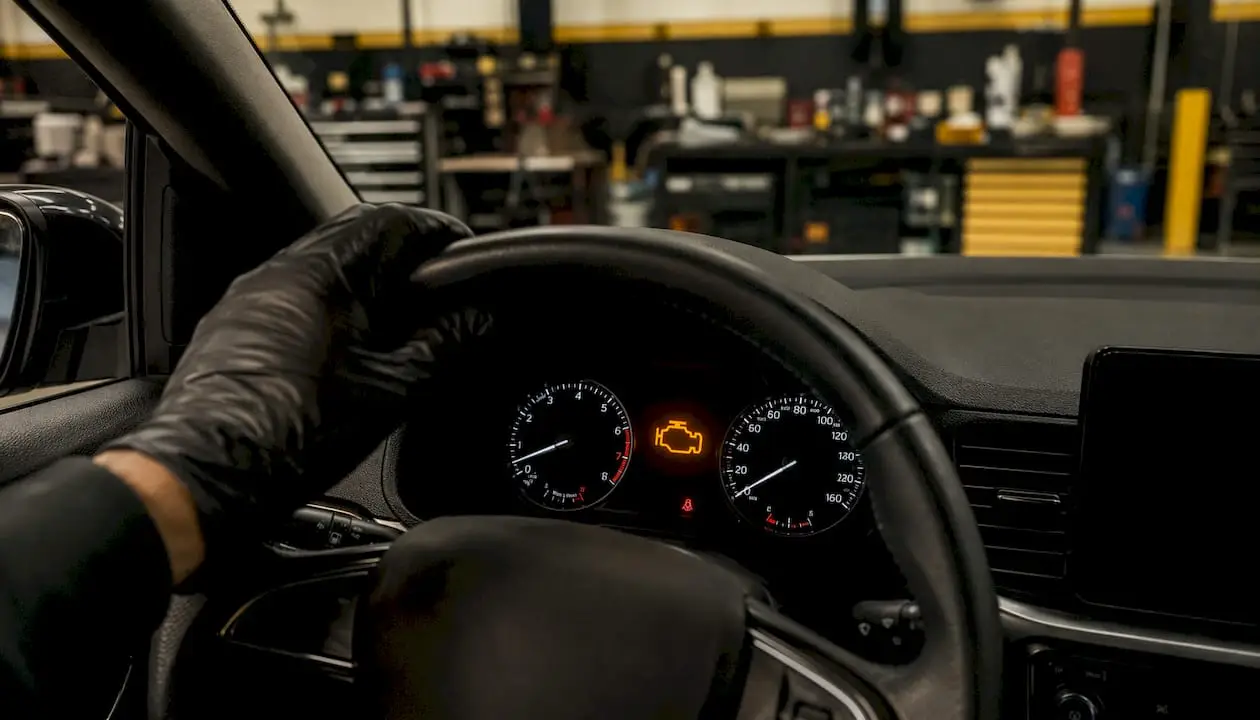
A flashing light means an active misfire is happening right now. Unburned fuel is being pushed into the exhaust and into the catalytic converter, which can reach temperatures above 1,500°F. At that heat, the converter’s ceramic substrate can physically melt after only minutes of continued driving. Catalytic converter replacement can be very costly. Stop driving as soon as it is safe to do so.
A steady (solid) light is less urgent but still demands attention. Small faults like a failing oxygen sensor or a vacuum leak reduce fuel efficiency and, left untreated, can gradually damage the catalytic converter over time. Technicians emphasize that untreated faults gradually cause carbon buildup and wear on components like the catalytic converter.
Quick decision guide:
- Steady light, car drives normally: Schedule a diagnostic within a few days.
- Steady light + rough idle, hesitation, or unusual smell: Get it checked today. Reduce load and avoid high speeds.
- Flashing light: Pull over safely. Do not continue driving. Call for a tow or roadside assistance.
- CEL plus a red oil pressure or temperature warning: Stop immediately. Red warnings override everything.
What are the most common causes of a check engine light?
Most CEL triggers fall into a handful of familiar categories. Knowing which one fits your symptoms helps you communicate clearly with a technician and set realistic cost expectations.
- Loose or missing gas cap (Severity: Low). Triggers EVAP codes like P0455, P0456, or P0457. No drivability symptoms. Tighten the cap three clicks; the ECM needs 1–3 drive cycles to verify the seal and clear the code.
- Oxygen sensor failure (Severity: Medium). Symptoms include reduced fuel economy and rough idle. Ignoring it stresses the catalytic converter over time.
- Catalytic converter degradation (Severity: High). Often triggered by a P0420 code. Usually a downstream consequence of neglected O2 sensors or misfires. Replacement is expensive.
- Spark plug or ignition coil failure (Severity: Medium–High). Causes misfires (P030X codes), rough idle, power loss, and poor fuel economy. Coil failures can escalate to catalytic converter damage if misfires persist.
- Mass airflow (MAF) sensor (Severity: Medium). Dirty or failing MAF sensors cause lean/rich conditions, hesitation, and poor acceleration. Often cleanable with MAF-specific cleaner before replacement is needed.
- EVAP system leak (Severity: Low–Medium). Beyond the gas cap, cracked hoses or a faulty purge valve can trigger EVAP codes. No immediate safety risk, but will fail emissions inspections.
- Vacuum leak (Severity: Medium). Causes lean codes (P0171/P0174), rough idle, and hissing sounds. Small leaks worsen over time.
- Transmission issues (Severity: High). Shift-quality problems, slipping, or torque-converter faults can trigger CEL codes alongside transmission warning lights.
What should you do right after the light comes on?
Follow these steps in order. They take about five minutes and give any technician a much clearer picture of what happened.
- Note the context. What were you doing when the light appeared? Highway speed, city stop-and-go, cold start? What is the mileage? Write it down or voice-memo it.
- Check for other dashboard warnings. A CEL alone is one situation. A CEL alongside a red oil or temperature light is an emergency. If you see red, stop driving.
- Check the gas cap. Turn off the engine, remove the cap, and retighten it until you hear three clicks. This costs nothing and resolves a surprising number of lights.
- Assess drivability. Is the light steady or flashing? Does the car feel normal? If the light is flashing or the car runs rough, reduce speed and load immediately. If it is flashing, stop as soon as it is safe.
- Get the code read. Many auto parts stores offer free OBD-II scans. These return stored codes quickly and at no cost. The limitation: free scans typically return stored codes only, without live data, freeze-frame snapshots, or pending codes that matter for intermittent faults.
- Decide on next steps. A P0455 (large EVAP leak) after a gas-cap tighten? Monitor it. A P0301 (cylinder 1 misfire) with rough idle? Book a diagnostic today.
Pro Tip: Before you clear any codes or visit a shop, take a photo of your dashboard and jot down freeze-frame data if your scanner shows it. That snapshot of RPM, coolant temp, and fuel trim at the moment of the fault can cut diagnostic time significantly.
How do mechanics and DIYers read diagnostic trouble codes?
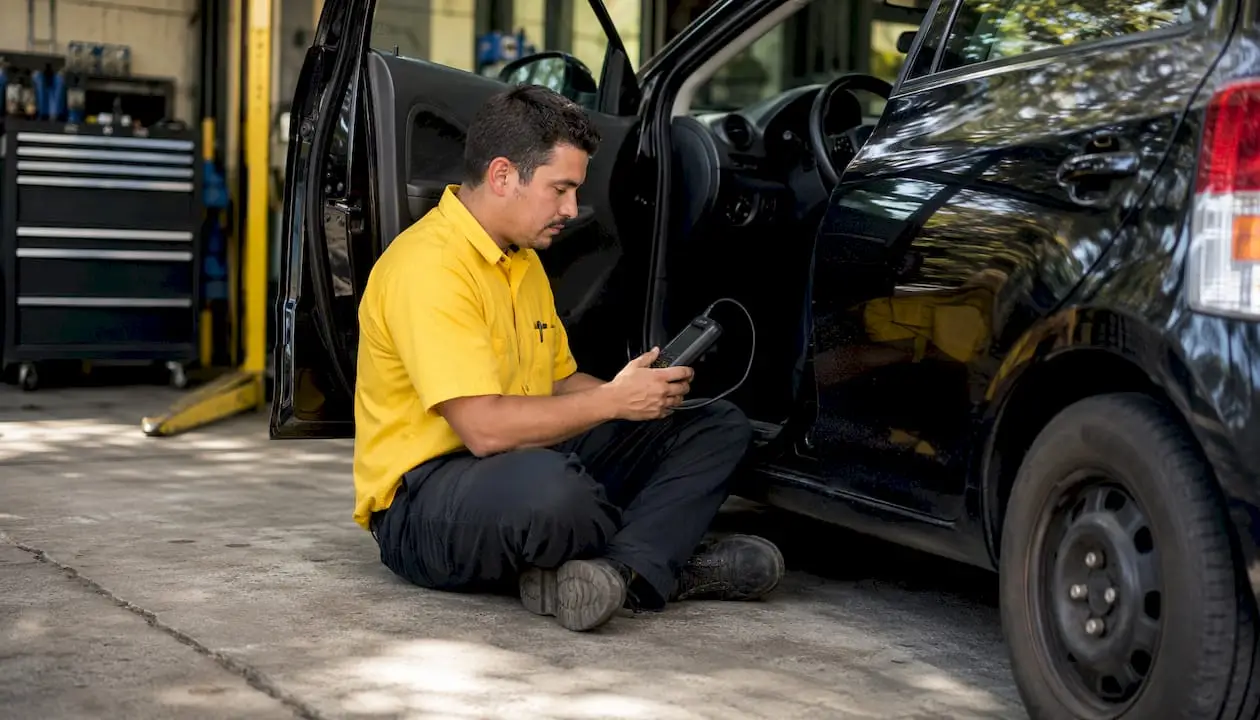
The OBD-II port is a 16-pin connector located under the dashboard, usually within 18 inches of the steering column. Any OBD-II compatible scanner plugs in there with the ignition on (engine off or running, depending on the test).
| Scanner Type | What It Reads | Best For |
|---|---|---|
| Basic handheld reader | Stored codes, code definitions | Quick DIY checks, gas-cap verification |
| Bluetooth dongle + app | Stored codes, pending codes, live sensor data | DIY drivers who want more depth |
| Professional scan tool | Stored, pending, freeze-frame, live data streams, bi-directional tests | Shop-level diagnosis |
| Dealer/OEM-level tool | All of the above plus manufacturer-specific codes and calibrations | Complex or brand-specific faults |
Code families give you a quick map of the affected system:
- P0xxx: Generic powertrain (fuel, ignition, emissions)
- P01xx: Fuel and air metering
- P03xx: Ignition system and misfires
- P04xx: Auxiliary emissions controls (EVAP)
- P07xx: Transmission
Free scans at auto parts stores are genuinely useful for a first look. Their limitation is real, though: they typically return stored codes without freeze-frame data or pending codes. An intermittent fault that has not yet set a stored code will not show up. For anything beyond a simple stored code, a professional scan with live data is worth the diagnostic fee.
Kwik Kar Irving’s electrical diagnostics capability covers wiring harness faults and sensor failures that a basic handheld reader will flag but cannot fully characterize.
What do common check engine light repairs cost?
Repair costs vary widely depending on the fault, the vehicle, and labor rates in your area. The table below reflects broad U.S. ranges.
| Repair | Typical U.S. Cost Range | Severity Tier |
|---|---|---|
| Gas cap replacement | under $200 | Low |
| EVAP hose or purge valve | under $200–$500 | Low |
| Oxygen sensor | $200–$1,000 | Medium |
| MAF sensor cleaning/replacement | $200–$1,000 | Medium |
| Spark plugs (full set) | $200–$1,000 | Medium |
| Ignition coil(s) | $200–$1,000 | Medium |
| Wiring harness repair | $500–$2,000 | Medium–High |
| Catalytic converter replacement | $1,000–$2,500+ | High |
Common check engine repairs range from inexpensive fixes under $200 to catalytic converter replacements that run into the thousands. A few factors drive cost upward fast: labor hours on hard-to-access components, the need for dealer-sourced parts, and the compounding effect of delayed repairs.
One scenario worth understanding: if a misfire has already damaged the catalytic converter, fixing the misfire alone will not clear a P0420 code. The converter itself must be replaced. That is why a flashing light demands immediate attention.
Severity tiers at a glance:
- Low (under $200–$500): Gas cap, EVAP hose, MAF cleaning. Safe to drive briefly; schedule soon.
- Medium ($200–$1,000): O2 sensor, spark plugs, coils, MAF replacement. Address within days to weeks.
- High (over $1,000): Catalytic converter, wiring harness, transmission components. Do not delay.
Should you just reset the check engine light?
Clearing the code without fixing the underlying fault is one of the most common mistakes drivers make. The light will return, often within a few drive cycles, and you will have lost something valuable in the process.
There is also an emissions inspection consequence. Clearing codes resets the OBD-II readiness monitors, which are the system’s self-tests for emissions components. Most states require these monitors to show “complete” before a vehicle can pass inspection. If you clear codes and drive to a Texas state inspection before the monitors reset, the car will fail even if the original fault is gone.
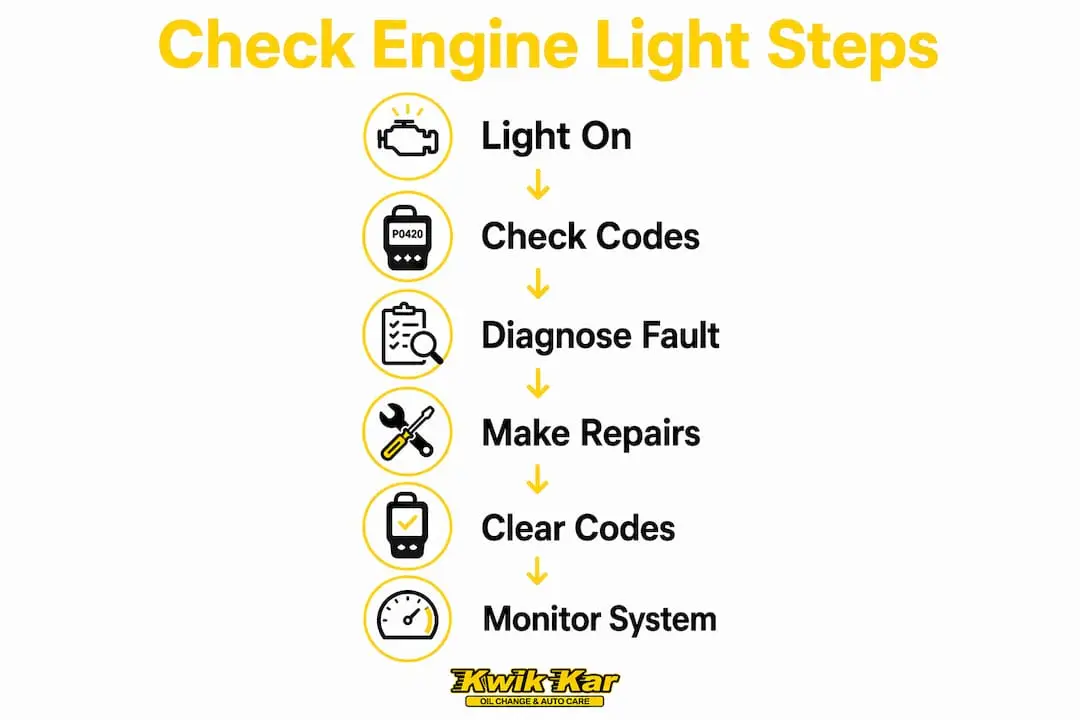
The right sequence: read the codes first, repair the fault, then clear the codes and drive enough cycles for the monitors to complete before any inspection.
How can you prevent future check engine lights?
Most common CEL triggers are preventable with routine maintenance. A few habits cover the majority of causes.
- Gas cap: After every fill-up, tighten until you hear three clicks. Replace a cracked or worn cap immediately.
- Spark plugs and ignition coils: Follow the manufacturer’s replacement interval (typically 30,000–100,000 miles depending on plug type). Worn plugs cause misfires that cascade into converter damage.
- Air filter and MAF sensor: Replace the air filter per schedule and clean the MAF sensor periodically. A dirty MAF causes lean conditions and poor fuel economy.
- Oxygen sensors: Most O2 sensors last 60,000–100,000 miles. Replacing them proactively at high mileage is cheaper than the catalytic converter damage they cause when they fail.
- Fuel system: Use quality fuel and consider a fuel-system cleaner periodically to reduce carbon buildup on injectors and intake valves.
- Scheduled maintenance: Keeping up with oil changes and manufacturer-recommended services is the single most effective way to prevent the neglect-driven failures that trigger CEL codes.
- EVAP system: Inspect hoses and connections during routine service. Small cracks in vacuum lines are cheap to fix early and expensive to ignore.
How does a professional shop like Kwik Kar Irving handle diagnostics?
A professional diagnostic visit follows a structured process that goes well beyond plugging in a code reader and reading a number off a screen.
At Kwik Kar Irving, the process starts with a technician interview: when did the light come on, what driving conditions preceded it, and what symptoms has the driver noticed? That context shapes how the technician interprets the scan data. From there, the OBD-II scan retrieves stored and pending codes along with freeze-frame data. Live data logging follows, watching sensor behavior in real time to catch intermittent faults that a static code read misses.
The findings feed into a Digital Vehicle Inspection (DVI): a documented report with photos, videos, and technician notes sent directly to your phone. You see exactly what the technician sees. No vague verbal summaries. The written estimate comes from that report, so you understand what is being repaired and why before any work begins.
Kwik Kar Irving’s engine diagnostic services cover the full range of OBD-II fault investigation, from simple sensor replacements to complex emissions and fuel-system repairs. All diagnostic work is performed by ASE-certified technicians.
Pro Tip: If your vehicle is still under a powertrain warranty or an extended service contract, bring documentation to the diagnostic appointment. Some repairs may be covered, and a shop with proper DVI documentation makes the warranty claim process significantly smoother.
When a fault is minor and the vehicle is safe to drive, Kwik Kar Irving technicians will say so and recommend monitoring. When a repair is urgent, the DVI report gives you the evidence to make that call confidently.
Key Takeaways
A flashing check engine light demands immediate action; a steady light demands prompt attention. Reading the stored DTC before doing anything else is the single step that determines every decision that follows.
| Point | Details |
|---|---|
| Read the code first | Retrieve the stored DTC before driving further or clearing the light. |
| Flashing means stop now | A flashing CEL signals active misfire that can destroy the catalytic converter in minutes. |
| Don’t reset without repairing | Clearing codes erases freeze-frame data and resets readiness monitors, risking inspection failure. |
| Cost scales with delay | Repairs include low-cost fixes like gas caps and high-cost ones like catalytic converter replacement. |
| Kwik Kar Irving | ASE-certified technicians perform OBD-II scans, live data logging, and DVI reports for full diagnostic transparency. |
Kwik Kar Irving gets your check engine light diagnosed right
When the light comes on and you want a straight answer, not a guessed repair, Kwik Kar Irving is the shop for drivers in Irving, TX. The team uses professional-grade OBD-II scanning with live data and freeze-frame analysis, not just the basic code read you get at a parts store. Every diagnostic visit includes a Digital Vehicle Inspection with photos, videos, and technician notes sent to your phone, so you see the evidence before you approve any repair.
ASE-certified technicians handle everything from a simple O2 sensor swap to catalytic converter evaluation, ignition system repairs, and fuel-system diagnostics. Check the current specials for available coupons, then schedule your diagnostic appointment at Kwik Kar Irving’s auto repair and maintenance services page. Bring the car in, get the real answer, and know exactly what your vehicle needs.
Useful sources
- EPA: What To Do With the Check Engine Light — Primary government guidance on OBD-II, what the light signals, and when to seek repair.
- AAA: Check Engine Light — Consumer-focused explanation of DTCs and why reading codes matters before any repair.
- Cars.com: What Does the Check Engine Light Mean? — Practical overview of OBD-II compliance and what drivers should expect from a scan.
- HelpByExperts: Flashing vs. Solid Check Engine Light — Technical detail on misfire-driven catalytic converter damage and reset consequences.
- Steer: Blinking vs. Steady Check Engine Light — Explains free scan limitations and the difference between stored and pending codes.
- Forbes: What Common Check Engine Problems Cost — Data-driven repair cost ranges from minor fixes to catalytic converter replacement.
- Kwik Kar Irving: Engine Diagnostics — Service page detailing OBD-II scanning, DVI process, and diagnostic capabilities at Kwik Kar Irving.
FAQ
Will AutoZone check my check engine light for free?
Yes. AutoZone and most major auto parts stores in the U.S. offer free OBD-II code reads. Keep in mind these scans return stored codes only and typically do not include freeze-frame data or pending codes, which limits their usefulness for intermittent faults.
What does a solid yellow check engine light mean?
A solid (steady) amber or yellow check engine light means the ECM has detected a fault and stored a DTC, but the issue is not immediately catastrophic. You can usually drive cautiously to a shop, but the fault should be diagnosed within a few days.
Why is my check engine light on but nothing seems wrong?
Many faults, such as a loose gas cap, a failing oxygen sensor, or a small EVAP leak, produce no noticeable drivability symptoms. The ECM detects the problem at the sensor level before it affects how the car feels. The light is working correctly; the fault just has not progressed far enough to change how the engine drives yet.
How do I fix a check engine light?
Read the stored DTC first, either with a personal OBD-II scanner or a free scan at a parts store. The code identifies the affected system. From there, repair the specific fault (tighten the gas cap, replace the O2 sensor, fix the misfire, etc.), then clear the code and complete enough drive cycles for the readiness monitors to reset. For anything beyond a gas cap, an ASE-certified technician at a shop like Kwik Kar Irving can confirm the root cause before parts are replaced.