A failing catalytic converter usually announces itself with a check engine light (often code P0420 or P0430), sluggish acceleration, worse fuel economy, a rotten-egg smell from the exhaust, or a rattle under the car. The converter is rarely the root problem. In most cases something upstream, like a misfire, a worn sensor or an engine burning oil, damaged it first. Fixing only the converter without finding that cause is how people end up paying twice.
This guide explains how to recognize a failing converter, what usually kills one, what the repair costs, and what it means for your Texas registration if you live in Irving or anywhere else in Dallas County.
TL;DR
- Common signs: check engine light with P0420/P0430, weak acceleration, poor mileage, sulfur smell, rattling from underneath, and a failed emissions test.
- Converters are built to last a long time. A young one that fails almost always points to a misfire, rich fuel mixture or oil burning that went unaddressed.
- A flashing check engine light means an active misfire. Reduce speed and get the car looked at right away, because raw fuel can ruin a healthy converter quickly.
- Replacement commonly runs from $1,000 to $4,000 depending on the vehicle and parts, so a proper diagnosis before buying anything matters.
- Dallas County vehicles still need emissions testing for registration, and the catalytic converter is part of that test.
Table of Contents
- What does a catalytic converter actually do?
- What are the symptoms of a bad catalytic converter?
- What does code P0420 mean?
- What causes a catalytic converter to fail?
- Can you drive with a bad catalytic converter?
- How much does catalytic converter replacement cost?
- How to confirm it is the converter before you pay
- Texas emissions rules and your converter
- Our perspective: why we start with the cause
- Protecting your converter
- Get it checked in Irving
- FAQ
- Sources
What does a catalytic converter actually do?
The converter sits in your exhaust system and uses precious metals to turn carbon monoxide, hydrocarbons and nitrogen oxides into less harmful gases. The U.S. Department of Energy describes the catalytic converter as the device behind greater reductions in vehicle emissions than any other single innovation.
It only works well when it is hot. The same DOE material notes that it needs internal temperatures of roughly 600°F to reach “lightoff,” which is why most emissions happen in the first minutes after a cold start. A practical takeaway: the Department of Energy’s guidance on idling says driving gently warms the converter faster than sitting still with the engine running.
The On-Board Diagnostics (OBD) system watches the converter by comparing readings from oxygen sensors before and after it. When the downstream readings start to look too much like the upstream ones, the computer decides the converter is no longer cleaning the exhaust well enough and turns on the check engine light.
What are the symptoms of a bad catalytic converter?
Symptoms vary with how the converter is failing. According to AAA’s guide to converter costs and symptoms, the signs to watch for include:
- A check engine light, steady or blinking, often with code P0420 or P0430
- Reduced engine performance and sluggish acceleration
- Poor fuel economy
- A sulfur or rotten-egg smell from the exhaust
- Rattling noises from underneath the vehicle
- A failed emissions test
Symptoms of a clogged converter
A converter can fail two ways: it stops cleaning the exhaust (worn out or contaminated), or it restricts the flow (melted or clogged internally). A restricted one tends to feel like this:
- The car runs fine around town but feels flat when you ask for power on the highway, such as merging onto I-35E or State Highway 114.
- Acceleration gets progressively worse over weeks, not all at once.
- In severe cases the engine struggles to rev, or the exhaust area under the car gets unusually hot.
If you notice that pattern, don’t wait. Backpressure strains the engine, and a badly plugged converter can leave you stranded.
Rattling versus a loose heat shield
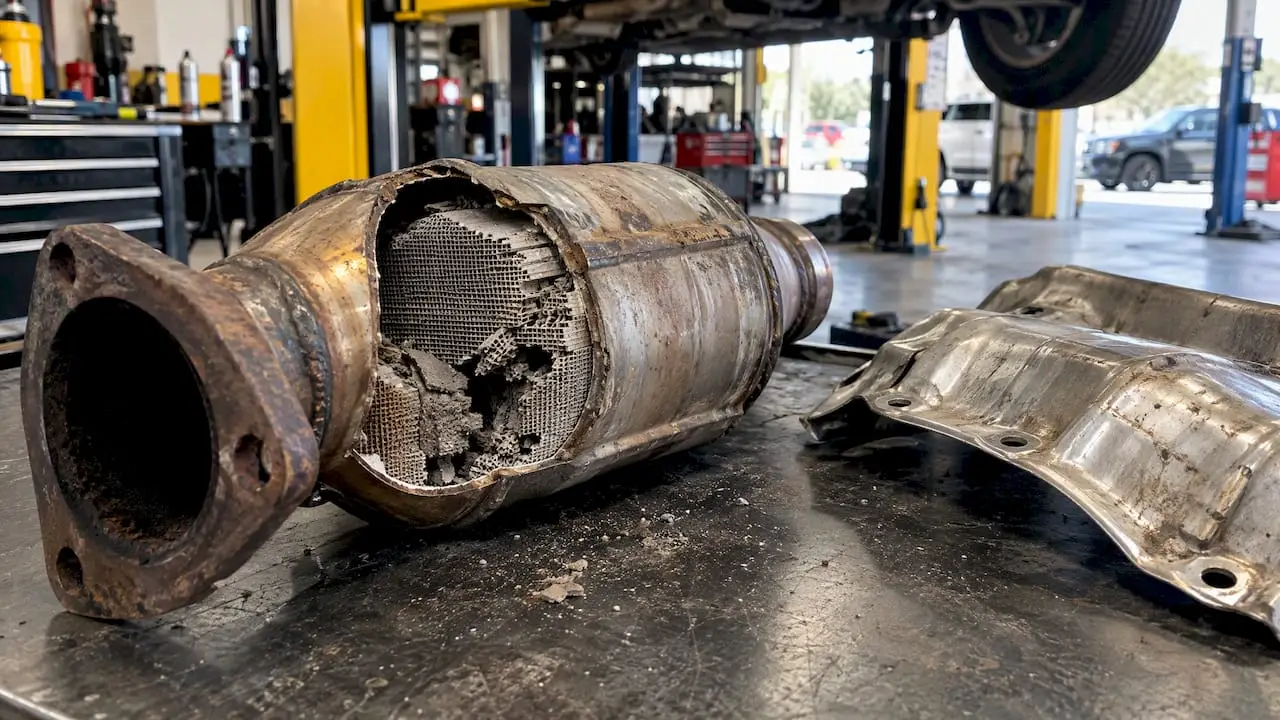
Rattling is a classic symptom, but not every rattle is the converter. A loose heat shield or exhaust hanger can sound similar. When the internal ceramic honeycomb breaks apart, you often hear it rattle when the engine starts or idles. A technician can tell the difference on a lift, which is cheaper than guessing.
What does code P0420 mean?
P0420 stands for catalyst system efficiency below threshold on bank 1, the side of the engine with cylinder number one. P0430 is the same message for bank 2 on engines with two exhaust banks. In plain terms: the computer thinks the converter is not cleaning the exhaust as well as it should.
That does not always mean the converter itself is dead. Other things can trigger the same code:
- A tired or slow downstream or upstream oxygen sensor
- An exhaust leak ahead of the sensors that lets in extra air
- Engine misfires or a rich or lean running condition
- Contamination from burning oil or coolant
That is why we recommend reading the code as a starting point, not a verdict. Our guide to diagnosing P0420 before replacing parts walks through the order we check things in. If the code shows up alongside rough running, also see how we diagnose P0300 misfires with live scan data.
What causes a catalytic converter to fail?
Converters are designed to last the life of a well-maintained vehicle. When one dies early, it is typically a victim. The common culprits, consistent with what AAA reports, are:
- Misfiring spark plugs or ignition parts. Unburned fuel reaches the converter and burns there, overheating the substrate.
- Faulty oxygen sensors. Bad readings cause the engine to run too rich or too lean, which stresses the catalyst.
- Oil burning inside the engine. Worn rings or valve seals send oil into the exhaust, where it coats the catalyst.
- Coolant leaking into the combustion chamber. Antifreeze in the exhaust contaminates the catalyst and is usually a sign of a larger engine problem.
- Ignored check engine lights. A cheap spark plug or sensor job turns into a converter job when the warning is put off.
- Physical damage. Speed bumps, road debris or a rusted exhaust can crack the housing or break the interior.
The EPA’s fact sheet on on-board diagnostics explains that the system can detect deterioration of sensors and components well before the driver notices a drop in performance. The light is an early warning, and early is the cheap time to act.
Why a flashing check engine light is different
A steady light says something needs attention soon. A flashing light says a misfire is happening now, and raw fuel is likely entering the exhaust. AAA warns that driving with it flashing can destroy a healthy converter in a short time. Ease off the throttle, avoid hard acceleration and towing, and get to a shop. If the car runs very roughly or loses power, pull over safely and call for help.
Can you drive with a bad catalytic converter?
Sometimes for a short time, but it is a gamble. A converter that has simply lost efficiency may let you drive for weeks, though you will fail emissions, and the underlying cause may keep getting worse. A clogged one is riskier: restricted exhaust flow can overheat parts, cut power when you need it for passing, and eventually stall the engine.
A good rule from our bays: if the light is steady and the car drives normally, schedule a diagnosis within days. If it is flashing, the car shakes, there is a strong sulfur smell, or power drops noticeably, stop driving it hard and have it inspected promptly. Safety-critical situations, like losing power in highway traffic, are not worth the risk.
How much does catalytic converter replacement cost?
AAA puts typical replacement costs between $1,000 and $4,000. Parts alone can range from about $300 to $2,500, labor at many shops runs $160 to $200 per hour, and OEM parts can cost 40% to 70% more than aftermarket ones.
We don’t publish a flat price for this repair because it depends on the vehicle, the number of converters, and whether the fix is the converter itself. Here is what drives the number:
| Factor | Why it moves the price |
|---|---|
| Vehicle make and model | Some vehicles have two or more converters, and some are built into the exhaust manifold |
| OEM vs. aftermarket | OEM costs more and matches factory catalyst volume; aftermarket is cheaper but may differ |
| Root cause repair | Sensors, spark plugs or an oil-burning issue must be fixed or the new converter can fail too |
| Labor | Rusted bolts and tight access add time |
One thing worth knowing about parts: aftermarket converters may have a shorter lifespan or differ in catalyst content, which can affect emissions compliance or trigger codes again. Ask your technician which option makes sense for your car and for Texas emissions rules.
How to confirm it is the converter before you pay
The worst outcome is a $1,500 converter that doesn’t fix the light. A proper diagnosis usually follows this order:
- Scan the codes and freeze-frame data. This shows what the engine was doing when the fault set.
- Check for service bulletins and software updates for your model.
- Fix other codes first. Misfire, fuel trim and sensor codes come before a catalyst code.
- Inspect the exhaust for leaks ahead of and around the sensors.
- Watch oxygen sensor behavior on a scan tool. A healthy converter smooths out the signal after it.
- Check for restriction with temperature or backpressure testing when clogging is suspected.
Our engine diagnostic service follows this approach. If you want to know what to expect on the invoice, read the questions to ask before an engine diagnostic.
Texas emissions rules and your converter
This is the part many Irving drivers get wrong. Texas ended safety inspections for non-commercial vehicles on January 1, 2025, but emissions inspections remain. The TxDMV calendar states that emissions inspections are still required in certain counties, and the vehicle must pass before you can renew registration.
Dallas County is one of them. The Texas Department of Public Safety lists Dallas among the affected counties, applies the OBDII test to gasoline vehicles from 2 through 24 years old, and lists the catalytic converter system among the inspection items. A faulty converter, or a code pointing at one, can mean a failed test and a delayed registration.
Qualifying commercial vehicles remain subject to applicable safety inspections. If you manage a work fleet, see our fleet maintenance program and our page on emissions and commercial inspections.
For more detail, read our Texas emissions test guide and, if you are chasing a “not ready” result right after a repair, our article on readiness monitors.
A practical example
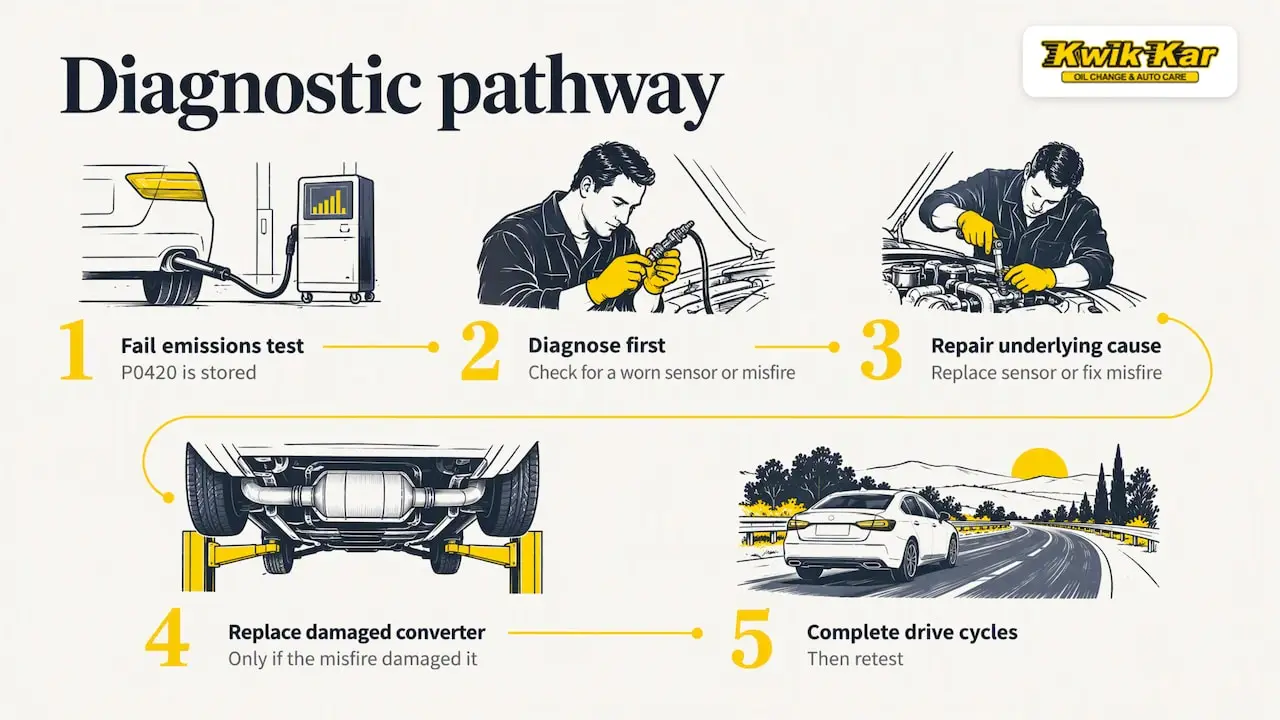
Say your registration renewal is due, and the check engine light has been on for a month. You head to an emissions station and fail, with P0420 stored. The cheapest path is rarely “replace the converter.” It is to diagnose first: if a worn oxygen sensor is the cause, replacing it may clear the code. If a misfire damaged the converter, you fix the misfire and then replace the converter. Start early enough to allow for repairs and the drive cycles the monitors need before a retest.
Our perspective: why we start with the cause
We see the same pattern again and again at our shop on Carl Road. A driver gets quoted a converter because the code says “catalyst efficiency,” when the real story began months earlier with a skipped tune-up, a weak sensor or a light that was ignored. A converter is an expensive way to learn that lesson.
That is why our technicians are ASE-certified and why we lean on Digital Vehicle Inspections. You get photos, videos and technician notes sent to your phone, so you can see what we see and decide with confidence rather than on trust alone. Catching a misfire or a leaking gasket early is the best converter protection there is. Our recommendations are meant to be honest: if a sensor fixes it, we will say so.
If the converter is truly done, we explain the OEM and aftermarket choices and what each means for your emissions test. We also encourage a professional inspection for anything that affects how the car drives, since power loss on a busy road is a safety issue.
— Kwik Kar
Protecting your converter
- Treat the check engine light as a deadline, not a suggestion. Cheap fixes get expensive.
- Keep up with spark plugs and scheduled maintenance. Our tune-up and maintenance services cover the ignition parts that keep fuel from reaching the exhaust unburned.
- Stay on top of oil changes. An engine that burns oil needs attention. Use our oil change interval guide to set the right schedule.
- Fix coolant and oil leaks early. Both can contaminate the catalyst.
- Drive the car. Short idling warm-ups do less for emissions than gentle driving.
- Mind theft risk. Converters are a theft target because of their precious metals. Read about catalytic converter theft prevention in Irving if your car is parked outside overnight.
Get it checked in Irving
If your check engine light is on, the car feels flat or you have a registration renewal coming up, we can scan, inspect and explain what is happening before you spend on parts. Our engine diagnostic service is a good first step, and we serve drivers from Irving and neighbors such as Las Colinas, Grand Prairie, Euless and Coppell. Repairs that qualify are backed by our 24-month/24,000-mile warranty, and we are RepairPal certified and CARFAX Top-Rated. Third-party financing may be available for larger repairs, subject to the provider’s approval and terms.
Call us at (469) 276-7337 or stop by 2100 Carl Rd, Irving, TX 75061. You can also visit kkirvingtx.com to schedule.
FAQ
How long does a catalytic converter last?
A converter should last the life of a well-maintained vehicle, often well beyond 10 years. Early failure usually means something else, such as misfires, oil burning or a bad sensor, damaged it. Regular maintenance is the best protection.
What happens if I don’t fix a bad catalytic converter?
You will likely fail the Dallas County emissions test, and fuel economy and power may keep getting worse. A clogged converter can overheat parts or stall the engine. The underlying cause, like a misfire, also keeps doing damage while you wait.
Can a bad catalytic converter be repaired or cleaned?
In most cases, a converter that is melted, broken inside or contaminated needs replacement. Additive cleaners are not a reliable fix for physical damage. A technician should first confirm that the converter, and not a sensor or leak, is the actual problem.
Will a P0420 code always mean I need a new converter?
No. The code says the converter seems inefficient, but oxygen sensors, exhaust leaks and misfires can set the same code. Diagnosing first can save you from replacing an expensive part you did not need.
Do I still need an emissions test in Irving?
Yes, if your gasoline vehicle is eligible. Dallas County is an emissions county, so eligible vehicles must pass before registration renewal, even though non-commercial safety inspections ended on January 1, 2025.
Sources
- AAA: How Much Does a Catalytic Converter Cost
- U.S. Department of Energy: Catalytic Converters for Cleaner Vehicles
- U.S. Department of Energy: Consumer Guide to Reducing Vehicle Idling
- EPA: Frequently Asked Questions About On-Board Diagnostics
- Texas DPS: Inspection Criteria for Emission Inspection