The most reliable way to prevent catalytic converter theft is to make your vehicle an unattractive target: park securely, add a professionally fitted physical shield, pair it with a vibration alarm, and etch your VIN or plate number on the part. Expect to spend a modest amount upfront on hardware and installation, and when in doubt, a trusted inspection can confirm your setup actually works. The shortlist of tested devices follows below.
TL;DR:
- Combining a physical shield, such as a high-strength strap or bolt-on steel plate, with an alarm system significantly delays removal and deters thieves.
- Physical barriers are most effective when hardware is hidden or recessed, especially in vehicles with accessible underbodies like trucks and SUVs.
- Hard-wired alarms like the CatEye offer continuous protection but can suffer from false triggers, while portable alarms like SparkWhiz provide alert-only defense.
- Proper installation is crucial, requiring professional inspection of anchor points, heat shields, and wiring, with about an hour needed for many shield setups.
- Preventative measures like parking in garages, VIN etching, and neighborhood watch routines are simple, low-cost actions that reduce theft risk immediately.
Table of Contents
- Best Anti-Theft Devices for Catalytic Converters, Compared
- How Shields, Cables, and Alarms Actually Work
- Choosing the Right Protection and Getting It Installed
- Low-Cost Steps You Can Take Today
- If Your Catalytic Converter Is Stolen: What to Do Next
- Why a Professional Inspection and Install Matter
- What We See Go Wrong Most Often
- Get Your Converter Inspected and Protected in Irving
- FAQ
- Sources
Best Anti-Theft Devices for Catalytic Converters, Compared
Independent testing gives us a real basis for comparison instead of guesswork. Car and Driver’s sawzall tests measured how long it actually takes a reciprocating saw to cut through each device, and the results separate the devices worth buying from the ones that just look reassuring.
- CatStrap wraps the converter in a high-strength strap with hardened internal strips, a solid fit for many passenger cars and SUVs with accessible underbodies.
- CatClamp uses braided-steel cable woven to chassis anchor points, built for trucks and vehicles with roomy frame-rail access.
- Cat-Rap bolts a steel plate beneath the vehicle with multiple hidden fasteners, suited to vehicles where underbody plate mounting is practical.
- SparkWhiz is a battery-powered vibration alarm you can manually arm, a lower-cost option for owners who want alert-only protection.
- CatEye is a hard-wired motion and vibration alarm built for continuous monitoring, drawing power directly from the vehicle for always-on readiness.
Our judging criteria follow the same logic independent testers use: how long a device delays a cut, how hard it is to defeat with common tools, how realistic installation is for an average owner, and whether an alarm actually alerts anyone nearby. Field tests on devices like CatEye Electronic Alarm and the Sparkwhiz Catalytic-Converter Anti-Theft Alarm show that decibel claims do not always translate to real-world deterrence since an alarm under a vehicle can be muffled or simply ignored by a passerby.
No single device guarantees protection. The goal is to add enough removal time and resale friction that a thief moves to an easier target instead.
How Shields, Cables, and Alarms Actually Work
A physical shield or cage covers the converter with hardened steel or a reinforced strap, mounted through bolts or straps to the chassis rather than the exhaust itself, since exhaust components flex with heat and vibration. The weak point in most shield designs is exposed or accessible fasteners, which is why tested devices hide or recess their hardware.
Cable locks and braided-steel systems weave through the chassis and around the converter, resisting common reciprocating saw blades. They tend to work best on trucks and SUVs with generous frame-rail access, since tight underbody clearance on sedans can make cable routing difficult.
Alarm systems detect tampering through vibration, tilt, or motion sensors rather than stopping removal outright.
- Battery-powered alarms like SparkWhiz offer portability and manual arming but rely on a charge that needs periodic checking.
- Hard-wired alarms like CatEye draw continuous power from the vehicle for always-on monitoring and typically claim a higher decibel output.
- False alarms are a real tradeoff: sensitive vibration sensors can trigger from nearby traffic or a slammed door.
Installers also have to route around heat shields and exhaust piping, since mounting hardware too close to hot components risks damage or a fire hazard, and that is where fit verification matters.
Choosing the Right Protection and Getting It Installed
Picking a device starts with a short checklist rather than guesswork.
- Check your ground clearance, since low-clearance vehicles limit which shields and plates will physically fit.
- Confirm your vehicle’s make and model against a device’s compatibility list before buying anything.
- Consider your parking habits: a driveway with motion lighting needs less hardware than a shared lot.
- Decide whether you want a physical barrier, an alarm, or both, since combining a barrier with an alarm is often the strongest defense.
- Factor in installation: DIY works for some strap and cable kits, but welded or bolted shields usually call for a lift and the right tools.
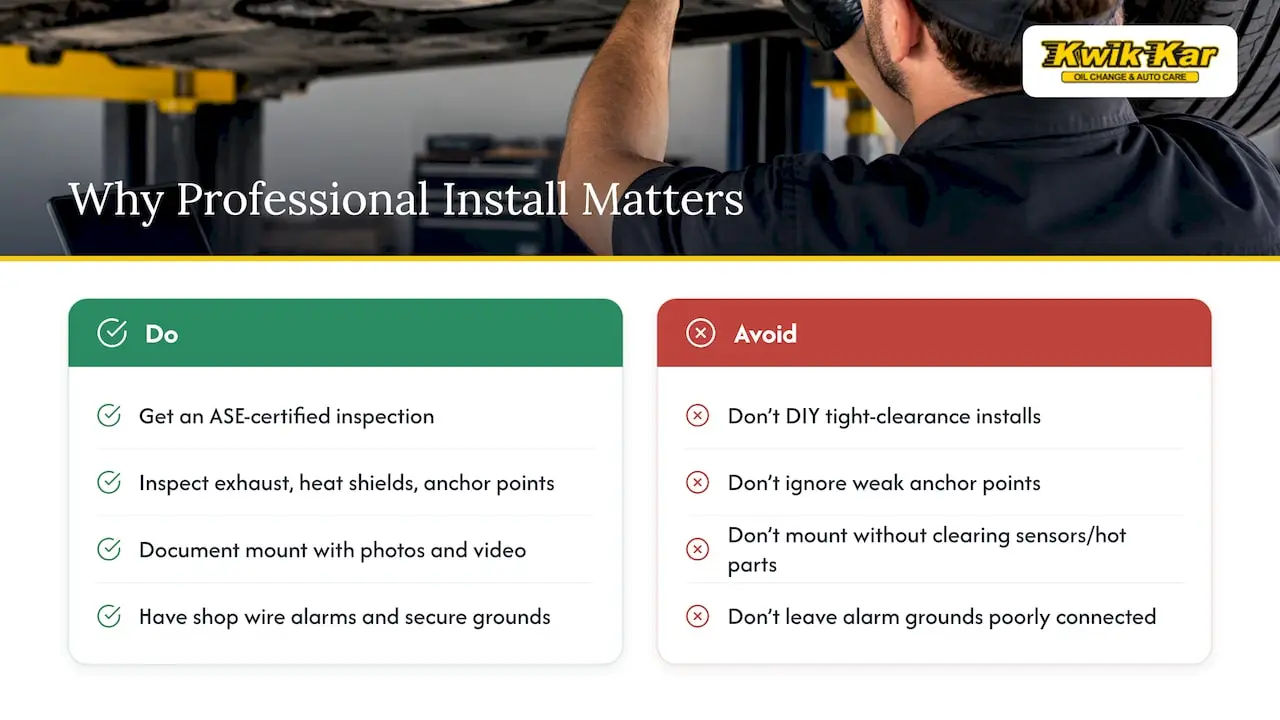
A professional install typically means a technician raises the vehicle, identifies safe anchor points away from exhaust heat and sensor wiring, and torques fasteners to spec. Shops can usually complete a vehicle-specific shield install in about an hour for many universal kits, checking anchor points and heat paths along the way to avoid collateral damage. Device prices and labor costs vary by retailer and vehicle, so it is worth asking a shop for a written estimate before committing. Our engine diagnostic service can also confirm nothing underneath has shifted or loosened after any underbody work.
Pro Tip: Have an ASE-certified technician verify fit and anchoring before you trust a shield to actually hold, since a loose or mis-torqued bracket creates false security instead of real protection.
Low-Cost Steps You Can Take Today
Before spending on hardware, a handful of free or cheap habits cut your risk right away.
- Park in a garage when possible, or as close to a building entrance as you can.
- Add motion-sensor lighting, or simply back into your spot so the undercarriage faces outward and away from easy access.
- Get your VIN or plate number etched onto the converter, since etching deters resale and helps police trace stolen parts; engineering guidance on part marking methods explains why a durable, traceable mark matters for scrap-yard identification.
- Check for free local etching events, since some police departments and AAA chapters periodically host them.
- Install a parking-mode dashcam that keeps recording while the vehicle is off.
- Coordinate with neighbors on a simple watch routine and report suspicious activity under a vehicle promptly.
If Your Catalytic Converter Is Stolen: What to Do Next
A stolen converter is usually obvious immediately: a loud, roaring exhaust note on startup and often a check engine light. Driving far on a stolen converter risks further exhaust and sensor damage, so keep the trip short.
- Pull over safely and avoid driving any farther than necessary to reach home or a shop.
- Photograph the scene and the damage underneath the vehicle for your records.
- File a police report promptly, since documentation helps both insurance claims and local tracking of theft patterns.
- Gather your VIN and registration details, which the report and your insurer will both need.
- Contact your insurer to ask about comprehensive coverage, since comprehensive policies often cover catalytic converter theft, though your deductible affects your out-of-pocket cost.
- Tow the vehicle to a trusted shop rather than attempting a temporary fix yourself, since converter removal often damages surrounding exhaust components.
Why a Professional Inspection and Install Matter
An ASE-certified technician checks more than just the converter mount. We inspect exhaust routing, heat shield condition, and the actual anchor points a shield or cable will bolt to, since a weak anchor defeats the hardware regardless of its strength rating. Our Digital Vehicle Inspections document that work with photos and video, so you can see exactly where a device was mounted and confirm it clears sensors and hot components. Some vehicles, particularly those with complex chassis layouts or tight ground clearance, genuinely need a shop install because DIY mounting risks hitting a fuel line or wiring harness. Our electrical team also handles the wiring side of hard-wired alarms like CatEye, since a poor ground connection is a common failure point.
What We See Go Wrong Most Often
The most common mistake we see is a DIY shield installed with the wrong hardware or anchored to a spot that works loose within months, which creates a false sense of security. A close second is an alarm that gets armed once and then ignored. Layering a physical barrier, an alarm, and VIN etching together is what actually raises the cost and risk for a thief enough to make them walk away. When you are not sure your setup is solid, book an inspection and let us check it.
— Kwik Kar
Get Your Converter Inspected and Protected in Irving
We check anchor points, exhaust routing, and heat shield condition before recommending any anti-theft device, and our Digital Vehicle Inspections give you photo and video proof of exactly what we found and installed. That means you are not guessing whether a shield is actually bolted to something solid.

| What we check | Why it matters |
|---|---|
| Exhaust routing and heat shields | Confirms safe mounting clearance for shields or cables |
| Anchor point strength | Prevents a device from working loose over time |
| Sensor and wiring proximity | Avoids damage when installing hard-wired alarms |
| DVI photo and video record | Gives you proof of correct fit after install |
We serve drivers, commuters, families, and local fleets throughout Irving, Texas, and offer same-day service availability for most inspections. If you want a second opinion on a device you already own or help choosing one, start with our engine diagnostic service, or visit our full service page to book an appointment today.
FAQ
Which cars are most likely to have a catalytic converter stolen?
Vehicles with higher ground clearance, along with hybrid vehicles, are frequently targeted because their converters are easier to reach and often contain higher concentrations of precious metals, according to NICB and Consumer Reports data. Trucks and SUVs with generous underbody access also see higher theft rates than low-clearance sedans.
How can I stop my catalytic converter from being stolen?
Combine secure parking with a professionally fitted physical shield or cable system, add a vibration alarm, and etch your VIN or plate number onto the part. Municipal guidance identifies parking, lighting, shields, and etching as the most effective prevention measures available to owners.
What is the best theft deterrent for catalytic converters?
No single device offers complete protection, but independent sawzall testing found that combining a hardened physical barrier with an alarm system significantly slows removal and increases the odds a thief gives up. Reported thefts have also declined in recent years as metal prices dropped and new laws took effect.
Will a car run if the catalytic converter is stolen?
Yes, a vehicle will typically still run without its catalytic converter, but it will sound noticeably loud and may trigger a check engine light or run poorly. Driving it any distance is not advisable since the damage to surrounding exhaust components tends to worsen.
Does car insurance cover catalytic converter theft?
Comprehensive auto insurance often covers catalytic converter theft, though coverage and your deductible amount vary by policy, so it is worth reviewing your plan before an incident happens. Lowering your comprehensive deductible can meaningfully reduce what you pay out of pocket after a theft.
Sources
- Tested: Best Catalytic Converter Anti-Theft Devices for 2025 — Car and Driver
- Catalytic Converter Theft Prevention — City of Blaine, MN
- Does car insurance cover catalytic converter theft? — AAA (insurance guidance)