P0420 means the catalytic system on Bank 1 is converting emissions at a rate below the manufacturer’s threshold, which the PCM flags once onboard sensors confirm the gap. If the check engine light is steady and the car runs normally, you can usually drive it short distances, but get a diagnostic scan soon. If the light is flashing or you feel misfires, stop driving and have the vehicle towed to avoid damaging the catalytic converter.
TL;DR:
- Most P0420 cases are caused by faulty oxygen sensors, exhaust leaks, or engine misfires, not the catalytic converter itself.
- Proper diagnosis involves live waveform analysis of sensors, visual inspections, and sometimes smoke testing before considering converter replacement.
- Replacing the catalytic converter is costly and should only be done if testing confirms it has lost efficiency, after ruling out cheaper fixes.
- A steady check engine light with normal power indicates short-term driving is safe, but flashing lights or misfires require immediate towing and repairs.
- Regular maintenance, such as fixing leaks and avoiding prolonged delays after a code appears, can prevent costly catalytic converter replacements.
Table of Contents
- What the P0420 code means and how OBD-II detects it
- Common symptoms to watch for
- Most common causes of P0420 (diagnostic priority order)
- How technicians diagnose P0420: tests you should expect
- Repair options and cost drivers
- Seriousness and driving guidance
- Prevention and maintenance tips
- Why a local ASE certified shop matters for P0420
- Local next steps: diagnostic service at Kwik Kar Irving
- Primary sources and official references
- Sources
- FAQ
What the P0420 code means and how OBD-II detects it
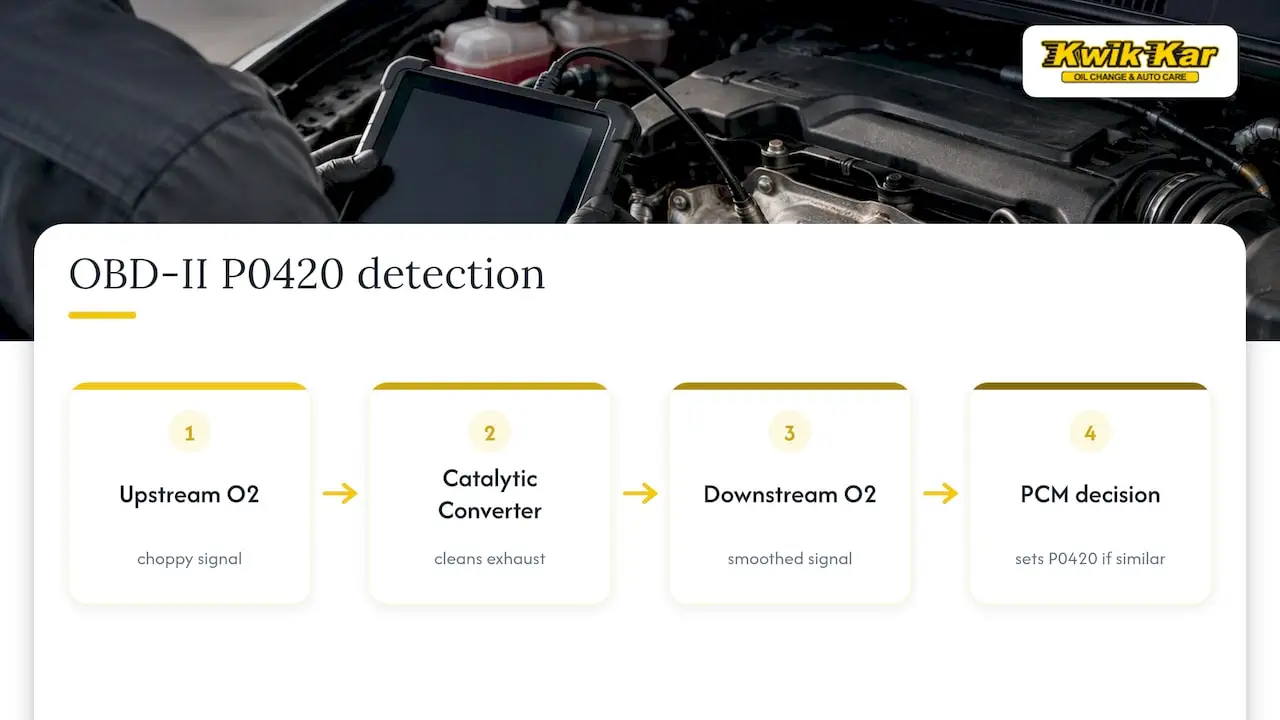
Every vehicle built since model year 1996 carries an OBD-II system that watches emissions-related components and stores a trouble code the moment something drifts out of range, a design meant to catch problems before they turn into bigger repair bills, according to the EPA’s OBD overview. For P0420, the computer compares signals from the upstream oxygen sensor, which reads exhaust before it enters the converter, against the downstream sensor, which reads exhaust after. A healthy converter smooths out the downstream signal compared to the choppier upstream one. When the two readings look too similar, the PCM concludes the converter is not cleaning exhaust efficiently enough and sets the code, though that reading alone does not prove the converter itself has failed, as KBB’s P0420 reference explains.
Common symptoms to watch for
Most drivers notice P0420 because of a dashboard light, not a dramatic mechanical problem. The symptoms range from mild to urgent, and knowing which category you are in helps you decide whether to drive to a shop or call for a tow.
- A steady check engine light with otherwise normal driving, often the first and only sign.
- Reduced fuel economy as the engine compensates for inefficient exhaust flow.
- A failed emissions or state inspection, since any stored emissions code typically results in a fail.
- Flashing malfunction indicator lamp, rough idle, stalling, or noticeable loss of power, which point to active misfires.
A flashing MIL signals an active misfire condition that can overheat and damage the catalytic converter within minutes of continued driving. If you see flashing rather than steady illumination, treat it as a different, more urgent problem than a simple efficiency code.
Most common causes of P0420 (diagnostic priority order)
Technicians typically work through causes in order of likelihood and cost, starting with the cheapest fixes before assuming the converter itself needs replacement.
- Worn or contaminated catalytic converter. Age, high mileage, or heat damage from past misfires can wear down the internal substrate that performs the actual conversion.
- Faulty oxygen sensors or damaged wiring. A sensor reading incorrectly, or a corroded connector, can produce the same signal pattern as a failing converter without the converter being at fault.
- Exhaust leaks near the sensors or manifold. A leak lets outside air skew sensor readings, mimicking poor catalytic efficiency.
- Engine misfires or fuel and ignition problems. Unburned fuel reaching the converter raises its temperature and alters the exhaust chemistry the sensors measure.
- Aftermarket exhaust modifications or damaged emissions parts. Non-stock components can disrupt the flow and spacing the sensors were calibrated to expect.
Working through this list in order helps avoid the single biggest mistake owners make with P0420: replacing the converter before ruling out cheaper causes.
How technicians diagnose P0420: tests you should expect
A proper diagnosis starts with pulling stored and pending codes along with freeze-frame data from an OBD-II scanner, which captures the engine conditions present when the code set. From there, a technician compares upstream and downstream oxygen sensor waveforms on a scope, both at idle and under load.
- A healthy downstream sensor shows a relatively flat, steady signal compared to the upstream sensor’s constant swings.
- A downstream signal that mirrors the upstream pattern too closely points toward reduced converter efficiency.
- Live data for fuel trims and misfire counts can reveal whether an engine problem, not the converter, is the root cause.
- A visual inspection checks for exhaust leaks, damaged wiring, or loose connectors, and a smoke test can confirm leaks that are hard to see.
Pro Tip: Ask for the actual waveform printout or digital inspection photos before approving converter replacement, not just a verbal explanation.
Bench testing or a dedicated catalytic efficiency test is usually reserved for cases where live-data checks and visual inspection do not point to a clear cause.
Repair options and cost drivers
The sensible repair order starts cheap and moves up only as evidence requires it. Replacing a faulty oxygen sensor, fixing an exhaust leak, or resolving a misfire are all lower-cost repairs that fix a meaningful share of P0420 cases without ever touching the converter.
- Oxygen sensor replacement or exhaust leak repair addresses the root cause in many cases.
- Misfire repair, whether spark plugs, coils, or fuel delivery, stops ongoing damage to the converter.
- Catalytic converter replacement becomes necessary only when testing shows the converter itself has lost efficiency, and it carries the highest cost of the group because of the part’s materials and labor involved.
- OEM versus aftermarket parts, vehicle complexity, and local labor rates all shift the final estimate.
Major emissions-control components, including the catalytic converter, are often covered under a federal emissions warranty that typically lasts several years or some tens of thousands of miles, so it is worth checking your vehicle’s coverage before paying out of pocket, per the EPA’s transportation and air pollution FAQ. If a shop recommends converter replacement without showing you waveform data or a clear diagnostic trail, it is reasonable to ask for that evidence or get a second opinion first.
Seriousness and driving guidance
A steady check engine light with no misfires or power loss generally means the car is safe for short trips to a shop, though the underlying cause still needs a diagnosis. The picture changes once the light flashes or the engine misfires. That combination means unburned fuel is reaching the converter and can overheat it quickly, so the safer move is to stop driving and arrange a tow.
- Steady MIL, normal power: schedule a diagnostic soon, short trips are generally fine.
- Flashing MIL, misfires, or stalling: stop driving and tow the vehicle.
- OBD-based state inspection programs fail a vehicle automatically when the MIL is commanded on with a stored code, according to Texas Department of Public Safety emissions testing guidance.
- Ignoring the code long term tends to worsen fuel economy and risks turning a sensor fix into a converter replacement.
Prevention and maintenance tips
Most P0420 cases trace back to maintenance that was deferred rather than a converter that simply wore out on its own. Staying ahead of a few routine items lowers the odds of seeing this code at all.
- Keep up with tune-ups, including spark plugs and ignition components, to prevent the misfires that overheat converters.
- Fix oil or coolant leaks promptly, since either can contaminate the converter if it reaches the exhaust.
- Address a check engine light as soon as it appears rather than waiting for symptoms to worsen.
- Follow the manufacturer’s service schedule for fuel-system inspections and cleaning.
Pro Tip: A fuel system that burns clean reduces strain on the catalytic converter, so don’t skip scheduled fuel-system service even when the car seems to run fine.
Why a local ASE certified shop matters for P0420
A code reader alone cannot tell you whether a converter has failed or a cheaper part is to blame. ASE certified technicians running live waveform comparisons, paired with Digital Vehicle Inspections that send photos and video of the actual readings, give you evidence instead of a guess. That transparency matters most with P0420, since replacing a converter unnecessarily is one of the most avoidable expenses in auto repair. A shop can also help confirm how a stored code affects your state inspection before you authorize any work.
— Kwik Kar
Local next steps: diagnostic service at Kwik Kar Irving
A P0420 code deserves a real diagnosis before a part gets replaced, and that starts with an engine diagnostic that pulls your codes, checks live sensor data, and tells you what’s actually happening under the hood. The diagnosis is backed by a Digital Vehicle Inspection, showing photos, video, and technician notes behind the recommendation before you approve anything.

- Schedule an engine diagnostic to confirm the cause before any parts get replaced.
- Review your Digital Vehicle Inspection results and written estimate before approving repair work.
- Call or book online with Kwik Kar Oil Change & Auto Care in Irving to get your P0420 checked out.
Primary sources and official references
For further reading, see the EPA’s OBD basics, Texas DPS emissions testing FAQ, and NHTSA technical service bulletins for model-specific failure patterns. Owners tracing an exhaust-related check engine light after modifications may also find this downpipe CEL diagnostic checklist useful, and technicians cross-referencing codes often use the TuningBot DTC database.
Sources
- OBD: Frequently Asked Questions (EPA-420-F-02-014)
- P0420 Code – Catalyst System Low Efficiency – 13.2% | KBB
- Emissions Testing | Department of Public Safety
- EPA: Frequent questions related to transportation, air pollution and climate change
FAQ
How do I fix error code P0420?
Fixing P0420 starts with a diagnostic scan to find the root cause, since the code itself only indicates low catalytic efficiency rather than naming a specific failed part. Depending on what testing shows, the fix might be an oxygen sensor, an exhaust leak repair, a misfire correction, or, if the converter itself tests bad, converter replacement.
How much does a P0420 cost to fix?
Cost depends entirely on the cause: an oxygen sensor or exhaust leak repair runs far less than a catalytic converter replacement, which is one of the more expensive single-part repairs because of material and labor costs. Getting a diagnostic first, rather than assuming the converter is at fault, is the best way to avoid overpaying.
Is a P0420 code serious?
A steady check engine light with normal driving is not an emergency, but it still needs attention soon since it often affects fuel economy and will fail an OBD-based state emissions inspection. A flashing light or active misfires alongside the code is serious and calls for stopping the vehicle and arranging a tow.
Can I still drive my car with a P0420 code?
If the check engine light is steady and the car runs normally, short trips to a repair shop are generally fine, though you should not delay getting it diagnosed. If the light flashes or you feel misfires, stop driving, since continued operation risks overheating and damaging the catalytic converter.