Replace your tires when the tread is down to 4/32 of an inch if you want a safe margin, and never run them below 2/32 of an inch, which is the point NHTSA says tires are no longer safe. Age matters too: plan on an inspection-based decision at 6 years and replacement by 10 years at the latest, whatever the tread looks like. Bulges, cuts, vibration and repeated air loss mean replacement or a professional look right away.
Below, we walk through each check, what it means on Irving roads, and what to do next.
TL;DR
- Tread: 2/32" is the legal and safety floor. Treat 4/32" as the point to start shopping, especially for wet-weather driving.
- Age: Many automakers say 6 years, and industry guidance says 10 years at the latest, even with plenty of tread left.
- Damage: Bulges, deep cuts, exposed cord, sidewall cracking or a sudden vibration mean stop driving and get it inspected.
- Mileage: There is no single number. Driving habits, load, inflation and road hazards decide the real lifespan.
- Check monthly: A quarter, a gauge and a look at the date code take five minutes.
Table of Contents
- The tread depth rules: 2/32" vs. 4/32"
- How to check your tread at home
- Age matters even when the tread looks fine
- So how many miles do tires last?
- Warning signs that mean replace now (or get it inspected)
- Irving heat, potholes and what they do to your tires
- Why replacing tires early is also about braking
- Our perspective: what we see at the shop
- Get a second set of eyes in Irving
- FAQ
- Sources
The tread depth rules: 2/32" vs. 4/32"
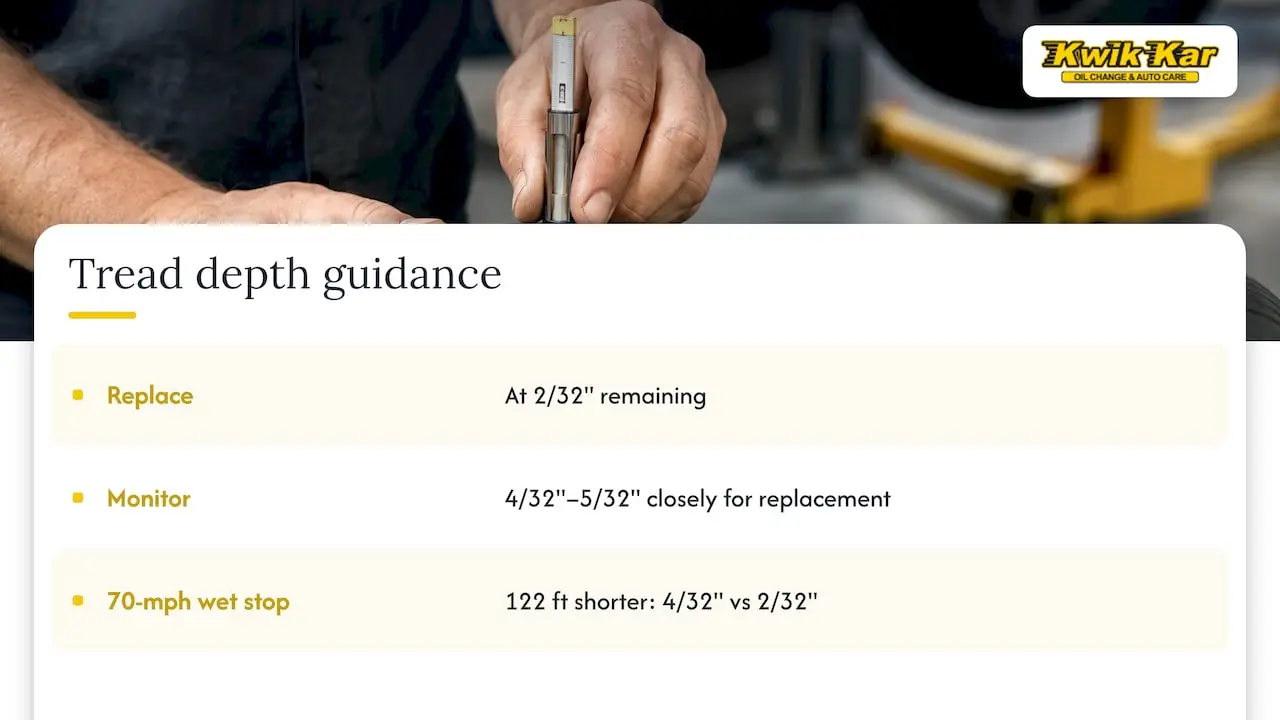
Tread is what channels water out from under the rubber and keeps the car gripping on wet or slick pavement. NHTSA says tires should be replaced when tread is worn to 2/32 of an inch. The tire industry’s own guide says the same: replace when 2/32" remains anywhere on the tread face.
Texas follows that number. A summary of state rules notes that tires need at least 2/32 of an inch of tread and must be in safe operating condition.
But legal is not the same as safe. AAA advises drivers to consider replacement sooner, and says tires at 4/32" to 5/32" should be monitored closely for replacement. In one AAA-cited test on a pickup at 70 mph, wet-pavement stopping distance was 122 feet shorter with 4/32" of tread than with 2/32".
That is why “replace tires at 4/32” is a common shop recommendation. It is not an upsell. It is where braking in the rain starts to suffer.
A quick reference
| Tread remaining | What it means | What to do |
|---|---|---|
| 6/32" or more | Good grip margin | Keep checking monthly |
| 5/32" to 4/32" | Wet stopping distance is starting to grow | Start planning and budgeting for replacement |
| 3/32" | Past the AAA comfort zone, short of the legal floor | Replace soon, before the next rainy stretch |
| 2/32" or less | Worn out, below the safe and legal minimum | Replace now |
If you are asking whether you need to replace tires at 3mm: 3mm is roughly 4/32" (1/32" is about 0.8mm). So yes, you are at the start of the replace-soon window, not an emergency, but close enough that you should book.
For heavier vehicles, the rule is stricter. Federal rules for vehicles over 10,000 pounds GVWR require front-axle tires to come off at 4/32" (NHTSA). If you run a work truck or a fleet, that matters.
How to check your tread at home
You have three options, from least to most useful.
- The penny test. AAA calls it an emergency check only: it catches tires that are already dangerously worn, not ones heading there.
- The quarter test. Put a quarter into a groove with Washington’s head upside down. If the top of his head is hidden, you have at least 4/32" left (AAA Exchange). If you can see above his head, you are under 4/32".
- A tread depth gauge. Cheap, accurate, and the best way to track wear over time. Measure across the width of the tread, not just in one groove.
Built-in wear bars are narrow strips of smooth rubber across the tread. When they sit flush with the surface, you are at 2/32". That is a late signal, not an early one. Do not wait for them.
Measure at the inside, middle and outside of each tire. If one edge is far lower than the rest, the problem is not the rubber, it is something upstream. We cover that in our guide to matching DIY checks to shop diagnostics for uneven tire wear.
Age matters even when the tread looks fine
Rubber hardens and cracks over time. NHTSA’s guidance notes that many vehicle manufacturers recommend replacement at 6 years, and some industry guidelines say 10 years at the latest, regardless of remaining tread. AAA’s regional clubs also recommend 6 years, while adding that age alone does not tell the whole story.
The tire industry makes a fair point here. The U.S. Tire Manufacturers Association says that predicting service life from calendar age alone is difficult, because load, speed, inflation and road hazards vary so much. Its answer is periodic professional inspection. It also notes that most people drive enough miles that wear retires the tire before age does.
How to read the date code
Look on the sidewall for the DOT code. The last four digits are the week and year of manufacture. For example, “0308” means the 3rd week of 2008 (NHTSA). The code may be on only one side of the tire, so check both.
A spare that has never touched the road still ages. So does a set on a car that sits in a garage most of the week. Heat, UV light and storage conditions can all speed up aging, which can mean replacement well before the 6-year mark.
So how many miles do tires last?
People search for “tire replacement mileage” and “how long do tires last” because they want a simple number. We would rather be honest: the number depends on the tire, and the manufacturer’s treadwear warranty for your specific set is the best mileage reference. What we can say is that mileage and age work together:
- A commuter on I-635, Highway 114 or the George Bush Turnpike adds miles fast and usually wears tread out first.
- A low-mileage driver usually hits the age limit first.
- Heavy loads, hard braking and fast cornering shorten life.
- Low pressure causes shoulder wear. Over-inflation wears the center.
If you drive 12,000 to 15,000 miles a year, the tread check will probably be your trigger. If you drive far less, the date code will be.
Warning signs that mean replace now (or get it inspected)
Tread depth is only part of the story. NHTSA’s guidance says drivers should look for cuts, punctures, bulges, scrapes and uneven wear, and treat noise, vibration or constant need for air as signs of possible internal damage that needs prompt professional inspection.
| Symptom | Likely cause | Safety concern | What to do |
|---|---|---|---|
| Bulge or bubble in the sidewall | Internal cord damage, often from a pothole or curb hit | Blowout risk | Do not drive on it. Replace. |
| Deep cuts, exposed cord | Road debris, impact | Structural failure | Replace |
| Cracking in the sidewall or between tread blocks | Age, heat, UV | Brittle rubber | Check the date code, get it inspected |
| Losing air every week | Nail, bead leak, valve, damaged wheel | Underinflation, heat buildup | Test for the leak, repair or replace |
| New vibration at highway speed | Imbalance, internal damage, worn suspension or steering parts | Loss of control, accelerated wear | Get it diagnosed |
| Wear on one edge only | Suspension or steering problem, or inflation habits | Short life, unpredictable handling | Diagnose before buying new |
| Louder road noise, cupped or scalloped wear | Worn shocks or struts, imbalance | Reduced grip and braking | Inspect the suspension |
Two cases come up often in our shop’s neighborhood. First, a nail or screw from a construction zone. Not every puncture means a new tire, and repair depends on location and size. See our guide to what to do about a nail in a tire and when a repair is safe. Second, a slow leak you cannot find. Our 24-hour slow leak test shows you how to narrow it down.
If the steering wheel shakes between 55 and 75 mph, the cause is not always the tires. Our guide on steering wheel vibration at highway speeds helps you time the symptoms so the diagnosis goes faster.
If a tire suddenly starts to vibrate or you feel a ride disturbance while driving, the tire industry’s service guide says to avoid abrupt braking or steering and drive with caution until you can stop safely.
Irving heat, potholes and what they do to your tires
North Texas summers are hard on rubber. Heat speeds up aging, and hot pavement raises pressure. A rule of thumb is that pressure rises about 1 psi for every 10°F increase in temperature. That is why a tire that looks fine at 7 a.m. can be overinflated or overheated by mid-afternoon. We explain when to check in our guide to how heat raises tire pressure.
Two habits protect tires in this climate:
- Check pressure monthly, cold. Use the number on the driver’s door jamb placard, not the number molded into the sidewall. AAA’s maintenance checklist recommends monthly checks for pressure and tread wear.
- Rotate on schedule. Even wear means the full set reaches replacement together. Our rotation interval guide covers the 5,000 to 7,500 mile range.
And after a hard pothole hit on Belt Line or MacArthur, look at the sidewall that same day, then watch for a pull or vibration.
Why replacing tires early is also about braking
Worn tread lengthens your stopping distance, which is part of why the AAA test above matters. But brakes and tires work as one system. Fresh brake pads on worn rubber still stop slowly in the rain, and worn shocks or struts let the tire bounce instead of staying planted.
If you notice longer stops, a pulsing pedal or noise, have the brakes looked at at the same time. Our guides on brake pad replacement and warped rotor symptoms show what to watch for. Suspension and steering wear is part of what we look at under our full range of auto repair services, including shocks and struts.
Wet-weather habits help too. If you want a driver’s perspective, this UK guide on habits that keep drivers safe in the rain covers following distance and speed. It is written for British roads, so apply the principles, not the local rules. For a similar UK take on cleaning and care, this overview of tyre dressing and tread wear is another reference, though dressing does nothing for tread depth or safety.
Our perspective: what we see at the shop
Most drivers do not come in asking about tread. They come in for an oil change, a noise, a pull, or a check engine light. The tires are one more thing we look at, and the best time to catch a problem is before it becomes a breakdown on the shoulder of 183.
A few things we believe:
- The 2/32" number is a floor, not a goal. If you are at 4/32" and heading into storm season, replacing is the safer call.
- Look at the cause, not just the symptom. Uneven wear and vibration often trace back to suspension, steering or inflation habits. Replacing without a diagnosis can mean wearing out the next set early.
- You should see what we see. Our ASE-certified technicians perform a Digital Vehicle Inspection with photos, videos and technician notes sent to your phone, so you can judge recommendations for yourself rather than taking our word for it.
- Recommendations should be honest. If something can wait, we say so. If it cannot, we tell you why.
We stand behind our work with a 24-month/24,000-mile warranty, and we are RepairPal and CARFAX certified.
— Kwik Kar
Get a second set of eyes in Irving
If you are not sure whether your tires, brakes or suspension have another year in them, bring the car in. We serve drivers across Irving with oil changes, brake repair, engine diagnostics, A/C service, batteries, suspension and steering work, state inspections and fleet maintenance. Our Ladies’ Day oil change coupon gives $25 off on Wednesdays, and we offer discounts for military and first responders.
Start at kkirvingtx.com to see our services and book. If your inspection is coming up, our Texas inspection checklist shows what to expect.
FAQ
Should I replace tires at 4/32"?
For most drivers, yes, or at least start planning. 2/32" is the legal minimum, but AAA’s testing shows stopping distances on wet pavement are noticeably longer at 2/32" than at 4/32". If you drive in heavy rain or highway traffic, 4/32" is a sensible trigger.
What is the tire age limit?
There is no single legal age limit for passenger cars. Many automakers recommend replacement at 6 years, and some industry guidelines say 10 years at the latest, regardless of tread. Check the DOT date code on the sidewall and have older tires inspected every year.
How long do tires last?
It depends on driving habits, load, inflation, road hazards and the tire itself. Most drivers wear out the tread before age becomes a factor, but low-mileage drivers may hit the 6-year mark first. Monthly checks of tread and pressure are the best predictor for your own car.
Do I need to replace tires if the tread is still above 2/32"?
Yes, if there is a bulge, a deep cut, exposed cord, or significant sidewall cracking. Those problems can cause a blowout regardless of tread depth. Have a technician inspect any tire with damage or a persistent vibration.
Can bad suspension make me replace tires sooner?
Yes. Worn shocks, struts or steering parts can cause cupping and uneven wear that shorten tire life. Diagnosing the cause before the next set goes on helps protect your investment.
Sources
- Tire Safety Ratings and Awareness, NHTSA
- Summer driving tips, NHTSA
- Tire Care & Safety Guide, USTMA
- Tire Facts, USTMA
- Care and Service of Passenger and Light Truck Tires, USTMA
- When to Replace Tires: Check Your Tread, AAA
- Tire Safety and Maintenance, AAA Exchange
- How Long Do Tires Last?, AAA Oregon/Idaho
- Time-Stamped Car Maintenance Checklist, AAA
- Texas Tire Regulations, Oversize.io
- How Do High Temperatures Affect Tires?, Buckingham & Vega Law Firm