Uneven tire wear means your tread is wearing down faster or differently across the tire surface instead of evenly, and it usually signals a pressure, alignment, or suspension problem. It can reduce wet-weather traction, throw off handling, and quietly drain fuel economy. Check your tire pressures and scan your tread for bald patches or ridges today, and book an inspection if anything looks abnormal.
TL;DR:
- Overinflation causes center tire wear, which can reduce traction and fuel efficiency, and is often unnoticed without regular pressure checks.
- Alignment issues, worn suspension parts, and imbalance frequently contribute to uneven tread patterns like feathering and cupping, requiring professional diagnosis.
- Routine monthly inspections using visual checks and tread measurement tools can prevent costly tire failures by catching early signs of uneven wear.
- Proper tire rotation, maintaining correct pressure, and suspension inspections are critical for preventing uneven wear and extending tire lifespan.
- Replacing tires is necessary once tread depth drops below 2/32 inch or wear bars are flush, especially if uneven wear shortens braking distance and increases risk.
Table of Contents
- Common Tire Wear Patterns and What They Mean
- What Causes Tires to Wear Unevenly
- How to Check Your Tires for Uneven Wear at Home
- Preventing Uneven Wear With Routine Maintenance
- When to Replace Tires Versus Repair the Underlying Problem
- What a Professional Tire Diagnostic Looks Like
- Why We Measure Before We Recommend Anything
- Get Your Tires Checked at Kwik Kar Irving
- FAQ
- Sources
Common Tire Wear Patterns and What They Mean
Your tread tells a story, and different wear patterns point to different root causes. Learning to read them before a shop visit saves time and helps you ask the right questions.
- Center wear: tread wears faster down the middle, usually from over-inflation pushing the center of the tire into the road.
- Outer or shoulder wear: the edges wear faster than the center, typically from under-inflation or consistently aggressive cornering.
- Feathering: tread blocks develop a sawtooth edge, smooth on one side and sharp on the other, a classic sign of toe misalignment.
- Cupping or scalloping: scooped-out dips appear around the tire, often from worn shocks or struts, or from an imbalance that lets the tire bounce instead of rolling flat.
- Bald spots or uneven patches: isolated flat areas can point to a stuck brake caliper, a bent wheel, or a long-standing balance issue.
Run your hand across the tread, not just your eyes, since feathering and cupping can sometimes be easier to feel than see. Tires have built-in tread wear indicators, or “wear bars,” which appear when tread wears down to the replacement threshold and offer a quick visual cue.
What Causes Tires to Wear Unevenly
Most uneven wear traces back to one of five mechanical or behavioral issues, and more than one is often at play.
- Incorrect tire pressure: too much air wears the center, too little wears the edges, and a tire pressure monitoring system often won’t warn you until a tire is already underinflated by a wide margin, so a manual check still matters, according to tire care guidance from USTMA.
- Alignment issues: incorrect toe, camber, or caster angles drag or tilt the tire against the road, producing feathering or lopsided edge wear. Dynamic steering geometry can shift under load even when a static alignment check looks fine, which is why SAE research on steering system compliance found that steering and suspension compliance can produce uneven front-wheel wear on their own.
- Worn suspension and steering parts: tired shocks, struts, tie rods, or wheel bearings let the tire bounce or wobble instead of sitting flat, a common driver behind cupping.
- Imbalance, bent wheels, or brake drag: an unbalanced wheel vibrates at speed and chews tread in small, repeating dips, and a sticking caliper can wear one tire faster than its partner.
- Driving habits and road conditions: hard cornering, frequent potholes, and curb strikes all accelerate localized wear regardless of how well-maintained the suspension is.
A worn tire often has more than one contributor, which is why a diagnostic that checks pressure, alignment, and suspension together beats guessing from the pattern alone. For more on how toe and camber problems show up behind the wheel, see our guide on why your steering wheel sits off center.
How to Check Your Tires for Uneven Wear at Home
A few minutes a month catches problems before they become expensive. Here’s a simple routine:
- Check pressure cold, before driving, and compare it to the number on your door-jamb placard, not the number molded into the tire sidewall.
- Walk around the vehicle and look at each tire’s tread and sidewall for bald spots, cupping, or uneven edges.
- Run the penny test: insert a penny into a tread groove with Lincoln’s head facing down. If you can see the top of his head, tread is worn to roughly 2/32 inch and it’s time to replace.
- Use a tread depth gauge for a more precise reading, especially if the penny test leaves you unsure.
- Check for exposed wear bars, the raised rubber ridges across the tread grooves, which signal the tire has reached its minimum legal depth.
- Note vibrations, pulling to one side, or a rough ride, all of which call for an inspection sooner rather than later.
- Photograph anything unusual and record tread depth numbers so a technician has a baseline to compare against.
Pro Tip: Keep a simple log of your tread measurements every month. A gradual drop in one spot tells a technician far more than a single snapshot.
Routine monthly checks, including pressure and tread inspection, are specifically recommended by the U.S. Tire Manufacturers Association to catch uneven wear before it becomes a safety issue.
Preventing Uneven Wear With Routine Maintenance
Consistent maintenance does more to prevent uneven wear than any single repair. A few habits make the biggest difference.
- Rotate tires regularly as recommended by your vehicle’s manufacturer, with the first rotation being especially important for setting an even wear pattern, per USTMA’s tire care essentials.
- Set inflation to the placard value, not the sidewall maximum, every time you rotate or service the vehicle.
- Ask for a balance check whenever you feel a vibration at highway speed, and request road-force balancing if a standard balance doesn’t resolve it.
- Have suspension components inspected periodically, since worn shocks or struts often cause cupping long before a ride feels noticeably rough.
- Adjust driving habits where you can: gentler cornering and slowing for potholes both reduce the mechanical stress that accelerates wear.
Pro Tip: If you’ve just had new tires installed, check alignment before you assume the tires themselves are the problem. Our guide on alignment after new tires walks through when that check matters most.
Not every tire rotates the same way. Directional and asymmetrical tires, or mismatched sizes, follow different rotation patterns, so check your owner’s manual before assuming a standard cross-rotation applies.
When to Replace Tires Versus Repair the Underlying Problem
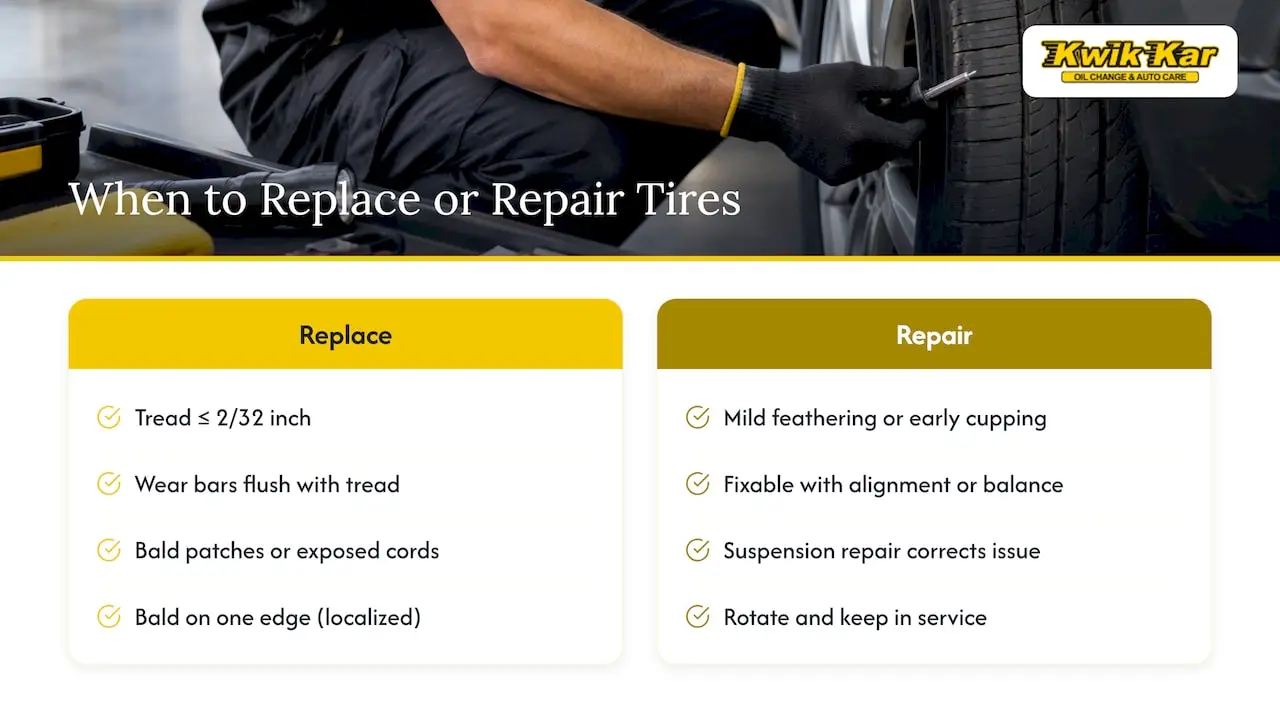
Tires should be replaced once tread depth reaches the legal minimum of 2/32 inch or less, the point at which traction and hydroplaning resistance drop sharply, according to NHTSA’s tire safety guidance. Wear bars becoming flush with the tread surface, or a penny test showing the top of Lincoln’s head, both confirm you’ve hit that threshold.
Uneven wear makes the math worse: a tire that’s bald on one edge can reach that danger point there long before the rest of the tread looks worn, which shortens braking distance and raises hydroplaning risk in wet weather. Mild feathering or early cupping caught quickly can often be corrected with an alignment, balance, or suspension repair, letting the tire be rotated and kept in service. Advanced wear, exposed wear bars, or bald patches usually mean replacement is the only safe option.
What a Professional Tire Diagnostic Looks Like
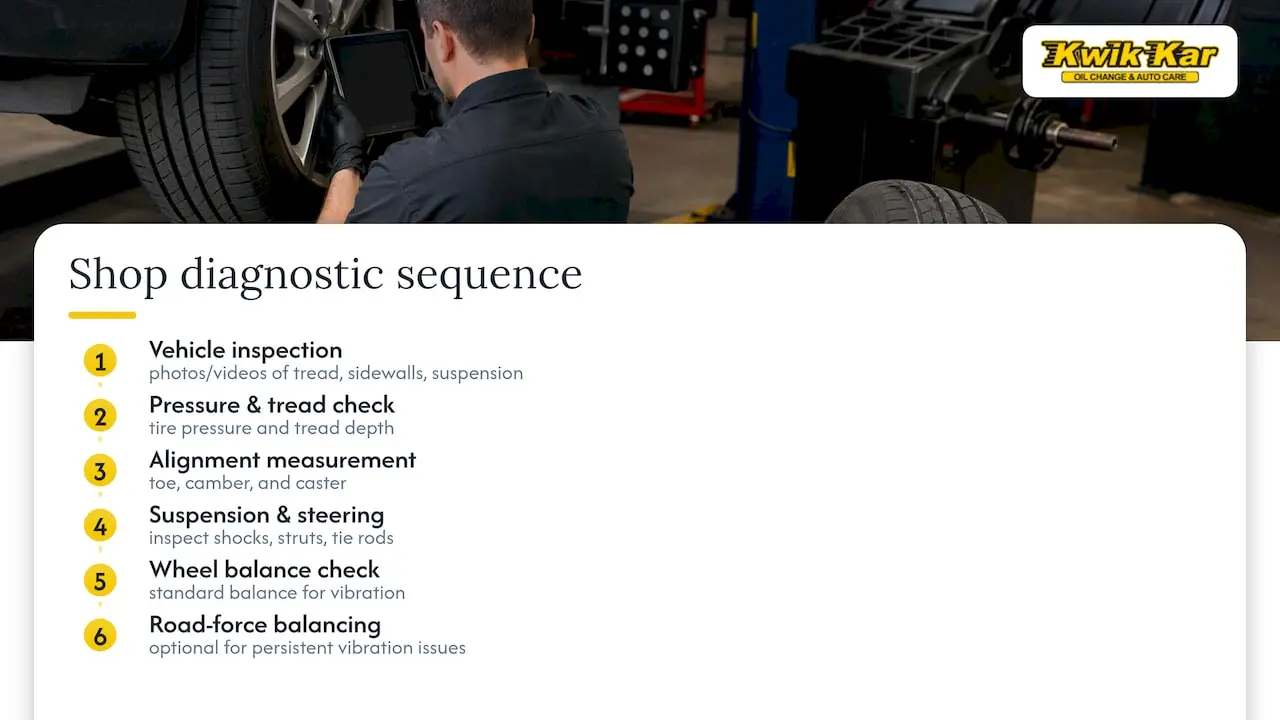
A thorough shop visit starts with a vehicle inspection process that often includes photos and video of your tread, sidewalls, and suspension components you can view to understand the technician’s findings. From there, the workflow typically includes a pressure and tread check, an alignment measurement covering toe, camber, and caster, a suspension and steering inspection for worn shocks, struts, or tie rods, and a balance check, with road-force balancing available for stubborn vibration issues. Our breakdown of road-force balancing covers when that extra step is worth requesting.
Before agreeing to repairs, ask for the before-and-after photos and the printed alignment specs. A shop with trained technicians should be able to explain the reasons for recommended repairs clearly.
Why We Measure Before We Recommend Anything
Uneven wear is rarely obvious from the driver’s seat until it’s already costly, which is why documented measurements are preferred over guesswork. Inspections often include photos and video through a digital vehicle inspection process, and technicians explain what the numbers mean before any work is recommended.
Get Your Tires Checked at Kwik Kar Irving
Catching uneven wear early is a lot cheaper than replacing a tire ahead of schedule. We offer full tire inspections, balancing, alignment checks, suspension repair, and rotations, with documentation to help you understand findings before any work begins.
If your car is pulling to one side, vibrating at speed, or showing uneven tread, schedule a diagnostic at our main service page and we’ll walk you through what we find. Already due for an oil change? We often check tires at the same visit, and new customers can save with our Ladies’ Day $25 off oil change coupon.
FAQ
Is it possible to fix uneven tire wear?
Mild uneven wear caught early can often be corrected by fixing the root cause, such as an alignment, balance, or suspension repair, then rotating the tire to even out remaining tread. Once a tire has advanced bald spots or exposed wear bars, replacement is the safer option rather than a repair.
How much does a tire alignment cost?
Alignment pricing varies by vehicle and shop, and no set national price applies. Contact a local shop for a quote based on your specific vehicle and what the inspection finds.
What is the 3% rule for tires?
The widely recognized standard is the 2/32 inch tread depth threshold for replacement, which you can check with a penny test or by watching for exposed wear bars, as outlined by NHTSA’s tire safety resources.
What are the symptoms of uneven tire pressure?
Uneven tire pressure often shows up as wear concentrated in the center of the tread, when a tire is overinflated, or along both edges, when it’s underinflated. You may also notice a softer ride, slightly reduced fuel economy, or a tire that looks visibly lower than its neighbors before a dashboard warning ever appears, since TPMS systems typically alert only once pressure drops significantly, per USTMA guidance.
Sources
- NHTSA — Tire Safety
- USTMA — Tire care essentials
- Effect of steering system compliance on steered axle tire wear (SAE)