Steering wheel vibration almost always traces back to your wheels, tires, brakes, or front-end suspension parts, and the fix depends entirely on when you feel it. Vibration that occurs solely or intensifies during braking is almost always related to the brake system, specifically the rotors. A vibration worst at a narrow highway-speed band is typically caused by wheel imbalance or certain tire defects. Whatever the trigger, note exactly when it happens and get the car inspected before the underlying part fails further.
TL;DR:
- Vibrations only during braking usually indicate warped brake rotors or uneven pad deposits, requiring immediate inspection for safe stopping.
- Vibration in a narrow highway speed range suggests wheel imbalance or tire defects, with road-force balancing often needed for out-of-round tires.
- Continuous vibration with humming noise typically points to a worn wheel bearing that a technician should check for play and roughness.
- Low-speed or bump-related vibrations often stem from suspension and steering component wear, such as tie rods, ball joints, or bushings.
- Accurate diagnosis hinges on noting the timing and specific conditions of the vibration, not just asking for tire balancing.
Table of Contents
- What Causes Steering Wheel Shake?
- Match the Timing to the Cause
- Safety Checks Before You Head to a Shop
- What a Shop Will Actually Test
- Why an ASE-Certified Inspection Makes a Difference
- The Diagnostic Mistake Most Drivers Make
- Schedule a Diagnostic Inspection in Irving
- Sources
- FAQ
What Causes Steering Wheel Shake?
Steering wheel vibration has a handful of usual suspects, and each one leaves a distinct fingerprint you can learn to recognize before you ever pull into a shop.
- Brake rotor judder. If the shake shows up only when you brake, and the pedal pulses along with it, you’re likely dealing with rotor thickness variation or uneven brake pad deposits baked onto the rotor surface, so consider these essential safety checks to run right now. This is almost always related to the brake system rather than the tires.
- Tire imbalance, flat spots, or belt separation. A rhythmic pulse at a specific highway speed that diminishes outside that range often indicates tire imbalance or a tire defect.
- Bent rim or wheel runout. An irregular vibration that remains after balancing typically means the wheel is not perfectly round, often due to impact damage.
- Worn wheel bearing. A continuous vibration with a humming noise that varies when cornering or shifting weight usually indicates a worn wheel bearing.
- Suspension or steering wear. Vibration at low speeds or over bumps, especially with a loose or vague feeling in the wheel, suggests worn tie rods, ball joints, or control-arm bushings.
- Engine or transmission mounts. A shake that’s strongest at idle and calms down when you shift into Neutral usually isn’t a wheel or steering issue at all.
Each of these causes has a different repair cost and urgency level, which is exactly why the next section matters as much as this one.
Match the Timing to the Cause
The moment you feel a vibration tells you more than almost anything else about what’s wrong, and where and when it happens can cut your diagnostic guesswork in half.
- Vibration only while braking. This points to the brake system, specifically the rotors and possibly the calipers. Treat this as higher urgency; braking performance and steering feel are directly connected to how safely you can stop.
- Vibration in a narrow highway-speed band, typically 55 to 75 mph. This usually means wheel imbalance or radial force variation in a tire. If a standard balance doesn’t resolve it, ask your shop about road-force balancing, which catches out-of-round tires that spin balancers miss.
- Continuous vibration at all speeds, often with a humming or whining sound. This pattern raises suspicion of a worn wheel bearing. A technician will check for play and roughness when the wheel is lifted off the ground.
- Vibration over bumps or at low speed, with looseness in the wheel. This points toward steering and suspension components like tie rods, ball joints, or bushings rather than anything wheel or tire related.
Car vibration issues rarely announce themselves clearly, but this kind of pattern matching gets you most of the way to an answer before a technician even puts the car on a lift.
Safety Checks Before You Head to a Shop
A few quick checks at home can tell you whether it’s safe to keep driving and will help your technician zero in on the problem faster.
- Walk around the car and look for visible tire damage, a bulge in the sidewall, or anything embedded in the tread.
- Check tire pressure on all four corners; a significantly underinflated tire can mimic imbalance symptoms.
- Note whether the vibration changes, gets better, or gets worse after a short drive of five or ten minutes.
- Write down the exact speed or driving condition where it starts, whether you recently hit a pothole or curb, and whether the vibration changes when you brake or swerve slightly.
Stop driving and arrange a tow instead of continuing if braking feels compromised, you smell burning, you see smoke, or the steering feels loose or unresponsive. None of those symptoms are worth risking a highway drive to a shop.
Pro Tip: Record a short video of the steering wheel shaking during a safe, low-speed drive, and try to capture any accompanying sound. Technicians can often narrow down the cause faster when they can see and hear the exact symptom instead of relying on your description alone.

What a Shop Will Actually Test
A proper diagnosis follows a sequence, not a guess. Most shops start with a road test to capture the exact speed band and brake behavior, then move to a lift inspection to check for bearing play and looseness in the suspension and steering components.
From there, the checks get more specific:
- Rotor inspection for thickness variation and pad material transfer, followed by a decision between resurfacing and full replacement.
- Wheel spin and runout measurement to see if a wheel or tire is physically out of round.
- Road-force balancing when a standard balance doesn’t resolve highway-speed vibration, since it simulates road load in a way spin balancers can’t.
- Common repairs after diagnosis include rebalancing, tire replacement, rim repair or replacement, rotor resurfacing or replacement, bearing replacement, and suspension or steering component replacement.
This sequence exists because guessing at parts wastes your money. A rotor swap won’t fix a bearing, and a new tire won’t fix a bent rim. The road test and lift inspection are what separate an educated repair from a lucky one.
Why an ASE-Certified Inspection Makes a Difference
Technicians at the shop are ASE-certified, and inspections include a Digital Vehicle Inspection with photos and videos sent to your phone. That means you see the worn bushing or the scored rotor yourself instead of taking someone’s word for it.
Several of our services address steering wheel vibration directly, including brake repair, suspension diagnostics, wheel-bearing inspection and replacement, and full engine diagnostics when the shake shows up at idle. Bring your symptom notes, any video you recorded, and your recent service history. That combination speeds up diagnosis considerably.
The Diagnostic Mistake Most Drivers Make
Most drivers treat steering wheel vibration as one problem with one fix, usually assuming it’s the tires and asking for a balance without mentioning when the shake actually happens. That’s backwards. The timing and location of the vibration is the diagnostic information that matters most, and skipping it is why some drivers pay for a balance, a rotation, even new tires, and the shake never goes away.
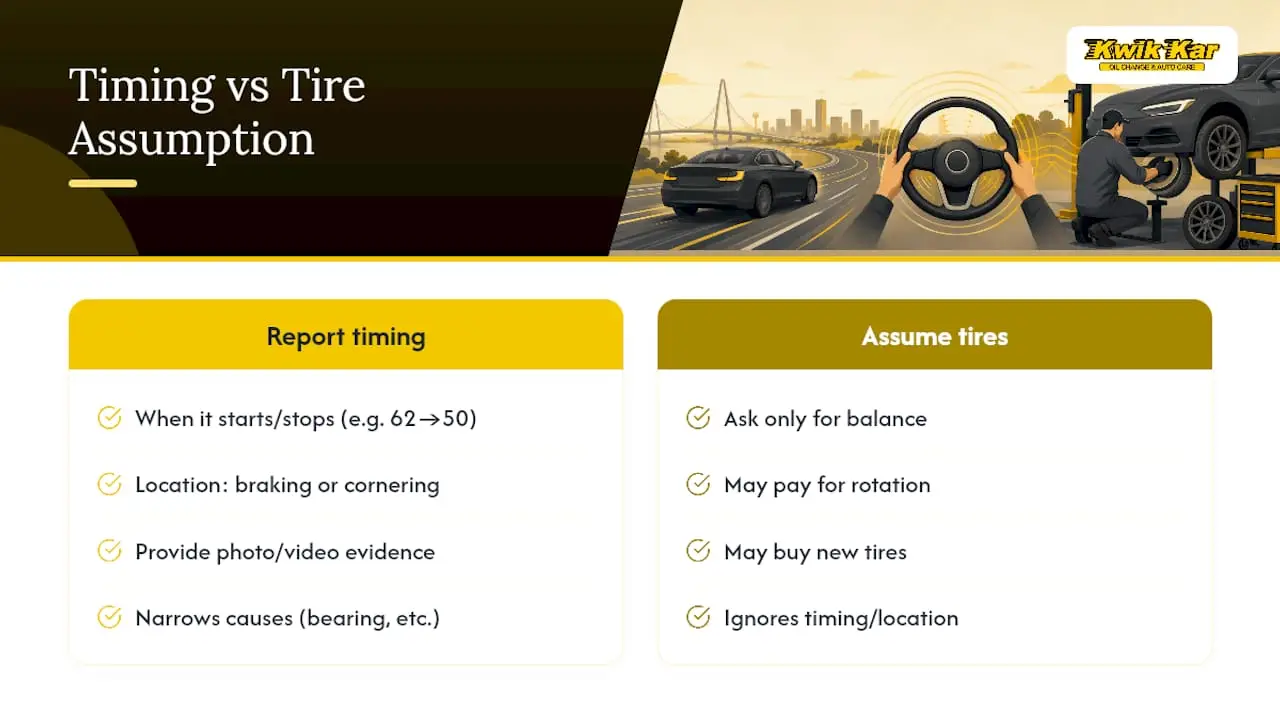
Conventional advice tends to jump straight to “get your tires balanced,” which is true often enough to sound right and wrong often enough to waste your money. A vibration that’s worst under braking has nothing to do with tire balance at all. A continuous hum that changes with cornering points to a bearing, not a wheel weight.
What actually works is treating your own observations as data. When you can tell a technician “it starts at 62 mph and goes away below 50” or “it only happens when I brake,” you’ve handed them a shortcut past half the diagnostic process. Pair that with photo and video evidence from a proper inspection, and you get a repair that’s targeted instead of a shot in the dark.
— Kwik Kar
Schedule a Diagnostic Inspection in Irving
Guesswork gets expensive fast when a vibration turns out to be a worn bearing instead of a simple tire issue. The shop runs a full road test, lift inspection, and targeted diagnostics on brakes, suspension, and wheel bearings, then provides a Digital Vehicle Inspection showing photos and video of findings before any work is approved.

Whether your steering wheel shakes under braking, hums at highway speed, or shudders over bumps, a local qualified team can pinpoint the cause and explain the repair options in plain language. If braking feels affected, don’t wait on it. Schedule a brake inspection with Kwik Kar Oil Change & Auto Care today and get a clear answer instead of another guess.
Sources
Claims on rotor judder and shop diagnostic sequence come from FCP Euro’s shake and vibration guide. Low-speed and suspension causes draw from Car Care Total. Highway-speed imbalance and road-force balancing details come from The Motor Guy, and safety guidance from RAC Drive.
- Diagnosing Steering Wheel Shake And Vibration
- Car vibrates at specific speed — causes & fixes
- Steering wheel vibrates at highway speed: causes, fixes, costs
FAQ
What would cause a steering wheel to vibrate?
The most common causes are tire imbalance, warped brake rotors, a bent wheel, a worn wheel bearing, or worn suspension and steering components like tie rods and ball joints. When and where you feel the vibration usually narrows it down quickly.
Why does my steering wheel vibrate at 70 mph?
Vibration in that highway-speed range typically points to a tire imbalance or wheel runout that a standard spin balance hasn’t fully corrected. If rebalancing doesn’t fix it, a road-force balance can catch an out-of-round tire that a regular balance missed.
Is it okay to drive if my steering wheel is shaking?
It depends on the cause and severity. A mild shake at one speed is usually safe to drive to a shop, but you should stop and arrange a tow if braking feels compromised, the steering feels loose, or you notice signs of failing suspension or worn wheel bearings.
How can I fix a vibrating steering wheel?
The fix depends entirely on the cause: rebalancing or replacing a tire, resurfacing or replacing a rotor, replacing a worn bearing, or repairing suspension and steering components. Kwik Kar Oil Change & Auto Care’s brake repair service includes a full inspection to confirm which repair actually applies to your vehicle.
What’s the difference between a standard balance and a road-force balance?
A standard spin balance only corrects weight distribution around the wheel, while a road-force balance also measures the tire’s rolling shape under simulated load. Ask about road-force balancing specifically if a regular balance hasn’t resolved your highway-speed vibration.