As of January 1, 2025, most passenger cars and light trucks in Texas no longer require a state safety inspection under House Bill 3297, but drivers in 17 emissions counties must still pass an annual emissions test before registering. This checklist walks through what to inspect, what to bring, and how to time your visit so your registration goes through without delay.
TL;DR:
- Emissions inspections are still required in 17 counties, with timing linked to your registration sticker month and recommended two to three weeks beforehand.
- Vehicle checks should include lights, brakes, tires, windshield, horn, seat belts, gas cap, and basic drivability, ideally completed before the inspection to avoid failures.
- Commercial vehicles remain fully exempt from the 2025 safety inspection change and need to maintain regular safety checks to remain compliant.
- Bringing proof of registration, insurance, and the Vehicle Inspection Report can prevent delays, with county offices accepting both online and paper VIRs.
- ASE-certified technicians and digital inspections help drivers identify issues early, especially in emissions counties, to prevent registration delays or failures.
Table of Contents
- Who the rule change affects and why checks still matter
- Which Texas counties still require emissions testing
- The system-by-system checklist to run before inspection
- What to bring and how inspections connect to registration
- What fleet managers still need to track
- How ASE-certified technicians and DVIs help you prepare
- Get your vehicle inspection-ready at Kwik Kar Irving
- Where to confirm the rules yourself
- Sources
- FAQ
Who the rule change affects and why checks still matter
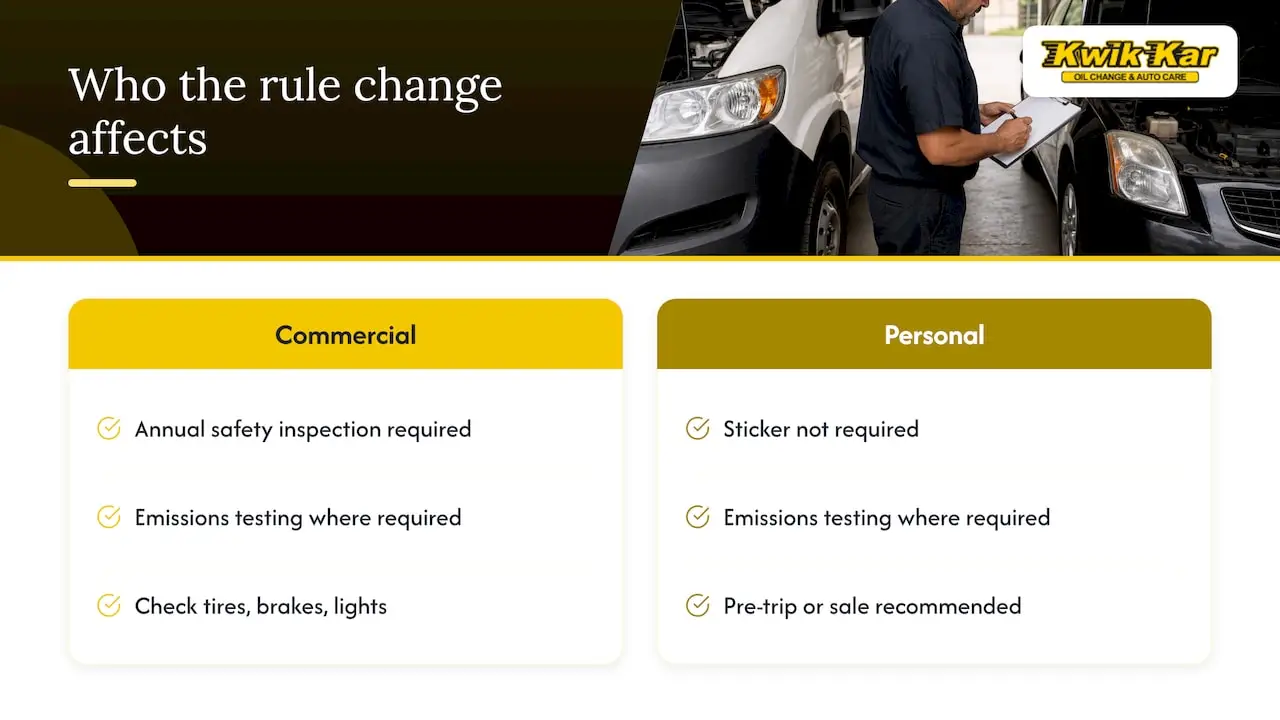
The safety inspection requirement went away for most non-commercial vehicles, but commercial vehicles are unaffected and still need a full annual safety inspection. If you drive a personal car, SUV, or light truck outside a covered commercial fleet, you are no longer required to get the old sticker based safety check.
That does not mean skipping every check is wise. Bald tires, weak brakes, and burned-out lights are still safety hazards, and many drivers choose a voluntary safety check before a long road trip or before selling a vehicle, since buyers and dealers often expect one. Texas DPS confirms the legal change, and TxDMV confirms that emissions testing remains a registration requirement in specific counties. You remain responsible for keeping your vehicle road-legal even without a mandatory sticker.
Which Texas counties still require emissions testing
Seventeen counties still require an annual emissions inspection before you can renew your registration: Brazoria, Collin, Dallas, Denton, El Paso, Ellis, Fort Bend, Galveston, Harris, Johnson, Kaufman, Montgomery, Parker, Rockwall, Tarrant, Travis, and Williamson.
Seventeen Texas counties still require emissions inspections for registration, according to Texas DPS. If you live in Dallas, Denton, Tarrant, or a neighboring county on that list, this step is not optional.
The inspection window is tied to your registration sticker month, not the calendar year. Getting tested a few weeks before your sticker expires gives you time to fix a check-engine light or failed emissions test without missing the renewal deadline. Before your visit, you can also check whether your inspection record has already posted:
- Look up your Vehicle Inspection Report at mytxcar.org before heading to the county tax office.
- If the record is not showing yet, bring a printed or electronic copy of the VIR as backup.
- Schedule the emissions test two to three weeks ahead of your sticker month to leave room for repairs.
The system-by-system checklist to run before inspection
Whether you are heading into an emissions test, a commercial inspection, or just want peace of mind, Texas DPS inspection criteria point to the same core systems mechanics check every time. Working through them in order takes most drivers under 20 minutes.
- Lights: Check every bulb, lens, and mount, including brake lights, turn signals, and the license plate lamp.
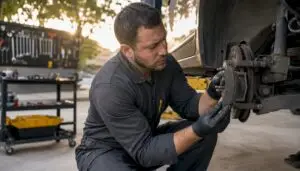
- Brakes and parking brake: Listen for grinding or squealing, check for fluid leaks, and confirm the parking brake holds on a slope.
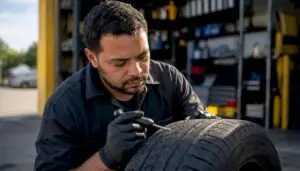
- Tires and wheels: Look for uneven tread wear, cracks, or visible damage, and confirm inflation matches the door-jamb sticker.
- Windshield and wipers: Make sure wipers clear the glass in a full sweep and that no chip or crack sits directly in the driver’s sightline.
- Horn and mirrors: Confirm the horn is audible from outside the car and that mirrors are secure, unbroken, and unobstructed.
- Seat belts: Every belt originally equipped on the vehicle should be present, buckling, and anchored correctly.
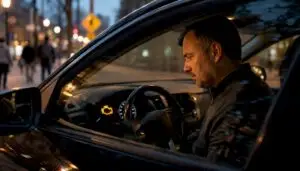
- Gas cap and check-engine light: A loose or cracked gas cap can trigger a code, and an illuminated check-engine light will need to be diagnosed and cleared before an emissions test.
- Window tint: Confirm your tint percentage and placement meet Texas limits so it does not become a rejection point.
- Basic drivability: A quick OBD-II scan can catch a pending emissions fault before it shows up as a failed test.
Pro Tip: Fix a check-engine light at least a week before your emissions test. Many emissions failures trace back to a code that had been sitting unresolved for months.
Brake dust buildup on wheels can also mask cracks or wear during a visual check, and drivers who want to clean components safely before an inspection can find safe brake dust removal guidance useful for getting a clear look at pad and rotor condition.
What to bring and how inspections connect to registration
Walking in prepared saves a second trip. Bring your registration renewal notice, current proof of liability insurance, and, if you already have one, a printed or electronic copy of your Vehicle Inspection Report.
- Registration renewal notice or current registration card.
- Proof of liability insurance valid for the vehicle being registered.
- A printed or downloaded VIR from mytxcar.org, if your inspection is already on file.
Registration fees and any applicable emissions-related fee lines are listed on the TxDMV registration and fees page, which also outlines how VIRs factor into renewal. If your inspection record has not posted online yet, most county tax offices will accept a paper or electronic VIR presented in person, so keep a copy handy rather than assuming the system will catch up automatically.
What fleet managers still need to track
Commercial vehicles were not part of the 2025 change. They still require a full annual safety inspection, and fleet managers who assume otherwise risk registration and compliance problems.
- Brakes, lighting, and wheel assemblies remain the most common commercial inspection fail points.
- Suspension components and exhaust systems are also frequent problem areas on older fleet vehicles.
- Keeping VIRs and maintenance records organized and accessible speeds up renewal and any compliance review.
Pro Tip: Build a pre-inspection maintenance pass into your fleet’s regular service schedule instead of reacting after a failed inspection. Digital Vehicle Inspection records with photos and technician notes give fleet managers a documented history to reference when a vehicle comes up for its annual check, which matters more for commercial units than personal vehicles.
How ASE-certified technicians and DVIs help you prepare
Technicians run through the same systems covered in the checklist above: lights, brakes, tires, belts, and emissions-related components. Inspections may include digital reports with photos, videos, and technician notes sent directly to your phone.
That documentation matters most in emissions counties, where a missed check-engine light or a worn belt can turn into a registration delay. Seeing the actual photo of a cracked hose or worn pad, rather than taking a verbal description, lets you decide what to fix now and what can wait. Catching a problem two weeks before your sticker month beats discovering it at the testing station.
— Kwik Kar
Get your vehicle inspection-ready at Kwik Kar Irving
Whether you need a pre-inspection check, help resolving a check-engine light before an emissions test, or a full brake and lighting review, Kwik Kar Oil Change & Auto Care in Irving handles it in one visit.
- ASE-certified technicians check the same systems Texas DPS lists for inspection.
- Digital Vehicle Inspections give you photos and notes before any repair decision.
- Same-day service helps you beat your registration sticker deadline.
If your check-engine light is on or your brakes need attention before your emissions test, schedule a brake inspection or explore state inspection and emissions support at Kwik Kar Irving. Call your local shop or book online today to get your vehicle ready before your sticker month arrives.
Where to confirm the rules yourself
- Texas DPS explains the 2025 rule change and the 17 emissions counties.
- TxDMV covers registration fees and the renewal process.
- Retrieve your Vehicle Inspection Report anytime at mytxcar.org.
Sources
- Vehicle safety inspection changes take effect January 2025 | Texas DPS
- Register your vehicle | TxDMV
FAQ
Do I still need a state inspection in Texas in 2026?
Most non-commercial cars and light trucks no longer need a safety inspection, a change that took effect January 1, 2025 under House Bill 3297. If you live in one of the 17 emissions counties, you still need an annual emissions inspection before renewing registration.
Which Texas counties still require emissions testing?
Seventeen counties require it: Brazoria, Collin, Dallas, Denton, El Paso, Ellis, Fort Bend, Galveston, Harris, Johnson, Kaufman, Montgomery, Parker, Rockwall, Tarrant, Travis, and Williamson, according to Texas DPS. Vehicles registered outside these counties do not need the emissions test.
What happens if my vehicle fails the emissions inspection?
The testing station will identify the failed component or code, and you will need to repair it and return for a retest. Scheduling your test two to three weeks before your sticker month, as recommended by TxDMV’s timing guidance, gives you room to diagnose and fix the issue without missing your renewal deadline.
Are commercial vehicles exempt from the 2025 change?
No. Commercial vehicles still require a full annual safety inspection covering brakes, lighting, wheel assemblies, suspension, and exhaust, unaffected by the 2025 personal-vehicle exemption. Fleet managers should keep this on their regular maintenance schedule.
Can Kwik Kar Irving help me prepare for an emissions inspection?
Yes, Kwik Kar Oil Change & Auto Care offers state inspection and emissions support along with diagnostic and repair services in Irving. Their ASE-certified technicians use Digital Vehicle Inspections with photos and notes so you can see and approve any needed repairs before your test.