No, most Texas drivers no longer need an annual safety inspection. House Bill 3297 eliminated the state safety inspection requirement for non-commercial vehicles starting January 1, 2025. You still have to pay something, and depending on where you live, you might still have to test.
Here’s the quick version of who does what now:
- Non-commercial vehicles: No more safety inspection. You pay a flat inspection program replacement fee instead.
- Emissions counties: If you’re registered in one of the designated counties, emissions testing is still required for most gas-powered vehicles.
- Commercial vehicles: Annual safety inspections are still mandatory, no exceptions.
The replacement fee is a modest annual charge for previously registered vehicles, and a slightly higher initial fee covering two years for new vehicles, according to DPS’s official announcement. Drivers in Bexar County will also see an $18.50 emissions fee once that county joins the program. Three agencies govern this system: the Texas Department of Public Safety (DPS), the Texas Department of Motor Vehicles (TxDMV), and the Texas Commission on Environmental Quality (TCEQ). If your records don’t sync properly at registration, mytxcar.org is where you go to pull proof.
Key Takeaways
Texas eliminated safety inspections for non-commercial vehicles on January 1, 2025, but emissions testing and commercial inspections still apply depending on your county and vehicle type.
| Point | Details |
|---|---|
| Safety inspections are gone | HB 3297 eliminated annual safety inspections for non-commercial vehicles starting January 1, 2025. |
| Replacement fee applies | Non-commercial owners now pay $7.50 annually, or $16.75 initially for new vehicles over two years. |
| Emissions testing continues | Affected counties still require testing for gas-powered vehicles 2 to 24 years old, with Bexar joining November 1, 2026. |
| Commercial vehicles are unchanged | Commercial vehicles still need annual safety inspections and skip the replacement fee. |
| Kwik Kar handles the maintenance side | Kwik Kar’s diagnostics and repair services in Irving help resolve check engine lights and safety issues before they cause a failed test or a roadside problem. |
Table of Contents
- What Changed: HB 3297, the Replacement Fee, and the Timeline
- Who Still Needs Inspections: Commercial Vehicles and Other Exceptions
- Which Texas Counties Still Require Emissions Testing?
- How to Prepare for Emissions Testing and Registration
- What Fees Should You Expect to Pay?
- What to Do If Your Inspection Record Doesn’t Show Up
- Kwik Kar Helps You Handle the Parts the State Still Requires
- Official Pages to Verify Rules and Find Inspection Stations
- Sources
- FAQ
What Changed: HB 3297, the Replacement Fee, and the Timeline
HB 3297 didn’t just tweak the inspection process. It removed the safety inspection requirement entirely for the vast majority of vehicles registered in Texas, effective January 1, 2025. That means no more checking your lights, tires, wipers, and horn at a certified station once a year just to get a sticker.
But the state still wanted a mechanism to fund the inspection program’s oversight and administration, so it replaced the physical inspection with a fee baked into registration.
- Previously registered non-commercial vehicles: $7.50 annually.
- New vehicles: $16.75 initial fee, covering two years.
- Fee is collected at registration, not at a separate inspection appointment.
TxDMV’s Registration and Title Bulletin #005-24 laid out the administrative side for county tax offices and dealers, including how the old Form VTR-270 got scrapped and how VIN certification now works during title transactions. If you bought a used car recently and noticed the paperwork felt different, that bulletin is why.
Who Still Needs Inspections: Commercial Vehicles and Other Exceptions
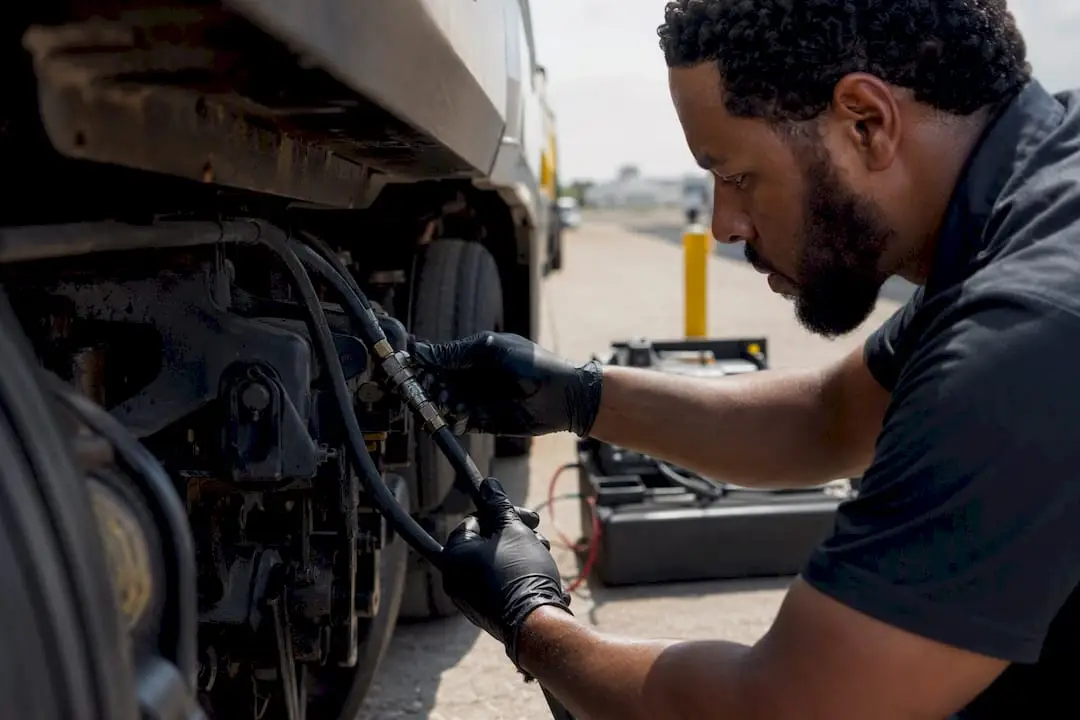
Commercial vehicles didn’t get the same break. Every commercial vehicle in Texas still needs an annual safety inspection, and commercial owners are exempt from the replacement fee since they’re already paying for the full inspection.
A few other situations still involve inspection paperwork even though the annual sticker system is gone:
- Rebuilt and salvage titles still require inspection-related documentation as part of the titling process, per TxDMV guidance.
- VIN certification during certain title transfers still applies, following the procedures outlined in RTB #005-24.
- Electric-only vehicles are exempt from emissions testing entirely, since there’s no combustion engine to measure.
If you drive a company truck, a delivery van, or anything registered under a commercial fleet designation, don’t assume HB 3297 applies to you the same way it does to a personal sedan. It doesn’t. Fleet managers especially need to keep their commercial inspection schedules intact, since falling behind on even one vehicle can complicate registration renewals across an entire fleet.
Which Texas Counties Still Require Emissions Testing?
Emissions testing survived HB 3297 completely intact. If you’re registered in one of the affected counties, you still need a passing emissions test before you can renew registration, regardless of the safety inspection change.
As of 2026, the counties in the program include Brazoria, Collin, Dallas, Denton, El Paso, Ellis, Fort Bend, Galveston, Harris, Johnson, Kaufman, Montgomery, Parker, Rockwall, Tarrant, Travis, and Williamson. Bexar County joins the program on November 1, 2026, according to TCEQ’s vehicle inspection and maintenance program page.
The rule applies to gasoline-powered vehicles between 2 and 24 years old. Diesel vehicles and vehicles older than 24 years are generally exempt, and electric vehicles never test at all.
| Test type | Common use case |
|---|---|
| OBDII | Standard test for most newer gasoline vehicles with onboard diagnostics |
| ASM-2 | Used for certain vehicle classes requiring a two-speed treadmill test |
| TSI (Two-Speed Idle) | Applied to older vehicles without OBDII capability |
If your vehicle fails, you get one free retest within 15 calendar days at the same station, per the state’s inspection program rules. After that window closes, you’ll pay for a fresh test.
How to Prepare for Emissions Testing and Registration
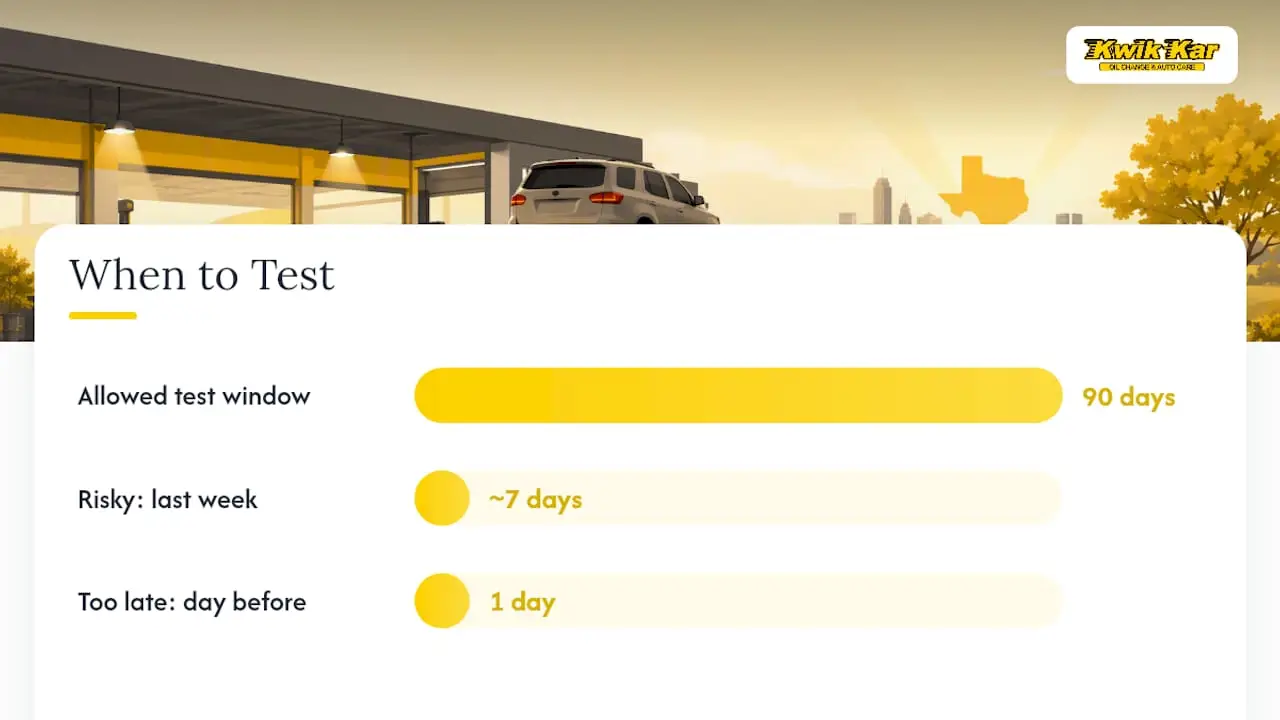
Emissions counties give you a window: you can test up to 90 days before your registration expires. Waiting until the last week is how people end up stuck without a valid registration sticker.
Here’s a simple sequence to follow:
- Check your registration renewal notice for the exact expiration date and county-specific requirements.
- Gather documents — proof of insurance, your renewal notice, a photo ID, and if needed, a printed Vehicle Inspection Report (VIR) or mytxcar.org printout.
- Run a quick vehicle check before your appointment: make sure the check engine light isn’t on, the gas cap is tight, and headlights/taillights work.
- Book the emissions test early in the 90-day window, so you have time for repairs if something fails.
- Plan for a possible retest — don’t schedule your test the day before your registration expires.
Pro Tip: A loose or cracked gas cap is one of the most common, and most avoidable, reasons for a failed emissions test. Check it before you drive to the station, not after you fail.
What Fees Should You Expect to Pay?
Two separate charges show up depending on where you live and what you drive. The inspection replacement fee applies statewide to non-commercial vehicles: $7.50 annually, or $16.75 for a new vehicle’s initial two-year registration period.
- Inspection replacement fee: charged at registration, statewide, non-commercial vehicles only.
- Emissions test fee: paid directly to the testing station, varies by county and provider.
- Bexar County’s published emissions fee is $18.50 once the program launches there in November 2026.
Commercial vehicles skip the replacement fee entirely since they’re still paying for full annual inspections. Your renewal notice from the county tax office will typically break out the inspection replacement fee as a line item, separate from your standard registration cost.
What to Do If Your Inspection Record Doesn’t Show Up
Most emissions results sync to the state system quickly, since certified stations maintain a direct data link to the vehicle identification database. Occasionally that link lags, and your record isn’t there when you go to register.
- Ask the testing station for a printed Vehicle Inspection Report (VIR) at the time of your test, just in case.
- Pull a printout from mytxcar.org if you didn’t get a physical VIR or misplaced it.
- Bring that printout to the county tax office or registration subcontractor. Acceptance can vary by office, so having the document on hand solves most delays on the spot.
- Contact the inspection station directly if the test genuinely failed to transmit, since they can resend the result.
- Escalate to TxDMV if the county tax office can’t resolve it and the station confirms the test was completed successfully.
Kwik Kar Helps You Handle the Parts the State Still Requires
Skipping the annual safety sticker doesn’t mean your brakes, lights, and check engine light stop mattering. DPS itself notes that driving with broken equipment can still be illegal, even without a formal inspection requiring you to catch it.
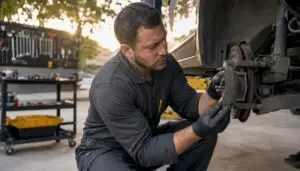
If you’re in an emissions county, a failed OBDII test almost always traces back to something fixable, like a check engine light tied to a sensor issue or a loose gas cap. Kwik Kar’s engine diagnostics service in Irving pinpoints exactly what triggered the code before you head to a testing station, so you’re not paying for a retest on something that could’ve been caught first. Our ASE-certified technicians also handle the safety-critical maintenance that still matters even without a state checklist forcing it, from brake repair to lights to tire condition, and every visit comes with a Digital Vehicle Inspection so you see photos and notes on your phone before agreeing to any repair.
Need an oil change while you’re at it? Check our current specials for $20 off, and get your car road-ready before your next registration deadline sneaks up on you.
Official Pages to Verify Rules and Find Inspection Stations
- Department of Public Safety: vehicle inspection news
- TxDMV: register your vehicle
- TCEQ: emissions testing program overview
- mytxcar.org for inspection and registration records
Sources
- Vehicle Safety Inspection Changes Take Effect January 2025 | Department of Public Safety
- Vehicle Inspection and Maintenance (I/M) Program – Texas Commission on Environmental Quality
- Register Your Vehicle | Texas Department of Motor Vehicles
- Registration and Title Bulletin #005-24 (TxDMV)
FAQ
Is a state inspection still required in Texas?
Not for most non-commercial vehicles. Safety inspections were eliminated statewide on January 1, 2025, though commercial vehicles and emissions testing in designated counties are still required.
What do I need for a vehicle inspection in Texas now?
If you’re in an emissions county, you need proof of insurance, your renewal notice, and a valid registration to get an emissions test at a certified station. Non-commercial owners outside emissions counties simply pay the inspection replacement fee at registration.
What are the new rules for inspections in Texas?
HB 3297 removed the annual safety inspection for non-commercial vehicles and replaced it with a $7.50 yearly fee, or $16.75 for new vehicles covering two years. Emissions testing and commercial vehicle inspections remain unchanged.
Do you still need a registration sticker in Texas?
Yes, registration stickers are still issued and required, but they’re no longer tied to a passed safety inspection for most non-commercial vehicles. In emissions counties, you still need a passing emissions test before the sticker is issued.
What happens if my emissions test doesn’t show up in the system?
Bring the printed Vehicle Inspection Report (VIR) or a mytxcar.org printout to your county tax office to complete registration while the record syncs.