If your brake pedal pulses or your steering wheel shakes when you brake, you likely have uneven rotor surface or thickness variation that needs inspection. The main warning signs are pedal pulsation, steering-wheel vibration, grinding or squealing noises, and longer stopping distances. A technician can confirm true warping with runout and thickness measurements. If any of these sound familiar, schedule a brake inspection before the problem gets worse.
TL;DR:
- Steering wheel shake often points to front rotors, while pedal pulsation without steering movement can indicate rear components; drivers may feel runout at 0.002 inches.
- Stop driving and seek immediate service for a sinking pedal, fluid leak, smoke, burning smell, or an ABS warning paired with reduced braking.
- Resurfacing works only when measurements remain within the rotor’s minimum thickness limit; otherwise, replace it, and inspect pads and rotors together to prevent recurring vibration.
- Combined pad and rotor replacement commonly costs $250 to $500 per axle in the United States, with vehicle and parts affecting the final bill.
- If shaking continues when you are not braking, check tires, wheels, or suspension first; rotor vibration is usually tied to braking.
Table of Contents
- How do warped rotor symptoms actually feel?
- Why do rotors warp or wear unevenly in the first place?
- How do technicians confirm a rotor is actually warped?
- When is it safe to keep driving, and when should you stop?
- What does a professional brake inspection actually check?
- Do front and rear rotors cause different symptoms?
- What owners get wrong about rotor symptoms
- Get your brakes checked with real proof, not guesswork
- FAQ
- Sources
How do warped rotor symptoms actually feel?
Rotor problems rarely announce themselves with one single symptom. They tend to build gradually, which is why so many drivers wait weeks before getting them checked.
Brake pedal pulsation is the most reported symptom. It feels like a rhythmic pulsing under your foot every time you press the brake, almost like the pedal is pushing back at a steady rhythm. Drivers typically notice it most between 30 and 70 mph, and it often happens on every stop rather than occasionally. Pedal pulsation and steering-wheel vibration are primary symptoms of uneven rotor surface or runout, and the sensation tends to get stronger with harder braking.
Steering wheel vibration usually points to the front rotors, since the wheel is mechanically linked to the front suspension and hub assembly. If the shake shows up in the wheel itself rather than just the pedal, front rotor runout is a likely cause. When the vibration shows up only in the pedal with a steady steering wheel, rear rotors or other rear brake components are more often the source. For a broader look at steering vibration causes beyond braking, our steering wheel vibration guide walks through speed-related patterns that point to tires or suspension instead.
Noises tell their own story. A high-pitched squeal typically means the pads have worn down to their built-in wear indicator and need replacing soon. Grinding is a different problem entirely: it usually means metal is already contacting the rotor surface, which can gouge and damage the rotor quickly. Our guide on brakes squeaking breaks down what each sound usually means and what to do about it.
Longer stopping distances and a spongy pedal are less obvious but just as important. A soft or sinking pedal combined with a longer stop than usual can indicate rotor damage severe enough to reduce braking surface contact, and it sometimes triggers an ABS warning light.
A few quick checks can help you narrow things down before a professional appointment:
- Does the vibration happen only when braking, or all the time while driving?
- Does it get worse at higher speeds or stay the same?
- Does it happen right away on a cold morning, or mainly after sustained hard braking?
Drivers can often feel pedal pulsation with runout as small as 0.002 inches, which explains why a rotor that looks fine to the eye can still cause a noticeable shake.
Why do rotors warp or wear unevenly in the first place?
“Warping” is the common word, but most of what drivers feel is actually uneven thickness or surface runout rather than a rotor bending out of shape. Several things contribute to it:
- Thermal stress from overheating, such as riding the brakes down a long grade or repeated hard stops in traffic, can unevenly harden or distort the rotor surface.
- Uneven pad contact from a sticking caliper, a seized slide pin, or contaminated pads applies pressure unevenly across the rotor face over time.
- Improper bedding-in after new pads or rotors, along with aggressive driving right after a brake job, can bake uneven material transfer onto the rotor before it has a chance to cure properly.
- Corrosion, scoring from worn-out pads, and manufacturing inconsistencies can all create localized high and low spots that show up as runout or thickness variation.
Resurfacing (machining the rotor surface flat again) can correct mild cases, but it only works within a safe margin of the rotor’s original thickness. Once a rotor is machined below its minimum thickness spec or shows severe thickness variation, replacement becomes the only safe option. Installing new pads on a worn or out-of-spec rotor tends to bring the vibration right back, which is why pad and rotor condition get checked together. For more on when pads alone need attention, see our brake pad replacement guide.
How do technicians confirm a rotor is actually warped?
Feeling a vibration is one thing, but confirming the cause takes measurement, not guesswork. Here’s the general process a shop follows:
- Visual inspection for scoring, heat spots, bluing, and uneven pad wear patterns that hint at where the problem started.
- Runout measurement using a dial indicator mounted against the rotor face while it spins, which captures how much the surface wobbles side to side.
- Thickness and thickness-variation checks with a micrometer at multiple points around the rotor, compared against the manufacturer’s minimum thickness spec.
- On-car lathe resurfacing, when the rotor has enough material left, versus a recommendation to replace when thickness variation or minimum thickness limits are exceeded.
- Wheel and tire checks, including road-force balancing, to rule out a tire or wheel issue mimicking rotor-related vibration.
Pro Tip: Ask for the actual runout and thickness numbers in thousandths of an inch, not just a “pass or fail” verdict. It helps you understand exactly why resurfacing or replacement is being recommended.
Runout and thickness variation require precision measurement, and some variation falls outside what a lathe can safely correct, which is why a shop may move straight to replacement rather than resurfacing.
When is it safe to keep driving, and when should you stop?
Some rotor symptoms call for an appointment this week. Others call for pulling over now.
Stop driving and call for service immediately if you notice:
- Severe grinding, visible smoke, or a burning smell coming from a wheel
- A brake pedal that sinks to the floor or loses normal resistance
- Visible brake fluid leaking near a wheel
- An ABS warning light paired with any loss of normal braking feel
Get same-day or next-day service if you have:
- Persistent pedal pulsation strong enough to affect how confidently you can stop
- Steering-wheel shake noticeable enough to affect your grip or lane control
Schedule service within the next few days if you have:
- Occasional, mild pulsation that comes and goes
- A faint squeal without grinding
- Minor visible scoring on a rotor with no other symptoms
Shops typically triage brake concerns the same way: anything involving a loss of stopping power or fluid loss gets seen immediately, while vibration-only complaints get scheduled as a diagnostic visit with runout and thickness checks.
What does a professional brake inspection actually check?
Technicians follow a structured process on every brake inspection: visual check for scoring and uneven wear, runout measurement with a dial indicator, and thickness checks with a micrometer against manufacturer specs. Nothing gets guessed at.
What sets the visit apart is what you see afterward. Inspections often include a Digital Vehicle Inspection: photos and short videos of your actual rotors and pads, paired with technician notes explaining what the numbers mean for your car specifically. You’re not told “your brakes need work,” you’re shown exactly where the scoring is and why resurfacing or replacement is the right call.
- Transparent, photo-backed diagnosis sent straight to your phone
- Pad and rotor replacement recommendations matched to your vehicle’s actual measurements
- Coupons and warranty terms available to help manage the cost of repair
Combined pad and rotor replacement commonly runs between $250 and $500 per axle in the U.S. market, depending on the vehicle and parts involved, which is a useful ballpark to keep in mind before your visit.
Do front and rear rotors cause different symptoms?
Front and rear rotors contribute differently to how a problem feels, mostly because of how braking force is distributed and how each axle connects to your steering.
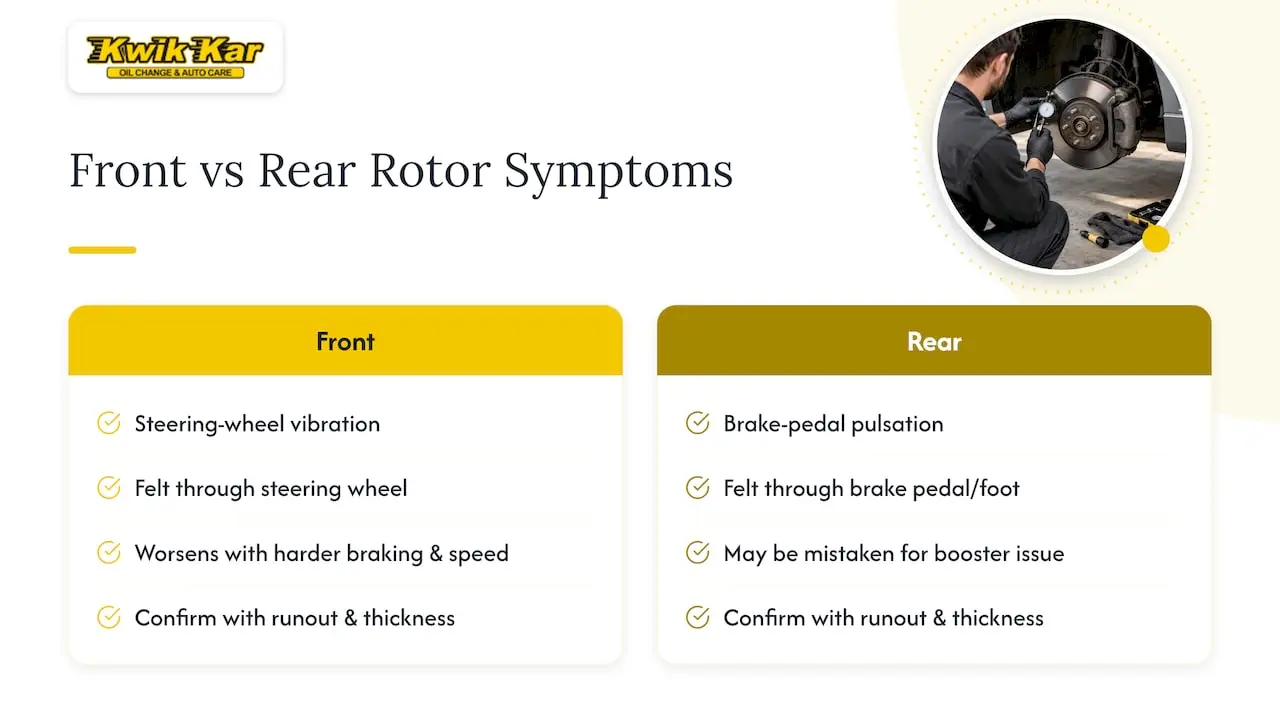
Front rotor issues almost always show up as steering-wheel vibration, since the front hubs are directly tied to the steering knuckle. The vibration often intensifies with harder braking and at higher speeds, because front rotors handle a larger share of stopping force on most vehicles.
Rear rotor problems are more likely to produce pedal pulsation without any steering-wheel movement, since the rear axle isn’t connected to the steering system. The pulsation can still be noticeable, but it’s felt through your foot rather than your hands. Rear-rotor symptoms are sometimes mistaken for a soft or failing brake booster, which is one more reason a measured inspection matters more than guessing based on feel alone.
Either way, the diagnostic steps are the same: runout and thickness measurement on the affected axle confirm where the real problem sits.
What owners get wrong about rotor symptoms
The most common mistake is ignoring an early squeal or faint pulsation because it isn’t severe yet. By the time grinding starts, pad material is gone and the rotor is often already scored. Another frequent error: pouring water on hot rotors to cool them faster, which can actually worsen warping from rapid, uneven cooling.
Practical advice: get a vibration or noise checked as soon as you notice it, keep a record of recent brake work, and follow bedding-in instructions after any pad or rotor service. A simple habit that catches problems early: glance at pad wear and listen for changes at every oil change.
Get your brakes checked with real proof, not guesswork
Some brake services are built around the idea: show you what’s happening, not just tell you. Certified technicians measure runout and thickness on every inspection, and Digital Vehicle Inspection sends you photos and video of your actual rotors so you can see the wear for yourself before approving any work.
- Technicians perform measured, not guessed, diagnoses
- Photo and video documentation sent directly to your phone
- Transparent pricing with available coupons on brake service
Our brake repair page has the full rundown of what’s included, and you can save on the repair with our brake replacement coupon. If the shake or pulsation is bothering you now, call or book online for a same-day inspection in Irving.
FAQ
Is it okay to drive with warped rotors?
Driving with mild, intermittent pulsation for a short time is generally low risk, but it can get worse and reduce braking performance over time. If you notice grinding, a sinking pedal, or an ABS light with the vibration, stop driving and get it inspected right away.
How much does it cost to fix a warped brake rotor?
Costs depend on whether resurfacing or full replacement is needed, along with the vehicle and parts involved. Combined brake pad and rotor replacement commonly runs between $250 and $500 per axle in the U.S. market, not including taxes or shop-specific labor differences.
Can you feel a warped rotor without braking?
Rotor-related vibration is almost always tied to the act of braking, since it comes from uneven contact between the pad and rotor surface. If you feel shaking or pulsing with your foot off the brake entirely, a tire, wheel, or suspension issue is a more likely cause.
Can rotors unwarp themselves?
No, rotor surface irregularities and thickness variation don’t correct themselves and tend to get worse with continued driving. A shop can measure the runout and thickness and determine whether resurfacing or replacement is the right fix.
Sources
- Brake rotor runout and thickness variation explained | Core Brake Parts
- How much does it cost to replace brake pads? | AAA Automotive