
Rotate your tires every 5,000 to 7,500 miles for most vehicles, or every other oil change if you’re on a 5,000 mile cycle. Electric vehicles, performance cars, and trucks that tow heavy loads often need rotation closer to the 3,000 to 5,000 mile mark because of extra torque and weight. Always check your owner’s manual first. It sometimes lists an interval built specifically for your car’s drivetrain and tire type.
TL;DR:
- Most vehicles benefit from tire rotations every 5,000 to 7,500 miles, but electric vehicles, performance cars, and trucks towing frequently may need rotation as early as 3,000 miles.
- Front-wheel-drive cars should typically rotate tires around the 5,000-mile mark due to uneven wear from steering and acceleration forces.
- Directional, staggered, or mismatched tires require special handling, with incorrect rotation risking damage and handling issues.
- Catching uneven wear early through visual checks, tread measurement, or vibration issues can prolong tire life and prevent safety problems.
- A professional inspection during rotation, including balancing, alignment, and condition checks, ensures proper wear patterns and safety.
Table of Contents
- Tire Rotation Interval Standards and Why They Exist
- Rotation Intervals by Drivetrain and Vehicle Type
- Special Tire Setups That Change the Rules
- Warning Signs Your Tires Need Rotation Now
- Common Rotation Patterns Explained
- First Rotation Timing and Rotation Best Practices
- Why ASE-Certified Technicians and Digital Inspections Matter
- What Most Drivers Get Wrong About Tire Rotation
- Sources
- FAQ
Tire Rotation Interval Standards and Why They Exist
Most tire manufacturers and safety authorities land in the same neighborhood: every 5,000 to 7,500 miles, with some guidance stretching to 5,000 to 8,000 miles. The National Highway Traffic Safety Administration recommends rotating every 5,000 to 8,000 miles when your vehicle’s manual doesn’t specify a number, and sooner if you spot uneven wear. Michelin’s own guidance lands in a similar range, suggesting every 5,000 to 7,000 miles or roughly every six months.
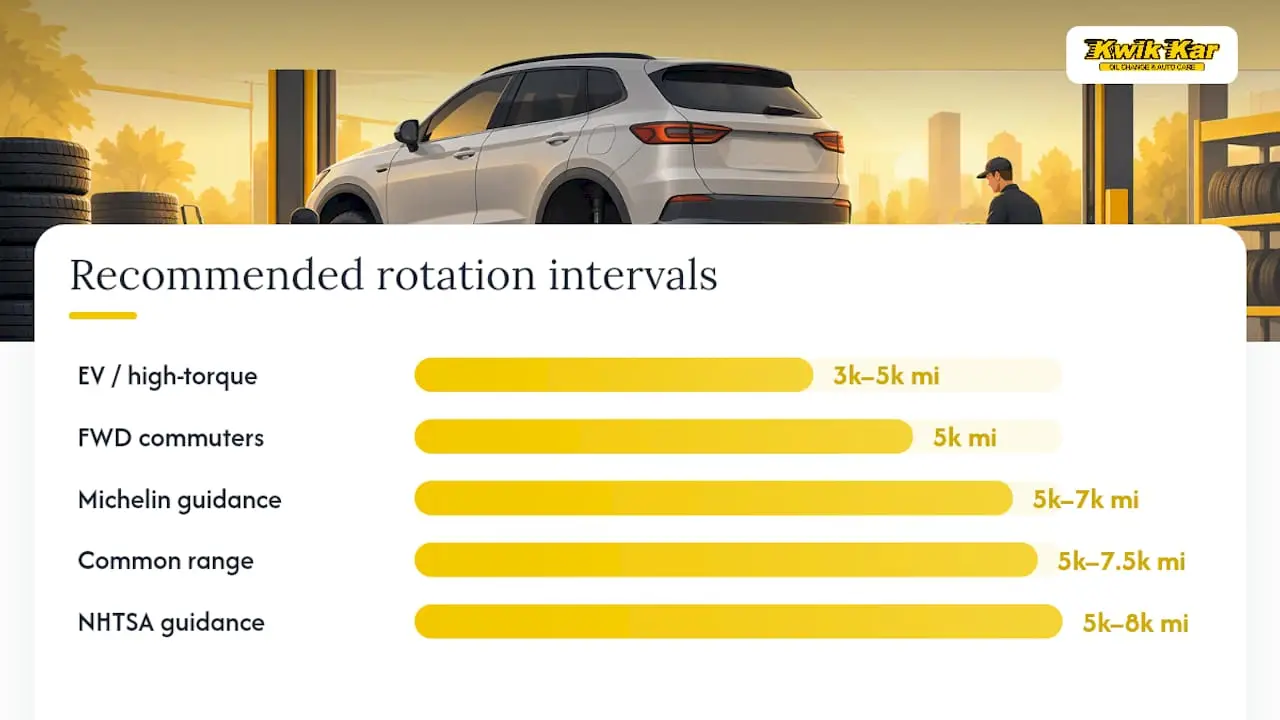
That range isn’t arbitrary. Front tires wear differently than rear tires because they handle steering, braking, and (on front-wheel-drive cars) most of the acceleration force. Rotating swaps that wear pattern around so all four tires age at roughly the same rate, which stretches the life of the full set.
The easiest way to remember your schedule is to tie it to your oil change. If you’re getting oil changed every 5,000 miles, rotate at every visit. If your oil interval runs longer, rotate every other visit. Consumer Reports backs this pairing as a practical way to stay consistent without tracking a separate calendar.
| Interval | Best fit |
|---|---|
| 5,000 miles | Front-wheel-drive daily drivers, city commuters |
| 5,000 to 7,500 miles | Most sedans, SUVs, and light trucks |
| 3,000 to 5,000 miles | EVs, high-torque performance cars |
Skipping rotations doesn’t just shorten tread life. Many tire warranties require documented rotation at manufacturer-specified intervals, and a gap in that record can void a claim if you need it later.
Rotation Intervals by Drivetrain and Vehicle Type
Your drivetrain changes how fast your tires wear unevenly, and that should shape where in the standard range you land.
- Front-wheel drive: Front tires carry steering and most of the acceleration load, so they wear faster than the rear. Stick to the lower end, around 5,000 miles.
- Rear-wheel drive: Wear is more balanced front to rear, so the standard 5,000 to 7,500 mile window works well without adjustment.
- All-wheel drive and 4×4: Power shifts between axles, which can create uneven wear patterns that are harder to spot early. Rotate at the lower end of the range and have a technician check for wear differences between axles.
- Light trucks and SUVs that tow: Heavy towing or frequent hauling accelerates wear on the tires bearing the most load. Shorten your interval when you tow regularly.
- Performance and sport cars: Wider, softer tires and aggressive driving wear faster. Rotate every 3,000 to 5,000 miles if you drive hard or track the car occasionally.
If you drive mostly highway miles at steady speeds, the standard range holds up fine. If your routine includes a lot of stop-and-go city driving, sharp cornering, or unpaved roads, move toward the shorter end of whatever range fits your drivetrain.
Special Tire Setups That Change the Rules
Not every tire and vehicle combination follows the standard rotation playbook. A few setups need different handling entirely, and getting it wrong can actually hurt performance instead of helping.
- Directional tires: These have a one-way tread pattern designed to move water in a specific direction, so they can only move front to back on the same side, never side to side. Swapping them incorrectly can hurt wet-weather grip and increase road noise.
- Staggered and asymmetrical setups: Cars with different-sized tires front and rear (common on many sports cars) often can’t be rotated at all without dismounting and remounting tires on different wheels, which adds cost and time.
- Full-size spares: If your vehicle came with a full-size spare rated for road use, include it in the rotation pattern so all five tires wear evenly over the life of the set.
- Mismatched tire sizes: Never rotate tires of different sizes between axles designed for different diameters. Doing so can throw off speedometer readings and stress the drivetrain.
- Electric vehicles: EVs are heavier than comparable gas cars and deliver instant torque, which accelerates tread wear and pushes some manufacturers to recommend rotation as often as every 3,000 to 5,000 miles. Check your EV’s specific manual rather than assuming the standard range applies.
When in doubt on any of these setups, Michelin’s guidance is blunt about the risk: rotating directional or staggered tires incorrectly can cause handling problems and accelerated wear that’s expensive to undo.
Warning Signs Your Tires Need Rotation Now
Uneven wear doesn’t wait for your next scheduled appointment, and catching it early saves you money.
- Look at the tread pattern. Wear concentrated on the inside or outside edge often points to an alignment issue as much as a rotation gap. Cupping (scalloped dips around the tread) or feathering (one edge sharper than the other) both signal it’s time for a closer look.
- Measure tread depth. Use a tread depth gauge, or place a penny head-down in the groove. If you can see all of Lincoln’s head, tread is worn below the safe threshold and needs attention.
- Notice vibration or pulling. A vibration that builds with speed usually points to a balance issue, and a car that pulls to one side often means an alignment problem. Either one should get checked before you rotate, since rotating won’t fix the underlying cause.
Pro Tip: Check tread depth at every fuel fill-up during summer road trip season. Heat and highway speed accelerate wear faster than most drivers expect, and catching a thin spot early beats a blowout on I-635.
Common Rotation Patterns Explained
Technicians choose a rotation pattern based on your drivetrain and whether your tires are directional.
- Rearward cross: Rear tires move straight forward, and front tires move to the rear on the opposite side. This pattern is typical for rear-wheel-drive and 4WD vehicles with non-directional tires.
- Forward cross: The reverse setup, often used on front-wheel-drive vehicles with non-directional tires.
- X-pattern: All four tires cross diagonally. This works well on vehicles with similar-sized tires front and rear and no directional restriction.
- Front-to-back: Tires stay on the same side and simply swap front and rear. This is the go-to pattern for directional tires, since it never crosses a tire to the opposite side.
- Side-to-side: Rarely used alone, this typically applies only to non-directional tires on specific staggered setups where wheel sizes match.
A technician who knows your tire’s construction will pick the right pattern automatically. AAA notes that getting this wrong on directional or staggered setups sometimes means the tires need to be dismounted and remounted rather than simply swapped in place, which is not something to guess at in a driveway.
First Rotation Timing and Rotation Best Practices
Your very first rotation matters more than people realize. Skip it or push it too far past the recommended mileage, and uneven wear patterns can set in before you ever get to the shop. The US tire industry’s own maintenance guidance treats that first rotation as the single most important one in the tire’s life, since wear that develops early tends to persist even after later rotations.
A few steps make every rotation count:
- Set tire pressure to the number on your vehicle’s door-jamb placard, not the number printed on the tire sidewall.
- Torque lug nuts to the manufacturer’s spec after remounting, not just by feel.
- Record tread depth, date, and mileage at every rotation so you can track wear trends over time.
- Pair the rotation with an alignment or balance check whenever you notice vibration, pulling, or uneven wear that suggests your wheels need attention.
These small steps take a few extra minutes and catch developing problems before they turn into a bigger repair bill.
Why ASE-Certified Technicians and Digital Inspections Matter
A rotation done right involves more than swapping four tires. A trained eye catches problems a rotation alone won’t fix.
- Tread-depth measurements at all four corners flag uneven wear before it becomes a safety issue.
- Inflation checks against the manufacturer’s placard, not guesswork.
- Torque verification on lug nuts to prevent wheels from loosening over time.
- Wheel and suspension condition checks, since a vibration that feels like a rotation problem is sometimes a balancing issue instead.
At Kwik Kar Oil Change & Auto Care, ASE-certified technicians pair every inspection with a Digital Vehicle Inspection, sending photos, video, and written notes straight to your phone so you can see exactly what they found. If wear patterns point to an alignment problem or a tire that’s beyond safe tread depth, you’ll see it in the photos and get an honest recommendation, not just a guess.
What Most Drivers Get Wrong About Tire Rotation
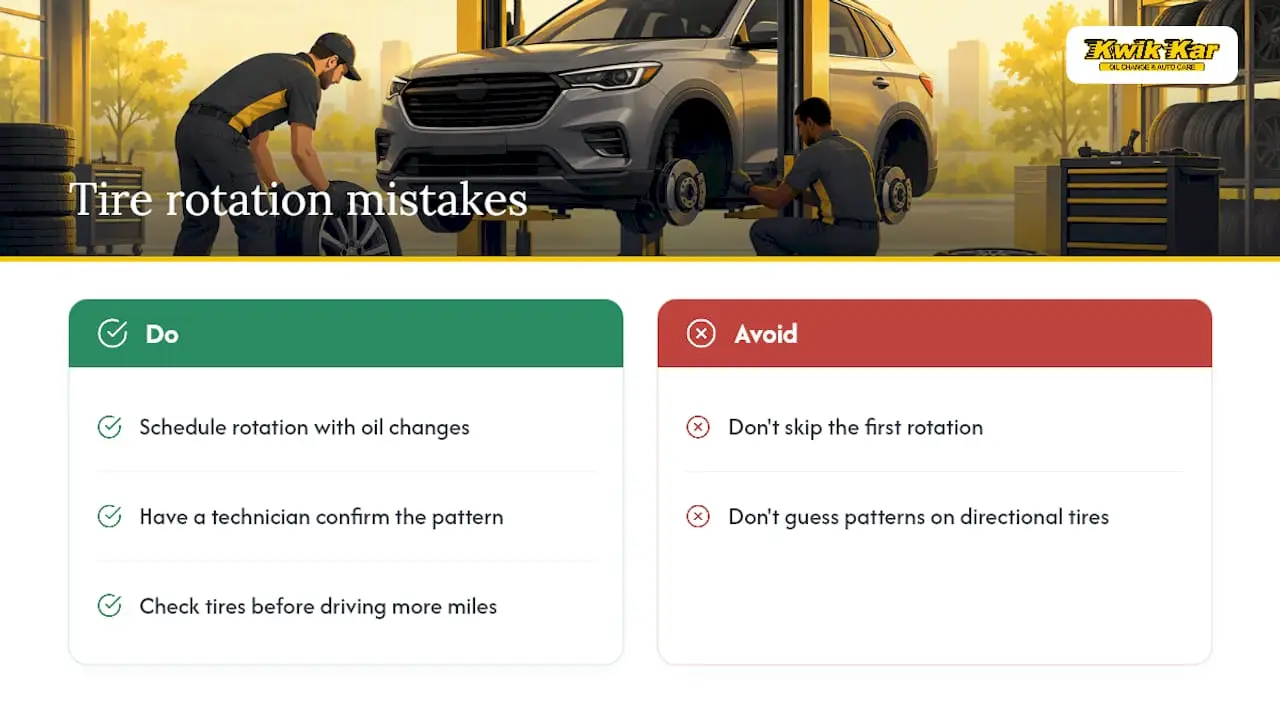
The most common mistake we see isn’t skipping every rotation. It’s skipping the first one. Owners assume rotation matters more later in a tire’s life, when the opposite is true: wear patterns set early and stick around.
The second mistake is trying to guess a rotation pattern on directional or staggered tires without checking. Both risks disappear when you tie rotation to something you already schedule, like your oil change, and let a technician confirm the right pattern for your specific tires. When in doubt, get a professional set of eyes on it before you drive another few thousand miles.
— Kwik Kar
Sources
- Tire safety and maintenance | NHTSA
- Tire Rotation: Why It Matters and How to Do It | Michelin
- Care and service of passenger and light truck tires (USTires brochure)
FAQ
Do I Really Need to Rotate My Tires Every 5,000 Miles?
Not always. Rotating every 5,000 miles is a solid baseline, especially for front-wheel-drive vehicles, but many vehicles do fine on a 5,000 to 7,500-mile range. Check your owner’s manual for the interval built for your specific drivetrain.
Is It Okay to Rotate Tires Every 7,500 Miles?
Yes, for most sedans, SUVs, and light trucks, 7,500 miles sits comfortably within the industry-standard range. Rear-wheel-drive vehicles with balanced wear patterns handle this interval well without issue.
Can I Rotate Tires Every 10,000 Miles?
Stretching beyond 5,000 to 8,000 miles goes beyond what most manufacturers and safety authorities recommend. The NHTSA points to 5,000 to 8,000 miles as the outer limit when no specific interval is listed, and waiting longer risks uneven wear that’s hard to reverse.
Can You Rotate Tires Every 3,000 Miles?
Yes, and for some vehicles it’s the right call. EVs and high-torque performance cars often wear tires faster due to instant torque and added weight, so a shorter 3,000 to 5,000 mile interval is common guidance for those vehicles specifically.
What Happens if I Never Rotate My Tires?
Skipping rotation entirely leads to uneven wear concentrated on whichever tires carry the most load, usually the front pair on front-wheel-drive cars, so it’s important to follow vehicle-care best practices to keep your tires and paint in top condition. That uneven wear shortens tread life, can void warranty coverage, and may eventually affect handling and wet-weather grip.
How Do I Know if My Car Needs an Alignment Instead of a Rotation?
Vibration that builds with speed or a car that pulls to one side while driving straight usually points to an alignment or balance issue rather than a rotation gap. Get it checked before rotating, since the underlying problem will just keep wearing the new tire positions unevenly.
If you’re due for a rotation or noticing uneven wear, book a visit with Kwik Kar Oil Change & Auto Care in Irving. Pair it with your next oil change or schedule a full vehicle inspection and let our ASE-certified technicians send you a Digital Vehicle Inspection with photos and notes so you know exactly what your car needs next.