
A rough idle is a symptom, not a diagnosis. The shaking, stumbling or bobbing RPM you feel at a stop light can come from ignition, air, fuel, sensors, engine mounts or worn internal parts, and the fastest way to find which one is to test one system at a time instead of replacing parts and hoping. This guide walks through how a technician does that, what you can safely check yourself, and what it means when the check engine light stays off.
We’re Kwik Kar Oil Change & Auto Care at 2100 Carl Rd in Irving, TX, and rough idle is one of the most common complaints we hear from drivers in Irving, Las Colinas, Grand Prairie, Euless and Coppell. Most of what follows is how we think about it at the bench.
TL;DR
- A rough idle is an engine running unevenly at a stop: shaking, RPM that bobs, or a stumble that sometimes ends in a stall.
- Diagnosis works one branch at a time: ignition, air and vacuum, fuel, sensors and throttle, then mechanical condition and mounts.
- No trouble codes does not mean no problem. It means the diagnosis starts with inspection and live data instead of a code lookup.
- A suspected fuel leak, flashing check engine light or overheating means stop driving and get the vehicle inspected.
- Reproduce the exact conditions (cold, warm, in gear, at a stop) and tell your technician. It shortens diagnosis.
Table of Contents
- What does a rough idle feel like?
- What causes a rough idle?
- How do technicians diagnose a rough idle?
- Why does my car idle rough at a stop but smooth while driving?
- Why does it idle rough when warm, or in gear?
- What if there are no trouble codes?
- How can you tell which system is at fault?
- What can you safely check yourself?
- When should you stop driving?
- Do emissions rules in Irving affect a rough idle repair?
- Our perspective: diagnose first, then replace
- Get your rough idle diagnosed in Irving
- FAQ
- Sources
What does a rough idle feel like?
A rough idle is when the engine runs unevenly or vibrates noticeably while stopped. RPM may bob up and down, and the engine may hesitate or even stall when you press the accelerator. Drivers describe it in different ways:
- A shudder through the steering wheel or seat while stopped at a light.
- A lopey or lumpy sound, as if one cylinder is skipping a beat.
- A low idle that hunts up and down.
- A vibration only in Drive that fades in Park or Neutral.
Those descriptions matter. General Motors uses nearly the same language in a service bulletin for certain Silverado and Sierra trucks, noting that rough idle may show up when the engine is warm or in Drive and can feel like a stumble or a lopey, lumpy or low idle. When you tell a technician exactly what you feel and when, you are giving them the first test.
What causes a rough idle?
Most causes fall into five groups. For a broader list of what makes an engine shake at a stop, see our rough idle causes guide. Here is how the groups differ.
| System | What goes wrong | Typical clues |
|---|---|---|
| Ignition | Worn spark plugs, bad plug wires, failing coils | Misfire, hesitation under load, often a flashing check engine light when severe |
| Air and vacuum | Cracked hoses, intake leaks, stuck EGR, PCV or idle air control valves, dirty throttle body | RPM hunts or idles high, hissing sound, changes when you rev |
| Fuel | Clogged or weak injectors, low fuel pressure | Worse when cold or under load, hard starts |
| Sensors | Faulty airflow, temperature or other sensors feeding the computer wrong data | Idle that wanders, poor fuel economy, sometimes codes |
| Mechanical | Low compression, worn valve train, worn engine or transmission mounts | Persistent roughness unaffected by tune-up items, or vibration that is felt but not heard |
Ignition problems include damaged or incorrectly installed spark plugs, plug wires and faulty ignition coils, while air-side causes include vacuum leaks and faulty airflow or temperature sensors, plus valves such as the EGR, PCV and idle air control. The same bulletin that describes a rough idle on GM trucks lists misfire or base-engine concerns, incorrect fuel, idle-speed fluctuation and engine-mount preload as possibilities. In other words, even the manufacturer does not point to one part.
How do technicians diagnose a rough idle?
The method is simple even when the fault is not. A good diagnosis follows this order.
1. Confirm the complaint is a fault
The first step is to verify the concern and decide whether it is a malfunction or normal operation. ASE’s advanced engine performance study guide tells technicians to verify the customer concern first for exactly that reason. Some vehicles idle with a mild, normal vibration, especially after a cold start. Our technicians are ASE-certified, and this is where that training starts: a test drive and a conversation before any parts are discussed.
2. Reproduce the conditions
If the roughness only happens warm, at a stop, or in gear, the technician needs to recreate that. For intermittent faults, the standard approach is to reproduce the exact condition, and if the shop cannot, use a road test with a data logger or recording scope to catch the event. This is why “it happens sometimes” is the hardest complaint to solve, and why notes matter. Write down:
- Cold start, warm, or after a long drive?
- In Park, Neutral or Drive?
- With the A/C on or off?
- Any check engine light, flashing or steady?
- Any recent fuel stop, repair or battery work?
3. Check codes, then look past them
A scan tool reads stored and pending codes and shows live data such as fuel trims and misfire counters. Codes point to a system, not a part. A P0300-type misfire code, for example, says the engine is misfiring, not why. We explain how to read one in our article on diagnosing P0300 with live scan counters. GM’s own procedure for covered trucks follows this logic: check codes and warning lights, monitor fuel trims and misfires, then measure the vibration itself with a specialized analyzer.
4. Test one branch at a time
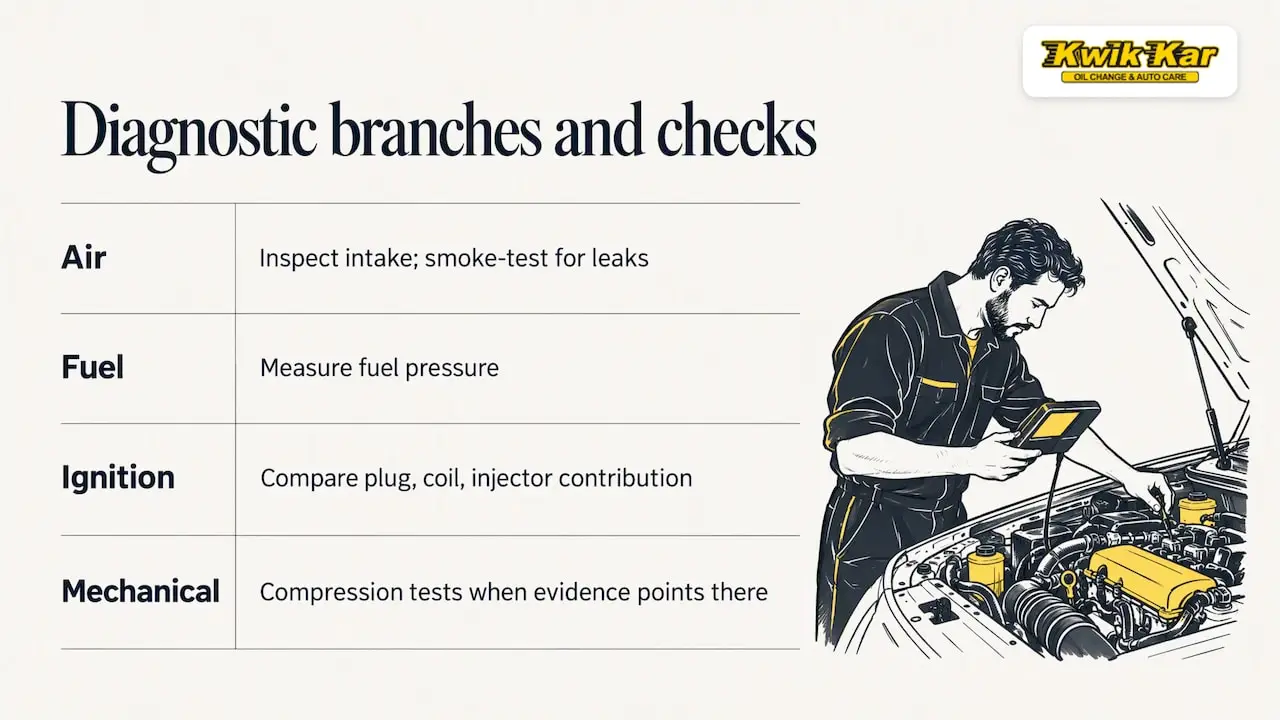
The most reliable workflow separates air, fuel, ignition and mechanical condition: inspect the intake and smoke-test for leaks, compare how plugs, coils and injectors contribute, measure fuel pressure, and run compression or related tests when the evidence points that way. Changing several things at once makes it impossible to know what fixed the problem, and it is how drivers end up paying for parts they did not need.
5. Confirm with measurement
Scan data can lie when a sensor is wrong, so ASE’s guidance asks technicians to differentiate electronic from mechanical problems and confirm scan data by directly measuring components. A fuel trim number is a clue. A measured vacuum, pressure or waveform is proof.
Why does my car idle rough at a stop but smooth while driving?
At idle the engine makes very little power, so every small imbalance is exposed. Under load and at higher RPM, a weak cylinder or a small air leak is masked. That is why many drivers notice the problem only at a red light, in a drive-through or in Irving rush-hour traffic on Highway 183 or Belt Line Road.
Three causes show up often in this pattern:
- Small vacuum leaks. A leak that is minor at 2,500 RPM becomes a large share of the air at 700 RPM.
- Dirty throttle body or idle air passages. Airflow at idle is tiny, so a little carbon changes it. Our article on throttle body cleaning covers the symptoms.
- Worn mounts. The engine is not necessarily running worse. The mounts simply stop absorbing normal vibration. Worn engine or transmission mounts can pass normal engine vibration into the cabin, so drivers mistake it for an engine problem. If the shake is worst when you shift from Park into Drive, see our transmission mount symptoms checklist.
Why does it idle rough when warm, or in gear?
Heat changes how parts behave. Coils and sensors that work when cold can fail as they heat up, fuel injectors can drip or lean out, and a vacuum hose that has hardened with age may crack when it expands. In Texas summers, underhood temperatures add to that.
In gear, the engine carries the load of the transmission and torque converter, and the mounts are under tension. GM’s bulletin for covered trucks specifically addresses a condition that appears warm and in Drive, and its procedure includes telling normal idle vibration apart from unacceptable vibration at the seat track before any mount work. Not every vehicle uses that tool, but the principle is general: measure instead of guessing.
If your car shakes in gear but smooths out in Park, mounts and transmission-related causes rise on the list. If the shake is the same in every gear, it points back to the engine itself: ignition, fuel or air.
What if there are no trouble codes?
This is the case drivers find most frustrating, and it is common. The computer only sets a code when a value crosses a threshold. A small vacuum leak, a weak coil that works most of the time or a sticky throttle can all run below it.
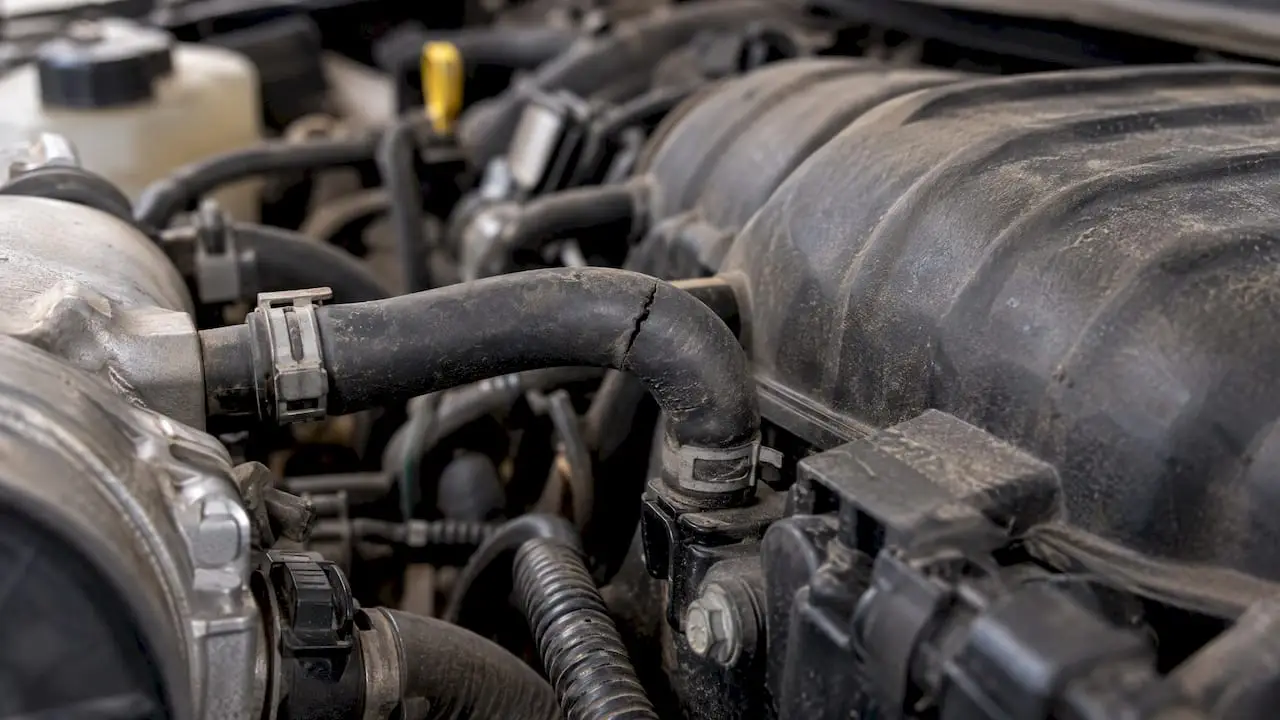
The approach changes. For no-code complaints, the usual guidance is to reproduce the symptom, then inspect for vacuum leaks, damaged wiring or connectors, bad grounds, low fluids and a dirty air filter before collecting live data. Plenty of faults, such as a cracked vacuum hose, can be found by looking, no scan tool required.
Official service procedures take the same view. Ford’s OBD diagnostic guidance sends technicians with a rough idle and no codes to a symptom chart rather than a code chart, and GM’s procedure for certain models says that if the flowchart does not isolate the concern, check injector balance rates with the engine cold and investigate possible coolant entry. When nothing obvious turns up, deeper tests such as a smoke test or injector balance test can find what a visual check misses.
If you are comparing the early checks for a no-code idle complaint on an import or European model, this overview of preventive maintenance for imported cars is a useful starting point for what to look at before the problem grows.
A short no-code checklist
- Inspect vacuum hoses and the air intake boot for cracks, loose clamps and oil soaking.
- Check the air filter and look for loose or corroded connectors and ground straps.
- Check fluid levels, since low levels can add to other problems.
- Look at spark plug and coil condition and service history.
- Listen for a hiss at idle, then watch whether RPM changes when you disturb a hose or connector.
- Collect live data (fuel trims, misfire counts) and compare with the symptoms.
- Move to smoke testing, injector balance and compression testing if the simple checks come up clean.
How can you tell which system is at fault?
These patterns help narrow the field before any parts are touched. They are guides, not guarantees, since several faults can overlap.
- Misfire on one cylinder only: points to a plug, coil, injector or a mechanical problem in that cylinder. Swapping a coil to another cylinder and seeing whether the misfire follows is a classic test.
- Idle high and unsteady, hiss under the hood: suspect an air leak. Smoke testing finds it quickly.
- Rough only when cold, improving as it warms: think fuel delivery, injector condition or coolant temperature sensor data. We cover the fuel side in why a diagnostic should come before a fuel induction service.
- Rough at all temperatures, plugs and coils fine: a relative-compression test can show which cylinders contribute less during cranking, and a running-compression test can help identify cylinder-specific problems or intake and exhaust restrictions.
- Vibration felt but engine sounds even: check mounts before anything else.
- Rough idle with a gas smell: see the safety section below.
If an evaporative emissions code is also set, the two problems can interact, because a leak in that system can disturb how the car idles. Our EVAP leak code guide starts with the gas cap and moves on to a smoke test.
What can you safely check yourself?
You can do a few things in a driveway without tools or risk, and they give your technician useful information.
- Look at the hoses. AAA advises checking for cracks, fraying, swelling, hardness, softness, stickiness or oil soaking. Some hoses carry engine vacuum to engine-management components, so a bad one can disturb idle. Only inspect with the engine off and cool.
- Note the warning lights. Steady versus flashing matters.
- Check the oil level and oil change history. Overdue service can add to wear. Our oil change interval guide explains how to set a schedule that fits your vehicle.
- Write down the conditions. Cold, warm, in gear, A/C on.
What we would not do is spray unknown cleaners into the intake, pull connectors with the engine running, or keep driving a car that is stumbling badly. Parts changed on a guess cost more than a diagnosis, and some repairs can hide the symptom for a few days without fixing it.
When should you stop driving?
Some rough idles are an urgent safety issue.
- Gasoline smell or a visible leak. AAA lists gasoline smells, visible fluid leaks, sweet or smoky burning smells, smoke or steam and high engine temperature as warning signs, and says that if you suspect a fuel leak, do not start or drive the vehicle. Have it towed.
- A flashing check engine light. This usually signals an active misfire that can overheat the catalytic converter. Reduce load and have the car inspected as soon as you can.
- Overheating, steam or a sweet smell. Pull over safely and shut the engine off.
- Stalling in traffic. If the engine cuts out at intersections or highway speeds, that is a safety problem, not just an annoyance.
In these situations, a professional inspection is the right call, not a weekend experiment.
Do emissions rules in Irving affect a rough idle repair?
They can. Since January 1, 2025, Texas no longer requires a safety inspection on non-commercial vehicles, but vehicles in an emissions county still need the annual emissions inspection. Irving is in Dallas County, so eligible vehicles registered here still need an emissions test. Commercial vehicles remain subject to commercial inspection requirements. Check the Texas DPS page for your vehicle’s current rules.
Why it matters for idle: a vehicle with an unresolved misfire or a not-ready monitor can fail. If your emissions test is coming up and the idle is rough, diagnose first. Our guide to readiness monitors that are not ready explains why clearing codes right before a test does not work.
Our perspective: diagnose first, then replace
We see the same pattern often. A driver replaces plugs, cleans the throttle body and tries a fuel additive, and the car still shakes. Each step was reasonable, but none was a test. Our view is simple: a rough idle deserves a diagnosis that ends with a measured finding, and you deserve to see it.
That is why we use Digital Vehicle Inspections. You get photos, videos and technician notes sent to your phone, so you can see a cracked hose, a worn mount or a fouled plug yourself and decide with confidence. Our recommendations are meant to be transparent, and we would rather tell you that a simpler fix is enough than sell a bigger repair. Our technicians are ASE-certified, we are RepairPal certified, and qualifying repairs carry a 24-month/24,000-mile warranty.
If you want to know what a diagnostic visit involves before you book, our article on questions to ask before an engine diagnostic lays it out.
— Kwik Kar
Get your rough idle diagnosed in Irving
If your engine shakes at a stop, hunts in gear or idles rough with no warning light, our engine diagnostic service is where we would start. We check codes and live data, inspect the intake, ignition and fuel side, and send you a Digital Vehicle Inspection so you can see what we found before approving any repair.

We serve drivers in Irving and nearby communities such as Las Colinas, Grand Prairie, Dallas, Euless, Coppell and Grapevine. Call us at (469) 276-7337 or visit 2100 Carl Rd, Irving, TX 75061. More about our services is at kkirvingtx.com.
FAQ
Can I drive with a rough idle?
Sometimes, for a short trip, if there is no flashing check engine light, no fuel smell and no overheating. A mild idle shake is usually not an emergency, but it can get worse and strain other parts. If the engine stalls, the light flashes or you smell gas, stop driving and have the vehicle inspected.
Can a rough idle happen with no check engine light?
Yes. The computer sets a code only when a reading crosses a set threshold, so small vacuum leaks, weak coils, sticky throttles and worn mounts can all cause a rough idle without one. The diagnosis then relies on a physical inspection, live data and tests like smoke or compression checks.
Is a rough idle always a spark plug problem?
No. Spark plugs, wires and coils are common causes, but air leaks, fuel delivery, sensors, throttle body deposits, engine mounts and internal engine wear can produce the same feeling. Replacing plugs without a test is a common way to spend money without fixing the problem.
Why does my car idle rough only at a stop?
At idle the engine produces little power, so small imbalances are not hidden by load or higher RPM. Vacuum leaks, dirty throttle bodies, weak cylinders and worn mounts all show up most clearly at a red light. Telling your technician whether it happens in Park, Neutral or Drive helps narrow it down.
Does a rough idle make me fail an emissions test?
It can. An active misfire or a fault that keeps readiness monitors from completing can lead to a failed or incomplete test. For eligible vehicles in Dallas County, diagnose and repair the rough idle before the emissions inspection.
Sources
- GM preliminary information on rough idle, NHTSA (2021)
- GM bulletin on P050D and P0300 no-code diagnosis, NHTSA (2018)
- Texas DPS: annual inspection criteria
- ASE Advanced Engine Performance Specialist (L1) study guide
- AAA: Make Sense of Car Care, Belts and Hoses
- Ford OBD II diagnostic procedure
- MOTOR Magazine: Rough-Idling Engine
- Rough idle diagnosis workflow
- Diagnosing emissions and driveability problems
- Rough idle: causes and solutions
- What is a rough idle and what causes it
- How to diagnose rough idle
- Engine idle gets worse after engine warms up