
A failing mass airflow (MAF) sensor usually shows up as a rough idle, hesitation or jerking when you accelerate, stalling soon after a start, worse gas mileage, black exhaust smoke, or a check engine light. The sensor tells your engine computer how much air is coming in so it can add the right amount of fuel. When that reading is wrong, the air-fuel mix is wrong, and the engine lets you know.
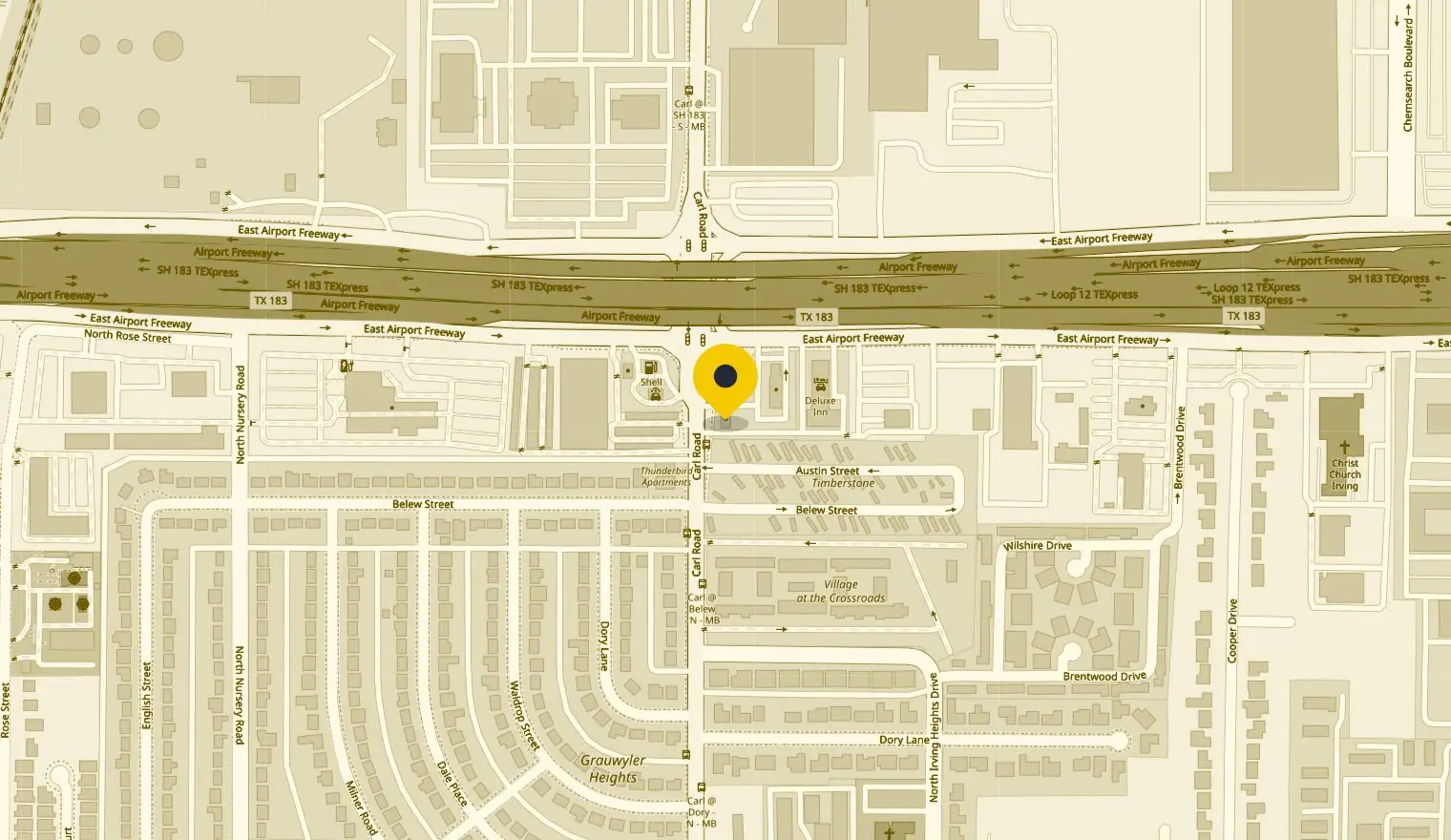
The catch is that other problems cause the same symptoms. A vacuum leak, a cracked intake boot or a weak fuel supply can look just like a bad MAF sensor. This guide covers what a bad or dirty sensor feels like, what causes it, what cleaning can and cannot do, and when to bring the car in. We’re Kwik Kar Oil Change & Auto Care at 2100 Carl Rd in Irving, and these are the patterns we see on engine drivability complaints.
TL;DR
- The most common MAF sensor symptoms are hesitation on acceleration, rough or unstable idle, stalling after startup, poor fuel economy, black smoke and a check engine light.
- A dirty sensor and a failed sensor feel much alike. Contamination can sometimes be cleaned off, while an electrically failed sensor needs replacement.
- Vacuum leaks, a dirty air filter, ignition faults and fuel delivery problems mimic MAF symptoms, so a scan and live-data check should come before any part is replaced.
- A flashing check engine light, severe shaking or frequent stalling means stop driving and get the car inspected.
Table of Contents
- What does a MAF sensor do?
- What are the symptoms of a bad MAF sensor?
- How do dirty MAF sensor symptoms differ from a failed sensor?
- What causes a MAF sensor to get dirty or fail?
- Is it the MAF sensor or something else?
- How do technicians diagnose a MAF sensor?
- Does cleaning a MAF sensor make a difference?
- Is it safe to drive with MAF sensor symptoms?
- How to keep a MAF sensor healthy
- Get your car checked in Irving
- FAQ
- Sources
What does a MAF sensor do?
The MAF sensor sits in the intake tube between the air filter box and the throttle body. Most use a thin heated wire or plate. Air flowing past it cools the element, and the sensor converts that cooling effect into an electrical signal. The engine computer uses that signal to set fuel delivery. Delphi notes that more than 9,000 liters of air can flow through an engine for every liter of fuel used, which is why a small error in the air reading matters.
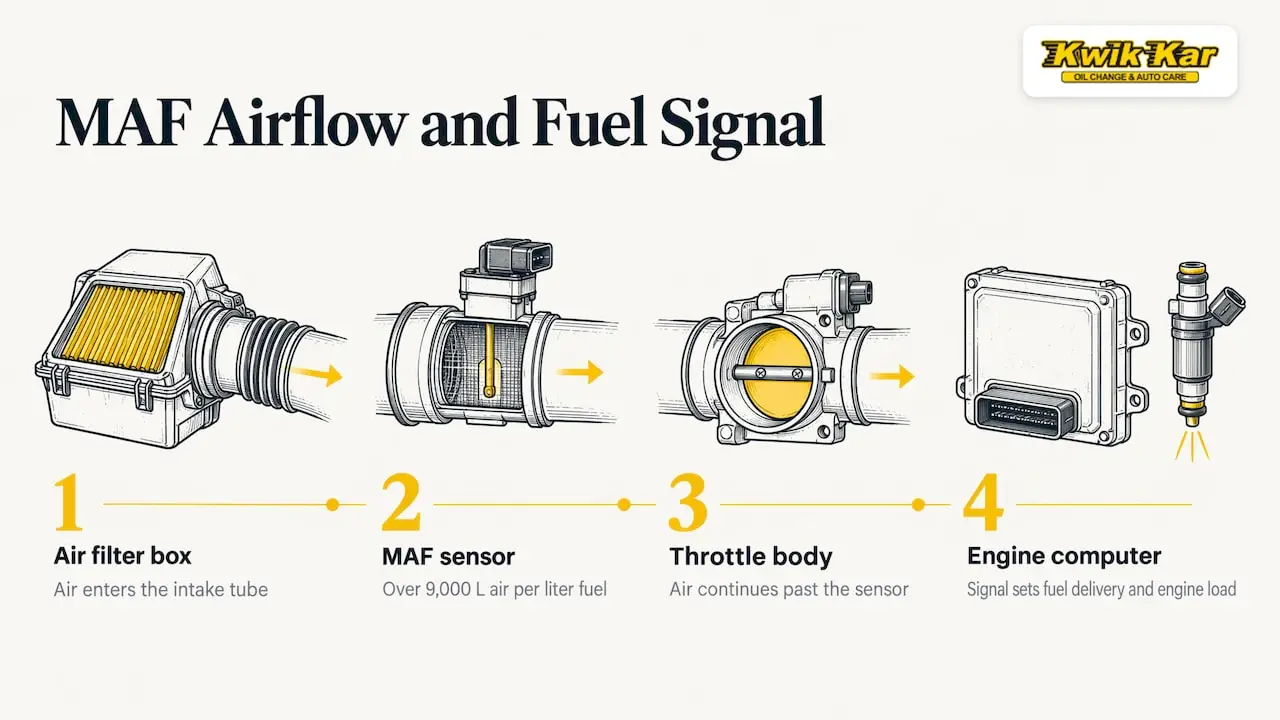
The signal is also used to calculate engine load. AutoZone points out that it can affect traction control and automatic shifting patterns in some vehicles, so a bad sensor can make more than the engine feel off.
What are the symptoms of a bad MAF sensor?
No single symptom proves the sensor is at fault, but these are the ones that show up most often.
1. Hesitation or jerking when you accelerate
MotorTrend describes hesitation after the pedal is pressed as the most common symptom of a faulty MAF. You press the gas and the car bogs, stumbles or surges before it picks up. If the sensor under-reports air, the engine runs lean under load and feels flat. If it over-reports, the mix gets rich and the car can feel sluggish.
2. Rough or unstable idle
The engine shakes at a stoplight, the RPM needle drifts up and down, or the idle sits too high or too low. A sensor that reads wrong at low airflow throws off the mixture exactly where the engine is most sensitive. If this is your main complaint, our rough idle diagnosis guide walks through the other usual suspects.
3. Stalling after start-up or at a stop
The engine fires, then dies a few seconds later, or cuts out when you come to a stop or let off the pedal. DENSO lists stalling shortly after startup, or when the accelerator is pressed or released, among typical MAF failure symptoms.
4. Hard starting
The engine cranks longer than usual before it catches. This happens when the computer is guessing at the fuel amount on a cold or warm start. It is a symptom shared with weak batteries and fuel delivery problems, so it needs more than a symptom check.
5. Worse fuel economy
If the mixture runs rich, you burn more fuel than you should. Track a few tanks before deciding. One bad week of mileage after a road trip or heavy A/C use is not a diagnosis.
6. Black smoke from the tailpipe
Excess fuel that does not burn cleanly can show up as black smoke. MotorTrend lists excessively rich or lean idling, often with black smoke, among the signs of a faulty sensor. Heavy smoke also deserves an in-person look no matter the cause.
7. A check engine light
WAI Global lists a check engine light with codes such as P0101, P0102 or P0103 as a sign of a failing MAF sensor. Lean codes like P0171 can also appear, and our P0171 lean condition guide explains what that code means and why a flashing light changes the advice.
8. Power loss, surging or backfiring
A lean mix under load can make the car feel weak on an on-ramp or surge at steady speed. DENSO also lists backfires and abnormal knocking among MAF-related symptoms. Treat these as a reason to have the car checked soon.
How do dirty MAF sensor symptoms differ from a failed sensor?
They overlap heavily. A dirty sensor is coated with oil film, dust or fibers that insulate the sensing element, so it reads airflow inaccurately. A failed sensor has an electrical or element problem. MOTOR magazine explains that contaminated sensors often over-report airflow at idle and under-report it under load. The result can be a rich idle and a lean feel when you accelerate, and that mixed picture is one reason the sensor is sometimes wrongly ruled out.
In practice:
- Dirty sensor: symptoms may come and go, and readings may improve after proper cleaning.
- Failed sensor: readings tend to stay fixed, drop out or jump around, and cleaning does not help.
- Clogged passage: DENSO notes the engine will usually start, run poorly or stall, and may not set a trouble code at all. No light does not mean the sensor is fine.
What causes a MAF sensor to get dirty or fail?
MotorTrend says most failures come from dirt, paper or oil contamination. The usual routes in:
- A worn, punctured or poorly fitted air filter. Dirt and fibers get past it and coat the element.
- Over-oiled aftermarket filters. Excess oil can be drawn onto the sensor.
- Oil vapor from the engine. A faulty PCV valve or an engine burning oil can send oil into the intake. Our PCV valve symptoms guide covers that side.
- Wiring and connector problems. Corrosion or a loose plug can interrupt the signal even when the sensor is fine.
- Age and vibration. Delta Automotive’s technical bulletin says age and vibration can degrade the sensing element, and that moisture can distort readings.
Delphi says contamination could occur as early as 18,000 to 25,000 miles, depending on the vehicle. Other sources describe a MAF sensor as a part with no fixed replacement interval, often replaced only when problems appear, with lifespans commonly quoted from 70,000 to 150,000 miles. Air filter condition and driving environment make the biggest difference, and Texas dust is not kind to intake systems.
Is it the MAF sensor or something else?
This is the question that saves money. A code alone does not prove the sensor is bad. VehicleRuns notes that P0101 can come from a dirty element, an intake leak after the sensor, a loose duct or a restricted air filter. AutoZone adds that P0101 can also trace to a clogged catalytic converter or restricted exhaust.
| Symptom | MAF sensor may be the cause | Other common causes |
|---|---|---|
| Rough idle | Wrong airflow reading at low flow | Vacuum leak, cracked intake boot, ignition fault, dirty throttle body |
| Hesitation | Under-reported air under load | Weak fuel delivery, clogged filter, failing spark components |
| Hard starting | Bad fuel estimate at start | Weak battery, fuel pump, sensor issues elsewhere |
| Lean code (P0171) | Under-reporting sensor | Vacuum leak, low fuel pressure, exhaust-side sensor issues |
| Poor mileage | Rich mix from over-reporting | Dragging brakes, tire pressure, oxygen sensor problems |
Similar sensors can confuse the picture too. Our guides to oxygen sensor symptoms and MAP sensor symptoms cover the neighbors that can throw similar codes. A grimy throttle body is another frequent lookalike for idle and throttle response complaints.
How do technicians diagnose a MAF sensor?
A proper check goes beyond reading a code.
- Scan for codes and freeze-frame data. Note which codes are stored and under what conditions.
- Inspect the basics. Look at the air filter, the intake tube between the sensor and throttle body, clamps and the electrical connector.
- Watch live data. WAI Global gives a rough benchmark of about 1 gram per second per liter of engine size at idle, with irregular or flat readings pointing toward sensor failure. Readings vary by engine, so the technician compares them against the specs for your vehicle.
- Check fuel trims. Trims show whether the computer is adding or pulling fuel, which separates a sensor problem from a leak or fuel issue.
- Rule out lookalikes. MotorTrend’s diagnostic advice includes checking fuel pressure, the fuel filter, vacuum leaks and oxygen sensors alongside the sensor.
This is the work behind our engine diagnostic service. If you want to know what to ask before authorizing one, see our engine diagnostics cost guide.
Does cleaning a MAF sensor make a difference?
Sometimes, when the cause is light contamination. Cleaning rarely restores a sensor to like-new accuracy, though. Vehicle Service Pros reports that cleaning a contaminated MAF can seem to bring performance back but rarely reaches 100 percent accuracy. A sensor with damaged or shorted internal circuitry has to be replaced.
If cleaning is on the table, the method matters:
- Use a cleaner made specifically for MAF sensors. AutoZone warns the wrong product can leave deposits that cause incorrect readings.
- Never use brake cleaner, carburetor cleaner or compressed air, and let the sensor dry fully. WAI Global recommends at least 15 minutes of drying time.
- Do not touch the hot wire or plate.
- Replace a dirty air filter first, and use dry filters only, because oiled ones can leave residue.
A clean, dry engine bay also makes it easier to spot oil leaks and loose connectors, and there are safe steps for cleaning the engine bay that keep water and degreaser away from sensitive electrical parts. Keep any cleaning away from the sensor itself.
After a cleaning or replacement, the codes should be cleared and the car driven through idle, steady cruising and moderate acceleration. VehicleRuns suggests confirming that MAF readings are stable, fuel trims are moving toward normal and no clamps or connectors were left loose.
Is it safe to drive with MAF sensor symptoms?
For a short trip with mild symptoms, a car often stays drivable, but do not put the repair off. Edmunds says driving with a P0102 code is not recommended, because reduced performance, rough idle and higher fuel use can turn into damage to the engine and exhaust over time.
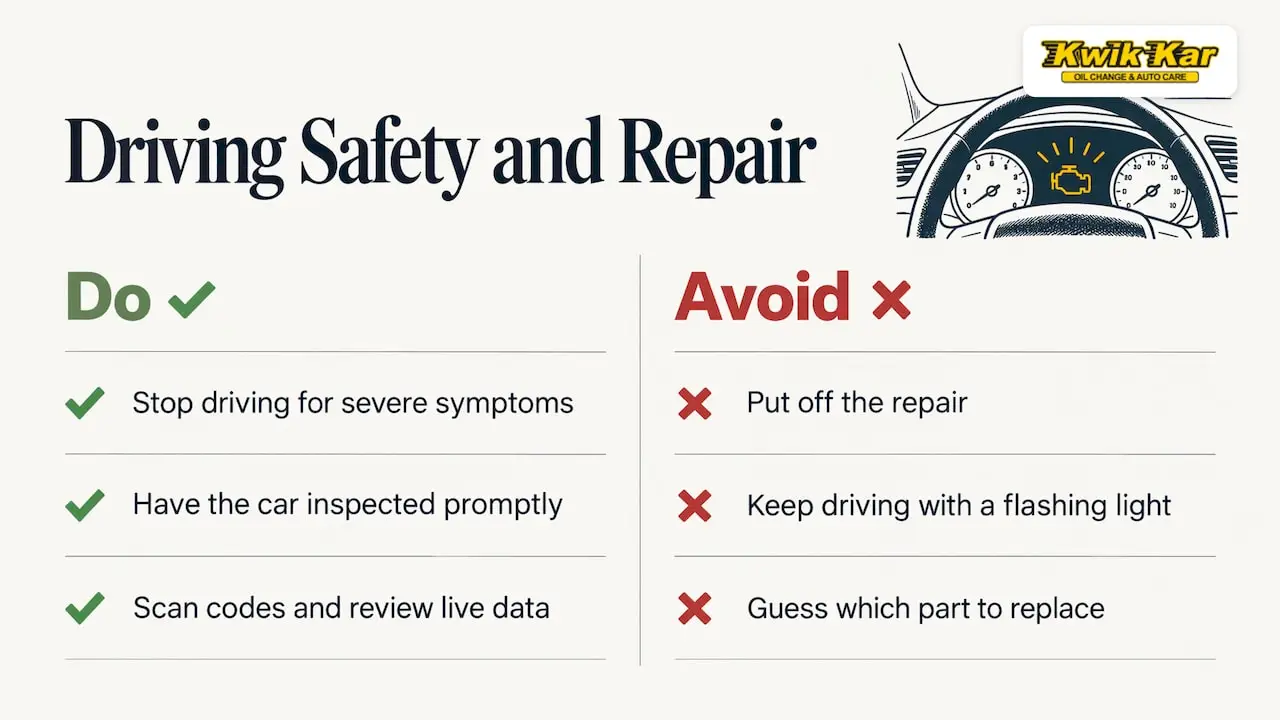
Stop driving and have the car inspected promptly if you notice a flashing check engine light, severe shaking, frequent stalling, loud knocking, a strong fuel smell or a big loss of power. A car that stalls in traffic is a safety issue, not just an annoyance. A flashing light signals active misfires that can overheat the catalytic converter.
Also keep emissions in mind. Texas ended yearly safety inspections for non-commercial vehicles on January 1, 2025, but Dallas County still requires emissions testing as part of registration for eligible vehicles. Qualifying commercial vehicles remain subject to applicable safety inspections. A rich or lean running condition can contribute to a failed emissions test, so it is better to sort out a MAF problem before test time.
Our take on MAF sensor problems
We rarely see a MAF sensor complaint that is only about the sensor. Idle, hesitation and mileage complaints usually have a short list of possible causes, and guessing which part to replace costs drivers money. That is why we start with a scan and a look at live data, and then inspect the air filter, intake tube and connectors before recommending anything.
Our ASE-certified technicians explain what they find, and our Digital Vehicle Inspections put photos, videos and technician notes on your phone. You can see a dirty filter or a cracked intake boot for yourself and decide with the facts in front of you. Repairs that qualify are backed by our 24-month/24,000-mile warranty.
Kwik Kar
How to keep a MAF sensor healthy
Most MAF trouble starts upstream, with the air filter and the intake path.
- Change the air filter on schedule. Delta Automotive recommends changing it every 15,000 miles to protect the sensor, and notes that dirty or worn filters can contaminate the element. Follow your owner’s manual for your vehicle, and shorten the interval if you drive on dusty roads.
- Make sure the filter seats properly. A gap lets unfiltered air past it.
- Stay current on oil changes. Oil that is overdue breaks down and adds to vapor and deposit problems. See our oil change interval guide.
- Fix oil leaks and PCV problems. Oil in the intake coats the sensor.
- Consider a fuel system check at higher mileage. Our fuel system cleaning article explains why a diagnostic comes first.
Get your car checked in Irving
If your car idles rough, hesitates or has a check engine light on, we can find out whether the MAF sensor is the culprit or something cheaper is. We serve drivers across Irving and nearby communities including Las Colinas, Grand Prairie, Euless, Coppell, Grapevine and Dallas, all from one shop at 2100 Carl Rd. Our engine diagnostic covers the scan, live-data check and inspection, and our tune-up and scheduled maintenance services keep filters and fluids on schedule.

If you’d rather start online, you can reach us at kkirvingtx.com or call (469) 276-7337. Same-day service may be available, so call to confirm.
FAQ
What are the first signs of a bad MAF sensor?
The earliest signs are usually a slightly rough idle, a stumble when you accelerate and gas mileage that slips. A check engine light often follows. Because other faults cause the same signs, a scan is the quickest way to learn what is going on.
Can a dirty MAF sensor cause a check engine light?
Yes. A contaminated sensor can send readings the computer does not expect, which can set airflow codes like P0101 or lean codes like P0171. The code points to a system problem, not a confirmed bad part, so the cause still needs to be verified.
How much does it cost to replace a MAF sensor?
Cost depends on your vehicle, the part and the labor to fit it, and diagnosis comes first. We don’t publish a flat price because the right fix may be an air filter, a hose or a cleaning instead. Call us at (469) 276-7337 for an estimate on your vehicle.
Can I drive with a bad MAF sensor?
Short trips may be possible with mild symptoms, but it is not a good idea to keep driving on it. Reduced performance and higher fuel use can turn into engine and exhaust damage. If the check engine light is flashing or the car stalls or shakes badly, stop driving and have it inspected.
Sources
- Understanding MAF Sensors, MotorTrend
- Making sense of your sensors: MAF sensor, Delphi Auto Parts
- Successful MAF Sensor Diagnosis, MOTOR
- The Symptoms of a Bad Mass Air Flow Sensor, AutoZone
- How to Clean a Mass Air Flow Sensor, AutoZone
- Mass Air Flow Sensor Troubleshooting, WAI Global
- How do Mass Air Flow sensors work, DENSO
- Mass Airflow Sensors, TechASSIST Bulletin 03
- Dirty or Bad MAF Sensor? How to Diagnose It, VehicleRuns
- 5 MAF sensor replacement questions answered, Vehicle Service Pros
- P0102: Mass Air Flow Sensor Circuit Low Input, Edmunds
- How Long Do MAF Sensors Last?, AutoGearLab
- Texas vehicle inspections and emissions testing, FOX 4
- Clean engine bay: safe steps, Diamondbrite