A lean condition means your engine is reporting too much air or too little fuel on one side of the engine. Start by noting your symptoms and checking whether the check engine light is steady or flashing. Then pull the trouble codes, freeze-frame data, and fuel trims with an OBD2 scan tool. If the light flashes or the engine runs badly, stop driving and get a professional diagnosis.
TL;DR:
- Positive fuel trims that fall from idle to higher speeds suggest a vacuum leak; rising trims point toward fuel delivery or a MAF problem.
- Record all codes, freeze frame data, and fuel trims before testing; codes on multiple banks can indicate a shared MAF or fuel pressure problem.
- A steady light with rough running needs a safety assessment; stalling, heavy shaking, or a strong fuel smell means stop and call for help.
- At home, inspect cool hoses, intake boots, the air filter, and sensor connectors, but leave fuel pressure and smoke tests to a shop.
- After repairs, clear the code, complete a road test, and confirm fuel trims return near zero; clearing it alone only hides the fault.
Table of Contents
- What does a P0171 “system too lean (bank 1)” code mean?
- What symptoms come with a P0171 code?
- What causes an engine running lean?
- How do you diagnose a P0171 code, step by step?
- Which quick checks can you safely do at home?
- What do P0171 repairs involve, and what will you pay?
- How can you prevent lean-condition codes?
- When should you bring a P0171 to a pro?
- Our advice to Irving-area drivers about P0171
- Book an engine diagnostic for your P0171 code in Irving
- FAQ
- Sources
What does a P0171 “system too lean (bank 1)” code mean?
Your engine computer, called the PCM, constantly adjusts how much fuel it injects. It watches the air coming in through the mass airflow (MAF) sensor or the manifold absolute pressure (MAP) sensor. It then checks the exhaust with oxygen (O2) sensors to see whether the mix of air and fuel came out right.
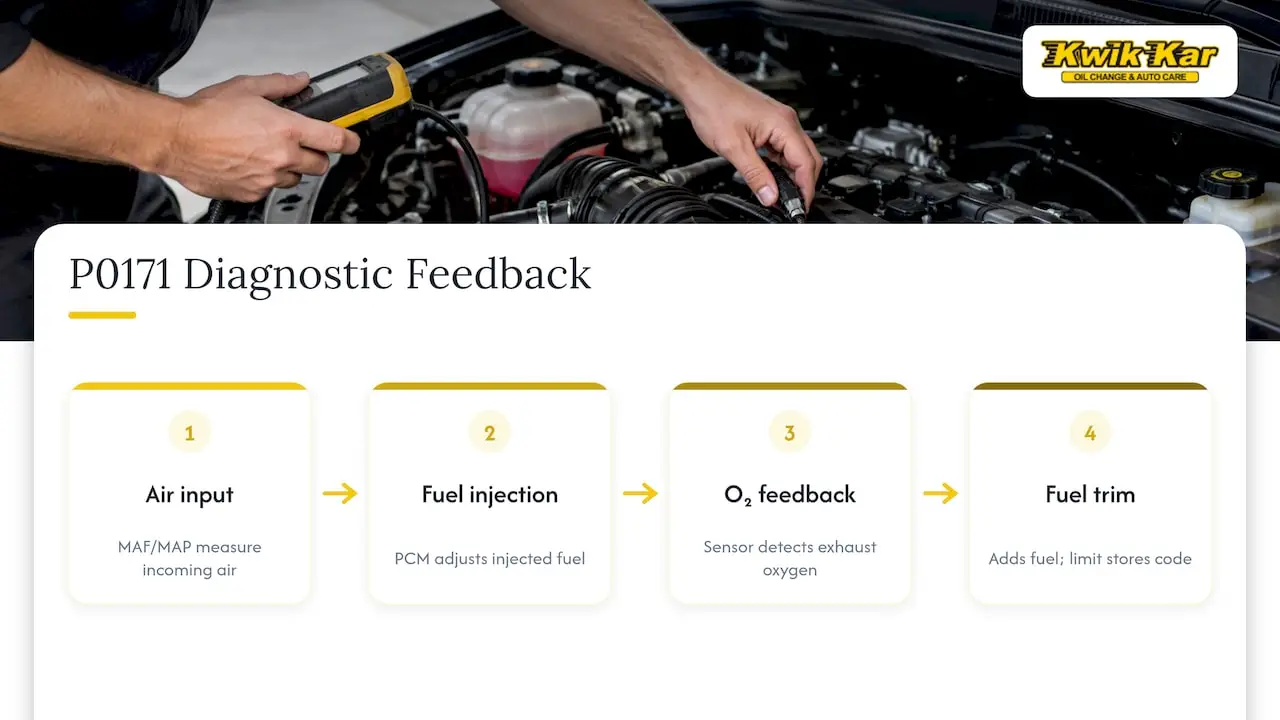
When the O2 sensor sees extra oxygen in the exhaust, the PCM reads that as a lean air fuel mixture. It responds by adding fuel, a correction called fuel trim. Fuel trim is shown as a percentage, and a large positive number means the computer is working hard to add fuel. If the correction hits its limit and the exhaust still reads lean, the PCM stores a lean-condition code and turns on the check engine light.
“Bank 1” is the side of the engine that holds cylinder number one. On an engine with a single cylinder bank, there is only one bank. On an engine with multiple banks, bank 1 is one cylinder head, and another bank is the other. Knowing the bank tells your technician which sensors and which side of the intake to check first.
A lean engine runs hotter and burns fuel less cleanly. Over time that can strain the catalytic converter and hurt both performance and emissions. For that reason, a lean-condition code deserves attention even when the car still seems to drive normally.
What symptoms come with a P0171 code?
Some owners notice nothing but a lit dashboard light. Others feel the engine struggling. Here is what we hear most often:
- Check engine light: steady in most cases, flashing when a misfire is severe
- Rough idle: the engine shakes or surges while you sit at a stoplight
- Poor fuel economy: you fill up more often because the computer keeps adding fuel
- Hesitation: the car stumbles or feels weak when you press the accelerator
- Misfire or stalling: the engine stumbles, loses power, or dies at idle
- Whistling or hissing under the hood: a classic sign of an intake leak
These symptoms point to causes. A whistle that gets louder with throttle often means a vacuum leak, and scan data will usually show a high short-term fuel trim at idle that settles down at higher speeds. A lean reading that gets worse as you accelerate can point toward a fuel delivery problem instead. Hesitation under load can also trace back to a dirty MAF sensor.
Severity matters. If the light is steady and the engine is running roughly, have a professional assess whether it is safe to drive to a shop. A flashing light is different: AAA explains that a flashing check engine light signals a serious problem that needs immediate attention. Stalling, heavy shaking, or a strong fuel smell also mean you should stop driving and call for help.

What causes an engine running lean?
Most lean codes trace back to unmetered air getting into the engine or to fuel that is not arriving in full. These are the usual suspects:
- Intake vacuum leaks: cracked vacuum hoses, a leaking intake manifold gasket, a worn PCV hose, or a split intake boot let extra air in after the airflow sensor has already measured it. This is the most frequent root cause we see.
- Dirty or failing MAF sensor: if the sensor under-reads airflow, the computer injects too little fuel. A faulty MAP sensor can do the same. Our guide to bad MAP sensor symptoms shows how to tell the two apart.
- Worn O2 sensors: a slow or contaminated sensor can report wrong oxygen levels and push the fuel trims off.
- Fuel delivery problems: a weak fuel pump, a clogged fuel filter, low fuel pressure, or partly clogged injectors can all starve the engine.
- EVAP and gas cap issues: a loose gas cap more often sets an EVAP code, but AAA lists a loose gas cap among common causes of a check engine light, along with a defective O2 sensor, a dirty MAF, and intake vacuum leaks.
- Exhaust leaks and EGR trouble: a leak near the upstream O2 sensor can pull in outside air and fool the sensor. A stuck EGR valve can also upset the mixture, and this technical breakdown of a stuck-open EGR valve explains the symptoms and testing in detail.
If your light came on after a gas station visit, start with the cap. If it came with a hiss, start with the hoses. If it came with a long crank and weak acceleration, think fuel pressure. Our article on EVAP leak codes covers the gas cap and smoke test route in more detail.
How do you diagnose a P0171 code, step by step?
Order matters. Cheap, fast checks come first, and expensive parts come last. Here is the workflow our technicians follow, and an owner with a scan tool can follow the early steps too.
- Pull the codes and freeze-frame data. Use a diagnostic scan tool to record every stored code, the freeze-frame snapshot, and short-term and long-term fuel trims. Note any related codes, such as misfires or a lean code for another bank. Lean codes for multiple banks may suggest a shared problem like the MAF sensor or fuel pressure.
- Inspect for obvious vacuum leaks. With the engine idling, listen for hissing and look over intake hoses, the intake boot, and PCV lines for cracks, loose clamps, or disconnected fittings.
- Check the MAF and MAP sensors. Look at live readings and compare them with specifications for your engine. If the MAF element looks dirty, clean it carefully with MAF cleaner only.
- Run a smoke test. A smoke machine pushes harmless vapor into the intake. Wherever smoke escapes, there is a leak. This finds pinhole leaks in gaskets and hidden hoses that you can neither see nor hear.
- Check fuel pressure and flow. A gauge on the fuel rail shows whether the pump and filter deliver enough fuel. Low pressure points to the pump, filter, or regulator.
- Test the O2 sensors and wiring. Watch sensor response in live data, inspect connectors, and look for exhaust leaks upstream of the sensors.
- Clear, road test, and re-check. After the repair, clear the code, drive through a full cycle, and confirm that fuel trims have settled near zero and the code stays gone.
Pro Tip: Compare short-term and long-term fuel trims at idle and at a higher engine speed. A big positive number at idle that shrinks at higher speeds can point toward a vacuum leak, while a number that grows with engine speed can point toward fuel delivery or a MAF problem.
Skipping steps costs money. Replacing an O2 sensor when the real problem is a split intake boot only drains your wallet. Emissions inspectors care about this too: EPA guidance for inspection programs says a vehicle should be failed if the MIL is commanded on for any diagnostic trouble code, so an unresolved lean-condition code can stand between you and a passing inspection.
Which quick checks can you safely do at home?
You do not need a full toolbox to narrow things down. These checks are safe for most owners:
- Gas cap: remove it and look at the rubber seal for cracks. Reinstall it until it clicks. A bad seal more often triggers an EVAP code, but it is a free check.
- Vacuum hoses and intake boot: with the engine off and cool, look for cracks, soft spots, split rubber, or hoses that have slipped off their fittings. Squeeze the large intake tube between the air box and the throttle body and look for tears in the folds.
- Air filter: a filthy filter or a loose air box lid can disturb airflow readings.
- MAF sensor cleaning: remove the sensor, spray only electronics-safe MAF cleaner on the sensing element, and let it dry fully before reinstalling. Never touch the element with a brush, cloth, or fingers, because the wires are extremely fragile.
- Connectors: check that the MAF and O2 sensor plugs are seated and free of corrosion.
Pro Tip: Write down your fuel trim numbers before you clear the code. If the code returns, you can compare the new numbers with the old ones and see whether your fix helped.
Know where to stop. Do not disconnect fuel lines or open the fuel system at home. Fuel rails stay pressurized, and a spray of gasoline near a hot engine is a fire risk. Fuel pressure testing and smoke testing belong in a shop with the right equipment.
What do P0171 repairs involve, and what will you pay?
Repairs follow the diagnosis. Typical shop fixes include:
- Vacuum hose or PCV hose replacement: often among the least expensive repairs
- Intake boot or intake manifold gasket repair: the part may be modest, but labor rises when the manifold must come off
- MAF sensor cleaning or replacement: cleaning is cheap, while a replacement sensor costs more
- O2 sensor replacement: price depends on which sensor and how hard it is to reach
- Fuel filter or fuel pump service: a filter is a lighter job, a pump usually means dropping the tank
- Injector cleaning or replacement: a good fit when pressure is fine but fueling is uneven
Exact prices depend on your make, model, and engine layout. The first billed step is usually an engine diagnostic, because paying to find the real cause is cheaper than replacing parts by guesswork. Our post on engine diagnostic costs lists questions worth asking before you pay for one.
Ask any shop for an itemized quote and for proof of the failure. At Kwik Kar, our Digital Vehicle Inspection sends photos, video, and technician notes to your phone, so you see the cracked hose or the dirty sensor before you approve the work.
How can you prevent lean-condition codes?
Maintenance is the cheapest protection against a P0171 code. Replace the engine air filter on schedule, because a clogged or poorly sealed filter can disturb airflow readings. Follow the fuel filter interval in your owner’s manual, and use quality fuel from busy stations. If your vehicle has high mileage, ask about a fuel system cleaning, and get a diagnostic first so you know a cleaning is the right fix. We explain that approach in our fuel system cleaning guide.
Keep up with factory service intervals, and have hoses and boots inspected during regular visits, since rubber ages in Texas heat. Most of all, do not ignore the check engine light. AAA warns that driving with the light on can let minor problems become major ones and can speed up engine wear. A quick scan costs far less than a damaged catalytic converter.
When should you bring a P0171 to a pro?
Some P0171 jobs are simple. Others need tools most garages at home lack. Our ASE-certified technicians start with a live-scan engine diagnostic, reading fuel trims and freeze-frame data so we know how the engine behaved when the code set. From there, we follow the same prioritized workflow described above.
We also perform a Digital Vehicle Inspection with photos and video, so you can see the failed part and the test results yourself, not just take our word for it. When a job calls for a smoke test, a fuel-pressure test, or a sensor test on the bench, that is the point to hand it to a shop with the tools and experience. Guessing at fuel system problems wastes money and can create safety risks.
Our advice to Irving-area drivers about P0171
Here is how we talk to drivers who come in with a lean-condition code. Pull the code first. Never ignore a flashing check engine light. And when you suspect a fuel pressure or hidden intake leak, let a shop run the smoke and pressure tests instead of swapping parts and hoping.
Our promise is simple: ASE-certified checks, a transparent Digital Vehicle Inspection, and honest help choosing the right repair path. If your symptoms are moderate to severe, such as rough running, hesitation, or a noticeable drop in fuel economy, book an engine diagnostic sooner rather than later. A lean condition rarely fixes itself, and waiting usually lets a small leak grow into a bigger bill.
— Kwik Kar
Book an engine diagnostic for your P0171 code in Irving
Fuel trims and freeze-frame data tell us what your engine was doing the moment the code set, and that is where an accurate fix begins. Our engine diagnostic service can help identify the cause of a lean-condition code.
- ASE-certified technicians read your codes and live data
- Photos and video of the problem sent straight to your phone
- Clear recommendations before any repair work begins
Call or stop by Kwik Kar in Irving, and we will get your engine back to the right air and fuel balance.
FAQ
What is the most common reason for P0171?
The most common cause is an intake vacuum leak, such as a cracked hose, a split intake boot, or a leaking gasket. Unmetered air enters after the airflow sensor, so the engine runs lean. A dirty MAF sensor is another frequent cause.
How much does it cost to fix P0171?
The cost depends on the cause and your vehicle. A cracked hose is usually a light repair, while a fuel pump or intake manifold gasket costs more. We start with an engine diagnostic so you pay to fix the real problem, and we can quote the repair after that.
How do you fix a system too lean condition?
Find the cause first. Check fuel trims, inspect for vacuum leaks, test the MAF sensor, run a smoke test, and confirm fuel pressure. Then repair or replace the failed part, clear the code, and road test the vehicle.
How do you reset the P0171 code?
You can clear it with a diagnostic scan tool after the repair is done. Clearing the code without a fix only hides it, and the light usually returns within a few drives. Confirm that fuel trims have settled before you call it finished.
Sources
- The Check Engine Light: Six Common Causes and What to Do | AAA Oregon/Idaho
- Performing Onboard Diagnostic System Checks as Part of a Vehicle Inspection and Maintenance Program