Most Texas drivers are now exempt from the annual safety inspection. As of January 1, 2025, non-commercial vehicles no longer need a safety inspection before registration under House Bill 3297. The emissions test is a separate requirement. It still applies to gasoline vehicles registered in certain counties, and that includes Dallas County, where Irving sits. Below we sort out which exemption applies to which vehicle, including classic and antique cars, electric vehicles, diesels and new cars.
TL;DR
- Non-commercial vehicles no longer need a Texas safety inspection to register. Commercial vehicles still do, in every county.
- Emissions testing remains in 18 counties, including Dallas, Tarrant, Denton and Collin. Electric vehicles, diesels, motorcycles and mopeds are exempt from it.
- Gasoline vehicles are tested from 2 through 24 years old, so a car that is 25 or older falls outside the standard test. New vehicles are exempt for their first two years.
- A “classic” plate and an “antique” plate are not the same thing, and only antique plates carry the inspection exemption.
- If your car fails, waivers and extensions exist. Fixing the cause is usually the faster route.
Table of Contents
- Did Texas Really End Vehicle Inspections?
- Which Vehicles Are Exempt From Texas Emissions Testing?
- Is There a Classic Car Inspection Exemption in Texas?
- What Still Applies to Commercial Vehicles?
- How Does the Dallas County Emissions Test Work?
- What Can You Do if Your Car Fails the Emissions Test?
- Our Perspective on the Exemptions
- Get Your Car Ready for Registration in Irving
- FAQ
- Sources
Did Texas Really End Vehicle Inspections?
Only the safety inspection for non-commercial vehicles ended. House Bill 3297 was passed by the 88th Legislature and signed in 2023. The Texas Department of Public Safety (DPS) confirmed that the change took effect on January 1, 2025. Brakes, lights and tires are no longer checked by a station as a condition of registering a personal car, SUV or pickup.
Two things did not go away:
- Emissions testing for vehicles registered in the affected counties.
- Safety inspections for commercial vehicles in all counties, per the same DPS notice.
We cover the full background in our guide to what changed with state inspection in Texas and who still needs one.
Which Vehicles Are Exempt From Texas Emissions Testing?
Emissions testing depends on two things: the county where the vehicle is registered and the type of vehicle. Texas requires it for vehicles registered in 18 counties: Bexar, Brazoria, Collin, Dallas, Denton, El Paso, Ellis, Fort Bend, Galveston, Harris, Johnson, Kaufman, Montgomery, Parker, Rockwall, Tarrant, Travis and Williamson. Gasoline-powered vehicles 2 through 24 years old in those counties get the OBDII test.
That age window creates most of the exemptions people ask about:
| Vehicle | Emissions test in an emissions county? |
|---|---|
| Gasoline car or truck, 2 to 24 years old | Yes |
| Gasoline vehicle, 25 years or older | Outside the standard 2 to 24 year test window |
| Brand-new vehicle | Exempt for the first two years |
| Electric vehicle | Exempt |
| Diesel vehicle | Exempt |
| Motorcycle or moped | Exempt |
| Motor home in an emissions county | Appropriate emissions test required |
The Texas Commission on Environmental Quality (TCEQ) lists electric vehicles, diesels, motorcycles and mopeds as not required to test. If you are not sure which category your vehicle falls in, the model year on your registration and the fuel type are the two facts that decide it.
What if I registered in an emissions county but live somewhere else?
The exemption follows where the vehicle is registered and primarily driven. DPS says a vehicle registered in an affected county may get its inspection at a station in a non-affected county if it is not primarily operated in the affected county, no longer qualifies as a designated vehicle, or will not return to the affected county before registration expires. A college student or a driver who has moved should read that page before registering.
Is There a Classic Car Inspection Exemption in Texas?
It depends on the plate, not just the age. This is where owners get tripped up.
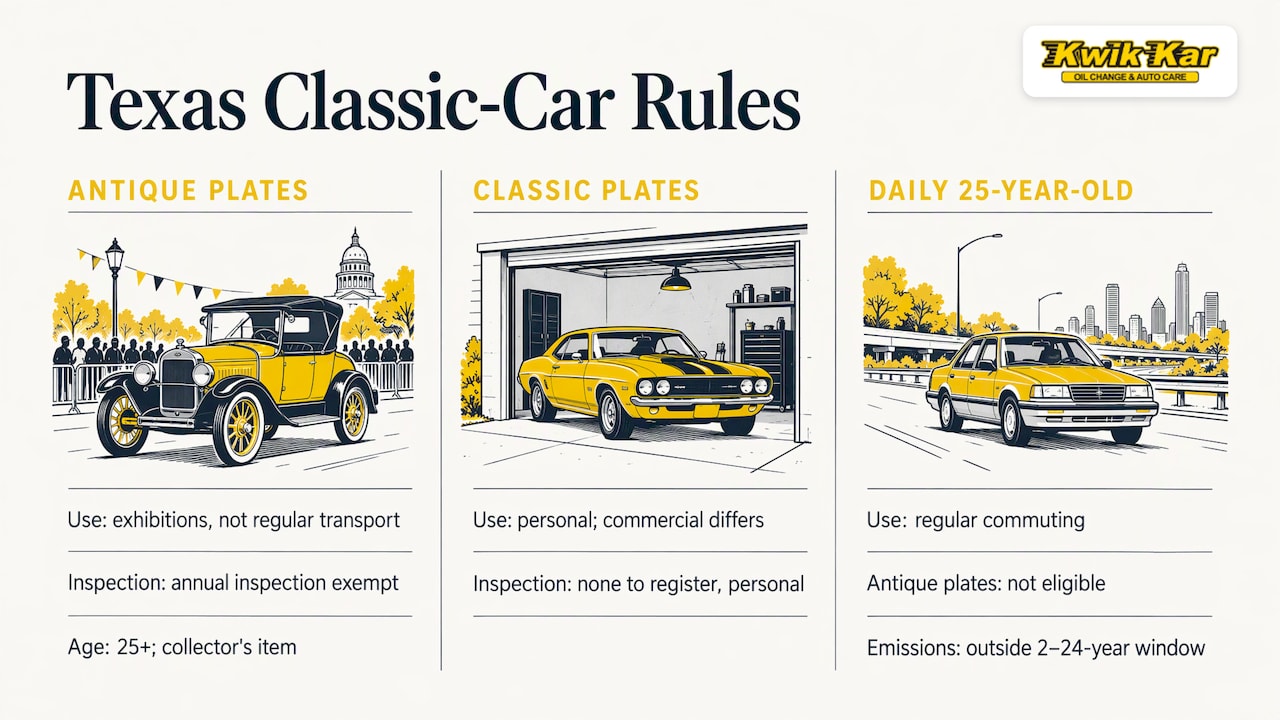
Antique plates. Under Texas Transportation Code Section 504.502, a passenger car, truck, motorcycle or bus must be at least 25 years old and a collector’s item. It must be used exclusively for exhibitions, club activities, parades and other functions of public interest, not regular transportation, and carry no advertising. DPS says vehicles registered as Antiques are exempt from annual inspection. The plate fee is $10 for each year or portion of a year remaining in the five-year registration period for vehicles made in 1921 or later, or $8 for earlier ones.
Classic plates. The same DPS page says vehicles registered as Classic have to carry an annual safety inspection. That page predates the 2025 change, so for a personal classic the practical effect now is the same as for any non-commercial car: no safety inspection to register. If the car is used commercially, the rule is different.
Daily-driven older cars. A 25-year-old car you commute in cannot use antique plates, because antique use excludes regular transportation. It also sits outside the 2 to 24 year emissions window for gasoline vehicles. You can confirm your exact status with your county tax office or the DPS inspection pages.
Older vehicles still benefit from a mechanical check even when no one requires it. Rubber brake hoses, aged fluids and weak batteries are common problems on a car that sits. A brake inspection before the first spring drive is cheap insurance.
What Still Applies to Commercial Vehicles?
The exemption stops at the commercial line. Commercial vehicles must still pass a safety inspection in all counties, and that covers work trucks, vans and fleet units. A pre-inspection walkthrough of lighting and reflectors catches the most common cheap failures. The checklist on DOT lighting requirements for fleets is a good reference when you walk around a truck or trailer.
Fleet managers in Irving and nearby areas such as Las Colinas, Grand Prairie and Coppell can learn how we handle this on our Texas emissions and commercial inspections page. For anything safety-critical on a work vehicle, such as brakes, steering or tires, have a technician look at it before the inspection, not after a failure.
How Does the Dallas County Emissions Test Work?
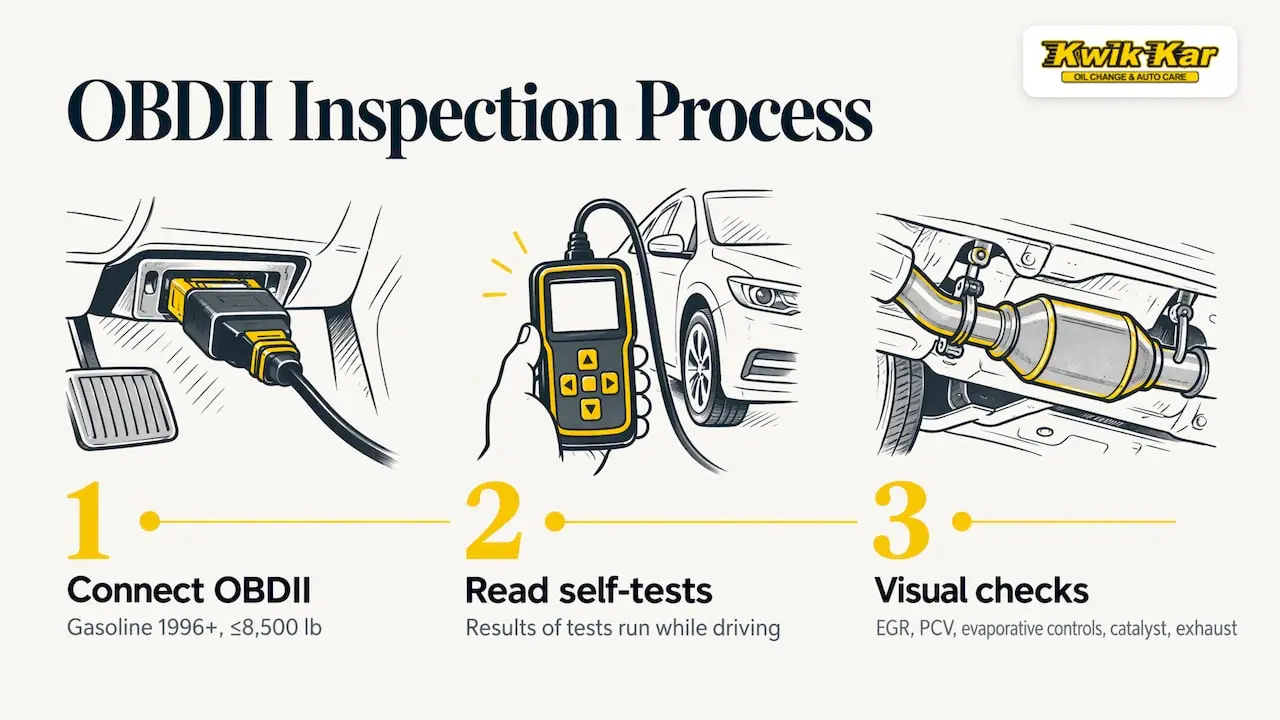
For most Irving drivers the test is a plug-in check. DPS says the primary method for gasoline vehicles of model year 1996 and newer, with a gross weight of 8,500 pounds or less, is the OBDII system read through the diagnostic connector.
The station is not measuring tailpipe smoke. According to the DPS inspector study guide, the OBDII inspection checks the results of self-tests the vehicle ran while being driven, and the engine does not need to be warmed up. The inspection also includes visual checks of components such as the EGR system, PCV system, evaporative emissions controls, catalytic converter and exhaust.
That explains why some cars fail right after a repair. If the battery was disconnected or codes were cleared, the self-tests may not have completed yet. We explain the process in our article on the drive cycle for a Texas emissions inspection.
When should I get the test done?
You can renew registration online 90 days before expiration. The Texas Department of Motor Vehicles advises that for vehicles subject to emissions inspection, the test must be done within that 90-day renewal period, so plan ahead to avoid a registration delay. Starting early also leaves time to fix a failure without a rush.
What does it cost?
The state collects a $2.75 emissions inspection fee at registration for gas-powered vehicles in emissions counties. The station charges its own fee for the test. For Bexar County, which started enhanced testing on November 1, 2026, TxDMV lists $18.50 paid to the station and $2.75 paid to the state. For the Dallas County station fee, ask the station or check with DPS.
For a fuller walkthrough, read our guide to the Texas emissions test in 2026.
What Can You Do if Your Car Fails the Emissions Test?
A failure is not the end of the road. Texas has relief options, and each has conditions.
- Low-mileage waiver. Available after the initial test and the retest both fail. You need at least $100 in emissions-related repairs and fewer than 5,000 miles driven in the previous inspection cycle.
- Individual vehicle waiver. After failing the initial test and retest, a motorist who has spent qualified emissions-related repair costs of $600 or more in affected counties (El Paso: $450) may qualify, per the same rule.
- Low-income time extension. Qualifying owners can get an extension valid for one inspection cycle, and it may be granted more than once during the vehicle’s life.
- Parts availability extension. Available when the failure is due to a part that is not readily available, per the TCEQ waivers page.
In practice, most failures trace to a handful of causes. A loose gas cap or small leak triggers an evaporative code, which we walk through in our EVAP leak guide. A catalytic converter efficiency code is covered in our P0420 article. A tired sensor can be the culprit, as in our list of oxygen sensor symptoms. When a warning light is on, an engine diagnostic finds the cause so you repair the right part, not several guesses.
The TCEQ also notes that a remote sensing element randomly checks emissions on highways as part of the program, so a lit check engine light is worth addressing before registration time.
Our Perspective on the Exemptions
Drivers hear “no more inspections” and assume the car is off the hook. We see it differently at the shop. The rule changed what the state requires, not what a vehicle needs to stay safe. Brakes wear, tires age and batteries fade whether or not a sticker is due.
That is why we perform a Digital Vehicle Inspection on visits. You get photos, video and technician notes on your phone, so you can see what we see and decide what to do and when. Our ASE-certified technicians give honest recommendations, and the choice stays with you.
For emissions, our advice is simple: do not wait until the last week of your registration window. Check warning lights early, have codes read, and fix the cause once. Qualifying repairs are backed by our 24-month/24,000-mile warranty.
Kwik Kar
Get Your Car Ready for Registration in Irving
If your registration is coming up and your check engine light is on, start with a diagnostic and a Digital Vehicle Inspection at Kwik Kar Irving. We are ASE-certified, RepairPal-certified and CARFAX Top-Rated, and we can walk you through what we find in plain language.
We serve Irving and drivers from nearby communities such as Las Colinas, Grand Prairie, Euless, Coppell and Grapevine. See our state car inspection page for details, or visit kkirvingtx.com to see what we offer. For a quick checklist before your visit, see our post-2026 Texas inspection checklist.
FAQ
Are Texas vehicle inspections mandatory in 2026?
Not for most personal vehicles. Non-commercial vehicles have not needed a safety inspection for registration since January 1, 2025. Commercial vehicles still need a passing safety inspection, and gasoline vehicles in emissions counties still need an emissions test.
Does Dallas County still require emissions testing?
Yes. Dallas County is one of the 18 counties where gasoline vehicles 2 through 24 years old must pass the OBDII emissions test. Electric vehicles, diesels, motorcycles and mopeds are exempt, and new vehicles are exempt for their first two years.
Is a 25-year-old car exempt from inspection in Texas?
A gasoline vehicle that is 25 or older is outside the 2 to 24 year emissions test window. Antique plates carry an inspection exemption, but they require collector use, not regular transportation. A daily driver does not qualify for them.
Is a classic car exempt from the Texas safety inspection?
DPS lists Classic-plated vehicles as needing an annual safety inspection, while Antique-plated ones are exempt. Since the 2025 change, non-commercial vehicles do not need a safety inspection to register anyway. Commercial use is the exception.
Can I get an emissions waiver after failing?
Possibly. After a failed test and retest, Texas offers a low-mileage waiver ($100 in emissions repairs, under 5,000 miles) and an individual vehicle waiver ($600 in qualified repairs). Low-income and parts availability extensions also exist. Confirm eligibility with the TCEQ.
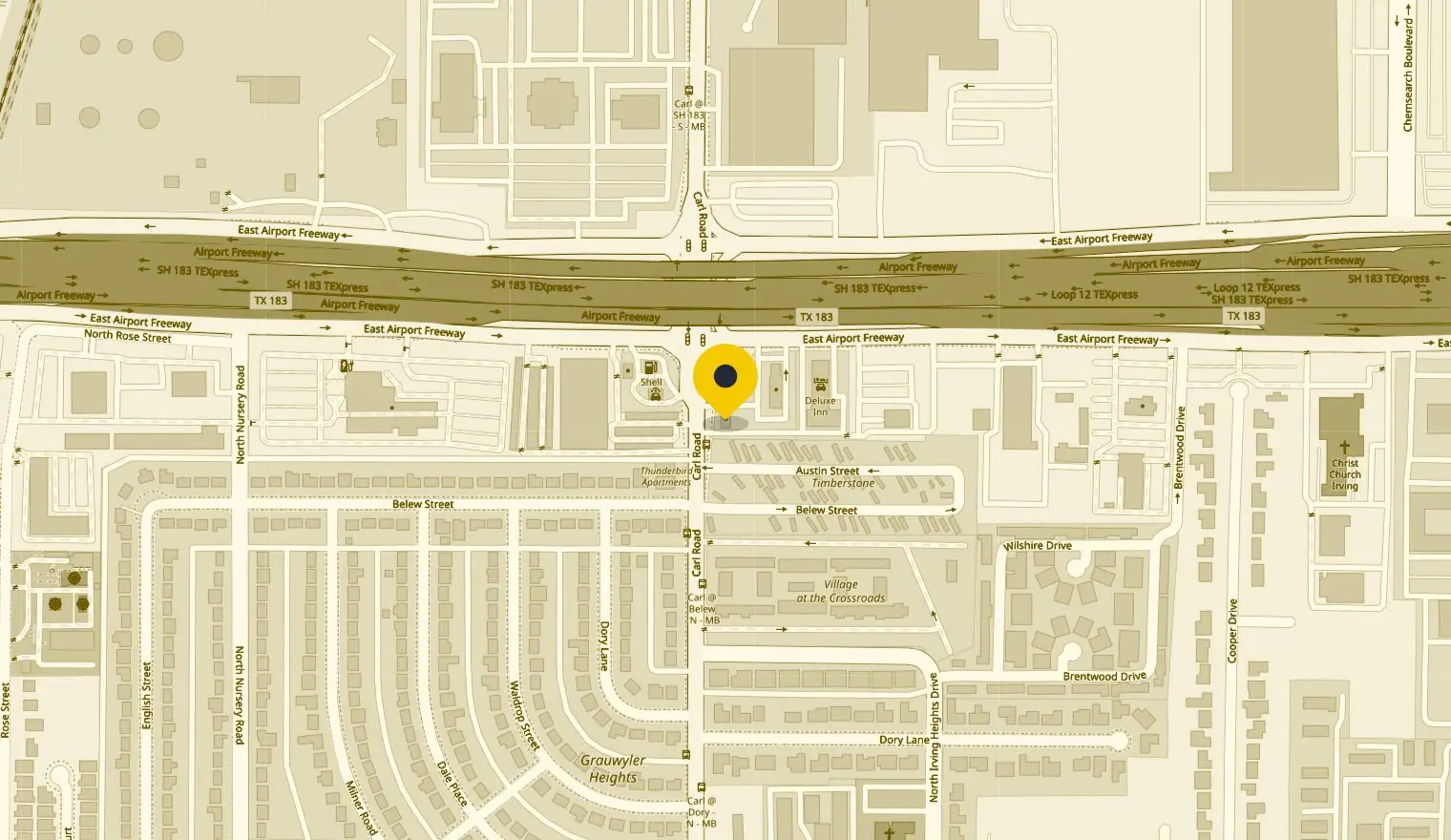
To schedule service, call us at (469) 276-7337 or stop by 2100 Carl Rd, Irving, TX 75061.
Sources
- Texas DPS: Vehicle Safety Inspection Program Changes Now in Effect
- Texas DPS: Inspection Criteria for Emission Inspection
- TxDMV Registration and Title Bulletin 005-24
- TCEQ: Vehicle Emissions Inspections in Texas
- Texas DPS: Unique Vehicles
- Texas DPS: Vehicle Emissions Testing Exemptions
- Tex. Transp. Code Section 504.502
- Texas DPS: Inspection Stations (Vehicle Emissions Inspection)
- Texas DPS: Emissions Inspector Study Guide
- TxDMV: Register Your Vehicle
- TxDMV Registration and Title Bulletin 003-26
- 37 Tex. Admin. Code § 23.52, Emissions Testing Waiver
- TCEQ: Waivers and Extensions
- DOT lighting requirements checklist for fleets