CVT fluid and conventional automatic transmission fluid (ATF) are different products built for different jobs, and you should not use one in place of the other. A CVT relies on a steel belt or chain gripping cone-shaped pulleys, so its fluid is engineered for traction and shear stability. A traditional automatic uses clutch packs, bands and a torque converter, so its ATF is engineered to manage friction. Put the wrong one in and you risk shifting problems, overheating and a transmission repair bill that dwarfs the cost of the right fluid.
We see this question from Irving drivers whose cars have a CVT and who aren’t sure what the last shop put in, or who are tempted to top off with whatever is on the shelf. Here is how the two fluids differ, what goes wrong when they get mixed up, and how to find the exact fluid your car calls for.
TL;DR
- CVT fluid and ATF are not interchangeable. Automakers such as Nissan specifically warn against ATF in their CVTs.
- CVT fluid is built to keep a belt or chain from slipping on its pulleys. Conventional ATF is built to control friction in clutches and a torque converter.
- Your owner’s manual names the exact fluid. Even among CVTs, one automaker’s fluid may not be compatible with another’s.
- If the wrong fluid went in, don’t drive on it for long. Have the fluid drained and the correct one installed by a technician.
- Color is not a reliable guide. Don’t pick a fluid by how it looks.
Table of Contents
- What is the difference between CVT fluid and ATF?
- Can you use ATF in a CVT?
- What happens if the wrong fluid goes into a CVT?
- How do you find the right fluid for your car?
- What if ATF has already gone into your CVT?
- Is CVT fluid vs. ATF the only choice? Other fluids to know
- How often should CVT fluid be changed?
- Our perspective
- Have your transmission fluid checked in Irving
- FAQ
- Book your service
- Sources
What is the difference between CVT fluid and ATF?
Both fluids lubricate and cool a transmission, and both carry additives that fight wear and oxidation. The difference is in how the transmission uses friction.
A conventional automatic has planetary gear sets and clutch packs that engage to select each gear. Its ATF has to give those clutches a controlled amount of grip, so they engage smoothly, without shuddering or slipping. A torque converter adds its own demands.
A continuously variable transmission has no fixed gears. It changes ratio by moving two variable-width pulleys connected by a steel belt or chain. The fluid has to allow the belt to be clamped hard enough that it doesn’t slip. Infineum’s technical overview explains that, unlike conventional ATF, CVT fluid is designed for the high clamping forces needed to keep the belt or chain from slipping against the pulleys. Transmission Digest adds that CVT fluid needs high shear stability to handle the pressures in the variators and pump, and it must also protect the forward, reverse and start clutches where the transmission has them.
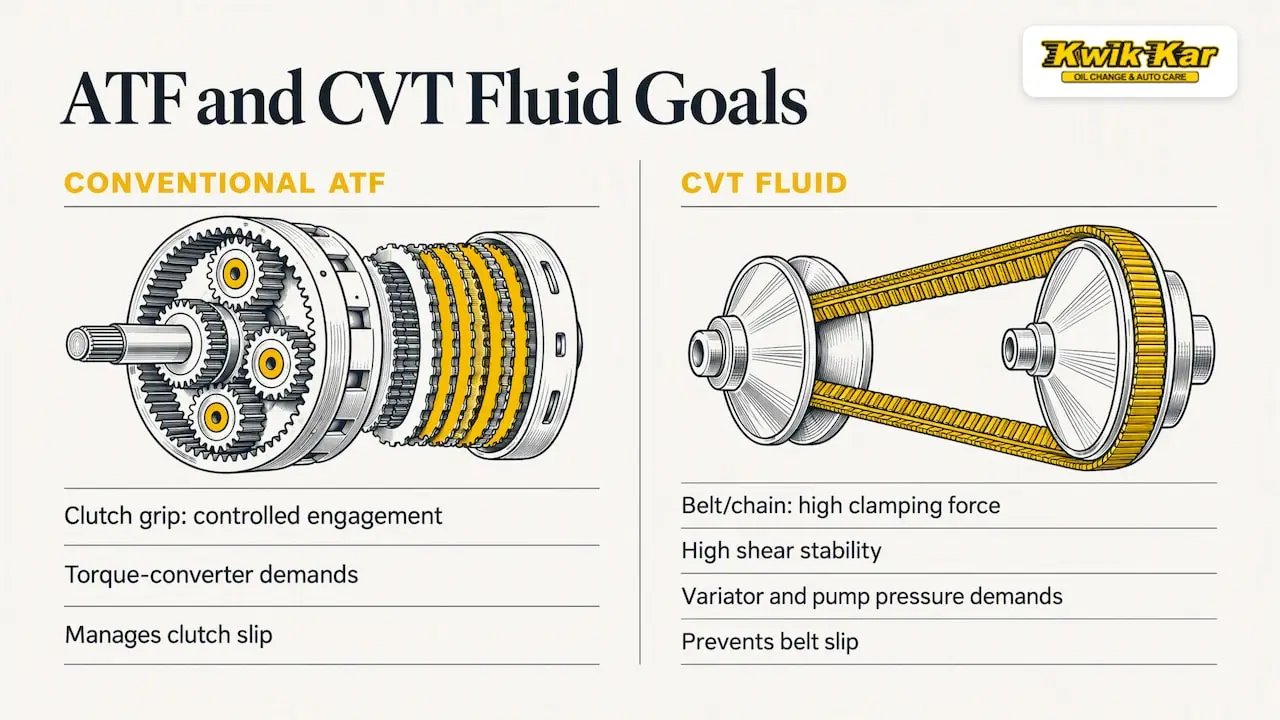
A simple way to think about it: ATF is tuned to manage slip in a clutch, while CVT fluid is tuned to prevent slip at the belt. Different goals, different chemistry.
Side-by-side comparison
| Feature | Conventional ATF | CVT fluid |
|---|---|---|
| Used in | Traditional geared automatics with a torque converter | Belt- or chain-and-pulley CVTs |
| Main job | Control friction for clutches and bands, serve the torque converter | Maintain belt or chain grip, resist shear, protect pulleys |
| Typical wear concern | Clutch and band wear, shift quality | Belt, chain and pulley wear under high clamping force |
| Substituting the other | Can cause belt slip, poor ratio control and damage | Also wrong for a geared automatic |
| Where to find the spec | Owner’s manual | Owner’s manual |
The last row is the one that matters. The labels on the bottle are a starting point, but the specification printed in your manual is the answer.
Can you use ATF in a CVT?
No. This is one of the clearest points in the industry, and automakers say so in their own documents.
- Nissan states that ATF or manual transmission fluid may damage its CVTs.
- A GM service document filed with NHTSA warns that using anything other than the specified CVT fluid may result in internal transmission damage, and says the Jatco CVT fluid in that application is not compatible with DEXRON VI or with another Saturn CVT fluid.
- Ford’s Motorcraft fluid guidance says CVT fluids have functional characteristics very different from other ATFs, and that the wrong one can cause severe damage and affect performance. That chart was published in 2007 and covers older model years, so use it as an illustration of the principle and check the current manual for your vehicle.
The reverse is also true. CVT fluid does not belong in a traditional automatic. Some fluid makers do sell multi-vehicle products, but Fuchs Lubricants notes that these cannot match the performance of dedicated, OEM-approved fluids for specific transmission types such as CVTs. The same company explains that the demands on a transmission fluid can’t all be optimized at once, which is why fluids are formulated for a particular transmission type.
What about “universal” or “multi-vehicle” fluids?
Some bottles claim to cover many applications, including certain CVTs. Two cautions apply. First, the claim only counts if the bottle states that it meets your automaker’s specification, not just that it is “compatible.” Second, a fluid that covers many cars is a compromise by design. If your manual names a specific fluid, we’d rather see that fluid in your car than a general-purpose substitute.

What happens if the wrong fluid goes into a CVT?
The outcome depends on the vehicle, how much wrong fluid went in and how far the car is driven afterward. We can’t tell you in advance what will happen to a specific car, and anyone who promises a precise outcome is guessing. What the documentation shows is the range of risks.
- Reduced performance and limp mode. A Nissan service bulletin on file with NHTSA says an incorrect fluid type can make a CVT enter fail-safe mode prematurely as fluid temperature rises, which reduces engine performance. The bulletin specifies Genuine Nissan NS-2 CVT fluid for that application.
- Belt or chain slip and wear. Without the traction the belt needs, it can slip against the pulleys, and slipping under load wears metal surfaces.
- Erratic shifting or ratio behavior. Drivers describe shuddering, surging, hesitation or a whining noise. These are symptoms, not a diagnosis, and several other problems can produce them.
- Damaged seals and clutches. Fluid chemistry that doesn’t match what the transmission was built for can stress parts that depend on it.
Fluid level matters too. Transmission Digest reports that low fluid can cause improper shifting and let air into the valve body, while overfilling can cause slipping and incorrect ratio codes. Lack of lubrication can damage the belt or chain. It also notes that an overfilled CVT can aerate its fluid on contact with moving parts, which affects pulley and solenoid control. So correct fluid and correct level are a pair: getting one right doesn’t excuse the other.
Signs your fluid may be wrong, low or worn
Watch for these, especially after a fluid service:
- Hesitation or a delay when you shift into drive or reverse (see our guide to delayed engagement in a transmission)
- Shuddering or jerking while accelerating gently
- Whining or humming that changes with speed
- A transmission warning light or reduced power
- Fluid that looks dark or smells burnt (more on that in our article on burnt transmission fluid)
If any of these show up, particularly with a warning light or noticeably reduced power, have the car inspected before continuing to drive it. A transmission is a safety-relevant component: sudden loss of power on a Dallas-area highway is a real hazard.
How do you find the right fluid for your car?
Start with the owner’s manual. Look in the capacities and specifications section for the exact fluid name or specification. Ford’s own guidance says the same: check the manual, and if its quick-reference charts don’t cover your model year, the owner’s manual takes precedence.
A few practical points:
- Find the transmission type. If the manual mentions “CVT,” “Xtronic,” “Lineartronic” or a similar name, your fluid is a CVT fluid, not ATF. If it lists a number of speeds, such as a six- or eight-speed automatic, it is a geared automatic.
- Match the exact name. Automakers often have more than one CVT fluid. Subaru, for example, specifies CVTF-II (green) for CVTs in naturally aspirated H4 vehicles and a different fluid, CVT ATF High Torque (orange), for turbo H4 and H6 CVTs. Two CVT fluids from one brand are not necessarily swappable.
- Don’t go by color. Conventional ATF is generally red, but CVT fluid has no standard color, and some CVT fluids are red too. A red bottle doesn’t tell you it’s right.
- Check the fluid type on the label. Look for your automaker’s specification on the bottle, not only a general “works with” claim.
- Ask for it in writing. When a shop services your transmission, you should be able to see the fluid specification on the invoice or inspection.
Some engineers are working on fluids that balance the needs of both transmission types. Honda has published research on a fluid adjusted to meet the friction characteristics of both conventional automatics and CVTs, aimed at longer intervals. That is research, and it doesn’t mean you can pour whatever you like into your car. Use what the manual says.
What if ATF has already gone into your CVT?
If you or a shop added conventional ATF to a CVT, don’t treat it as a small mistake you can ride out.
- Stop driving it as much as possible. Short, gentle trips to a shop are better than a long commute or highway run.
- Don’t try to dilute it. Topping off with CVT fluid afterward leaves a mixture that is still wrong, and it may overfill the unit.
- Get the fluid properly replaced. A technician needs to drain the incorrect fluid and refill with the specified one. Manufacturer service documents also stress doing this correctly: one U.S. service document says CVTs require CVT fluid even when flushing the cooler, and emphasizes setting the fluid level correctly and performing any required learned-value reset or initialization after service.
- Have the transmission checked. If the car already shuddered, slipped or went into reduced power, ask for a diagnostic scan and inspection so any damage is found early. Our engine diagnostic service can read stored codes and begin that process.
If the car sat only briefly with the wrong fluid and you caught it quickly, the odds are better than if it was driven for thousands of miles. But we can’t promise an outcome without looking at the vehicle.
Is CVT fluid vs. ATF the only choice? Other fluids to know
Transmission fluid isn’t one product. Castrol’s overview groups them into manual, automatic and CVT-specific fluids: manual fluid supports the synchronizers and gears, ATF provides friction for clutches and bands, and CVTs should use CVT-specific fluid.
You may also run into dual-clutch fluids, which are a separate category, and some manual gearboxes that don’t use ATF at all. Differentials and transfer cases use their own gear oils as well. If your car is all-wheel or four-wheel drive, those services belong on your maintenance list too. We cover them in our articles on differential fluid changes and transfer case service.
How often should CVT fluid be changed?
There isn’t one number. Some manufacturers call for periodic changes, some list the fluid as lifetime fill under normal driving, and many specify shorter intervals under severe use such as towing, heavy stop-and-go traffic or high heat. Texas summers and the traffic on I-635, Highway 114 and Highway 183 can all count as demanding conditions, so read the severe-service schedule in your manual and don’t assume the lifetime claim fits your driving.
A few things we’d do:
- Follow the interval and the specified fluid in your manual.
- If you bought the car used and don’t have its service history, ask for a fluid inspection before assuming it has been done.
- Have fluid condition and level checked as part of a regular inspection, since fluid condition and level determine how well the transmission performs.
For general background on what a fluid service involves, see our guide to transmission fluid changes. It is written for a wider range of transmissions, so use your manual to confirm what applies to a CVT.
Our perspective
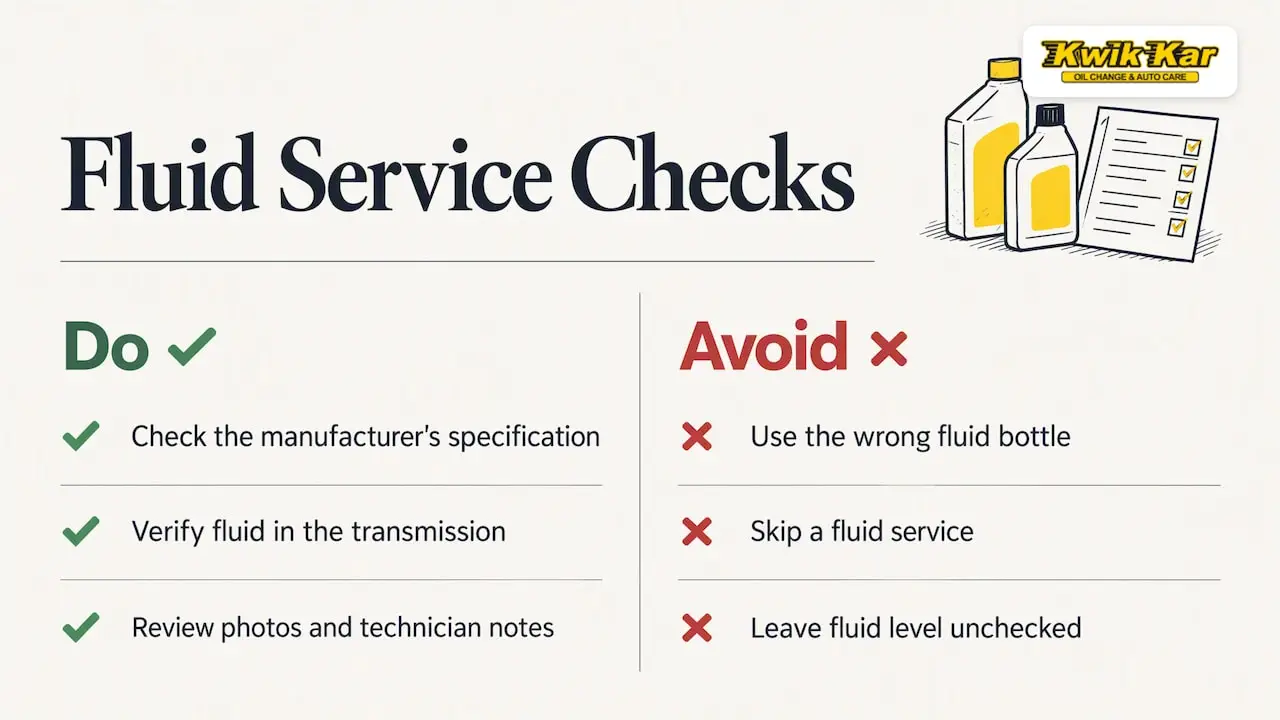
Most of the transmission trouble that reaches a shop doesn’t begin with a failing part. It begins with a small decision: the wrong bottle, a skipped service, a fluid level that was never checked. Because CVT and ATF look so alike in a pan, people assume they are close cousins. They are not, and the cost of treating them that way tends to be much larger than the cost of looking up the correct specification.
Our approach is to start with what your vehicle’s manufacturer specifies, then verify what is actually in the transmission. Our ASE-certified technicians do that work, and our Digital Vehicle Inspections send photos, videos and technician notes to your phone, so you can see fluid condition and any findings for yourself rather than taking our word for it. We give recommendations you can check, and we would rather tell you a fluid service isn’t needed yet than sell one you don’t need. Qualifying repairs are backed by our 24-month/24,000-mile warranty.
— Kwik Kar
Have your transmission fluid checked in Irving
If you’re unsure what fluid is in your car, or a recent service left you with new shifting problems, we can inspect it and compare what we find against your manufacturer’s specification. Our transmission and clutch service covers fluid services and repairs for cars, SUVs and light trucks, and we welcome drivers from Las Colinas, Grand Prairie, Euless, Coppell, Grapevine and Dallas. Ask us about any current discounts for military, first responders and our Wednesday ladies’ offer when you book.

Fleet manager? We also handle recurring maintenance for company vehicles through our fleet services.
FAQ
Can I mix CVT fluid and ATF if I’m in a pinch?
No. Mixing leaves you with a fluid that matches neither requirement, and automakers warn against using anything other than the specified CVT fluid. If you’re stranded with a low level, it’s better to get to a shop than to add a guess.
Is CVT fluid just a type of ATF?
Not in the sense that matters. Both are transmission fluids, but CVT fluid is engineered for traction at a belt or chain and pulley, while ATF is engineered to manage friction in clutches and torque converters. Treat them as separate products with separate specifications.
How can I tell what fluid my car takes?
Check the capacities and specifications section of your owner’s manual for the exact fluid name. If you don’t have the manual, a technician can look up the specification for your year, model and transmission. Don’t rely on color or on a bottle’s general claims.
Can the wrong transmission fluid ruin a CVT?
It can. Automaker documents cite damage, reduced performance and premature fail-safe mode from the wrong fluid. How serious it gets depends on the vehicle and how long it was driven, so have it checked promptly.
Does a CVT service need a state inspection in Texas?
No. Since January 1, 2025, non-commercial vehicles no longer need a Texas safety inspection before registration. Vehicles registered in emissions counties, including Dallas County, still need emissions tests, and commercial vehicles still need a passing safety inspection. A fluid service is about protecting the transmission, not passing an inspection.
Book your service
Call us at (469) 276-7337 or stop by 2100 Carl Rd, Irving, TX 75061 to schedule a transmission fluid check. You can also learn more at kkirvingtx.com. Bring your owner’s manual if you have it, and we’ll go through what your car needs.
Sources
- Nissan USA: XTRONIC CVT overview
- Infineum: Power transmission fluids
- Transmission Digest: CVT maintenance basics
- GM service document: Transmission General Description (NHTSA)
- Ford/Motorcraft automatic transmission fluid chart
- Fuchs Lubricants: Why one-fits-all transmission fluids put your car at risk
- Nissan service bulletin on CVT fail-safe mode (NHTSA)
- Ford: How to find the recommended transmission fluid
- Subaru service bulletin on CVT fluids (NHTSA)
- Castrol: Automatic vs manual transmission fluid types
- Honda Technical Review: Development of a long life CVT fluid
- Service document on CVT replacement and cooler flushing (NHTSA)
- Texas DPS: Vehicle Safety Inspection Program changes