
When your car hesitates on acceleration, the engine is not getting the right mix of air, fuel or spark at the moment you ask for power, or the transmission is not passing that power along smoothly. The usual suspects are worn spark plugs, a restricted fuel filter or dirty injectors, a vacuum leak, a failing sensor, a dirty throttle body, or a transmission problem. A scan and a hands-on inspection tell you which one it is. Guessing by replacing parts usually costs more.
This guide explains what hesitation feels like, the causes in the order a technician tends to look at them, what you can check safely, and when to stop driving and get the car inspected. We are Kwik Kar Oil Change & Auto Care at 2100 Carl Rd in Irving, and we see this complaint often, from Las Colinas commuters to families running errands in Grand Prairie and Euless.
TL;DR
- Hesitation, stumbling or sluggish response when you press the gas usually traces to the fuel, ignition, air intake, sensor or transmission systems.
- A steady check-engine light means get the car checked soon. A blinking one means drive as little as possible and get help quickly.
- Hesitation while merging, passing or pulling out into traffic is a safety issue, not just an annoyance. Have it inspected before it gets worse.
- A scan tool reads the codes, but a technician still has to test the parts behind them. Our Digital Vehicle Inspections send photos, video and notes to your phone.
- Some brief hesitation is normal in certain vehicles, so describe exactly when it happens.
Table of Contents
- What does hesitation on acceleration feel like?
- What causes a car to hesitate when accelerating?
- What can you safely check yourself?
- When is hesitation a safety problem?
- How we diagnose hesitation
- Our perspective: scan first, replace second
- Get it looked at in Irving
- A note on Texas inspections
- FAQ
- Sources
What does hesitation on acceleration feel like?
Drivers describe it in different words, but it is the same family of symptoms:
- A short lag after you press the pedal, then the car catches up.
- A stumble, stutter or “flat spot” at a certain throttle position, such as pulling away from a stop sign.
- Sputtering or jerking while you climb through the gears.
- A car that feels sluggish, as if it is holding back, even though the engine sounds fine.
- Surging, where power comes and goes while your foot stays still.
The details matter. A hesitation that shows up only on a cold start points somewhere different than one that appears at highway speed, under load, or only when the A/C is on. Write down when it happens before you call a shop. It speeds up the diagnosis.
Is any hesitation normal?
Sometimes. A federal service bulletin for certain vehicles describes a brief sag or hesitation when a driver coasts below about 15 mph with the throttle closed and then applies the throttle aggressively. The manufacturer says that behavior is a normal characteristic of torque management, designed to reduce driveline clunk. That is a narrow situation. If your car hesitates during ordinary acceleration, with a steady pedal and no coasting beforehand, treat it as a symptom worth checking.
What causes a car to hesitate when accelerating?
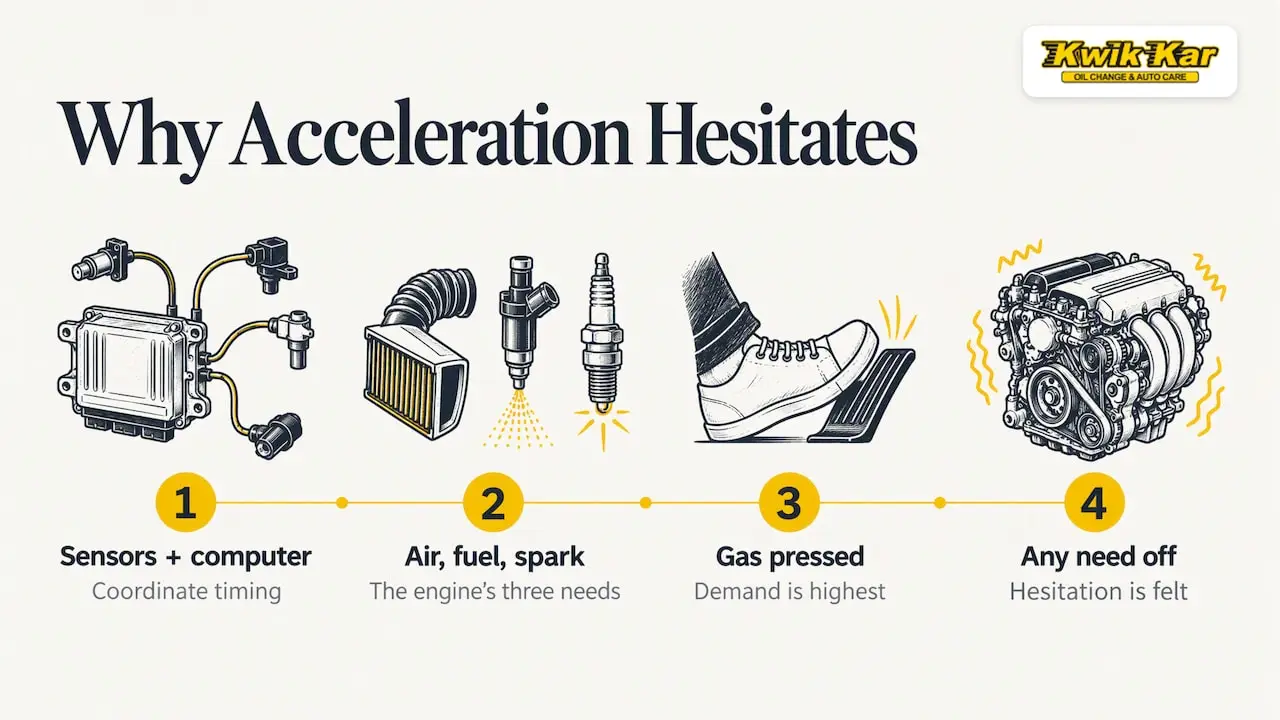
An engine needs three things at the right time: air, fuel and a spark, all controlled by sensors and the engine computer. When any one of them is off, you feel it right when demand is highest, which is when you press the gas. A technician generally works through these groups.
Fuel delivery problems
This is the most common group. The engine needs more fuel the moment you accelerate, and a restricted system cannot keep up.
- Clogged fuel filter. It limits flow, so the engine runs lean under load. The car may idle fine and then stumble when you ask for power.
- Weak fuel pump. A pump that cannot hold pressure causes hesitation, especially going uphill or at highway speed.
- Dirty or failing fuel injectors. Deposits distort the spray pattern, so cylinders get an uneven mix. Often you also feel a rough idle.
- Poor fuel quality. A federal service bulletin notes that contamination by water, sediment or excessive alcohol can disrupt combustion and show up as hesitation or sputtering. If the problem began right after a fill-up, tell your technician which station you used.
If injectors are the suspect, our fuel injector and pump repair service covers testing and repair. Before you buy a bottle of cleaner or book a cleaning service, read why we recommend a diagnostic first when fuel system cleaning comes up, especially past 60,000 miles.
Ignition system wear
Spark plugs, ignition coils and plug wires fire the mixture. When a plug is worn or a coil is weak, a cylinder misfires under load. At idle the engine can mask it, but when you accelerate the demand rises and the misfire becomes obvious as a stumble or shudder. Misfires often set a code, and a flashing check-engine light during a misfire is a signal to slow down and stop driving the car hard.
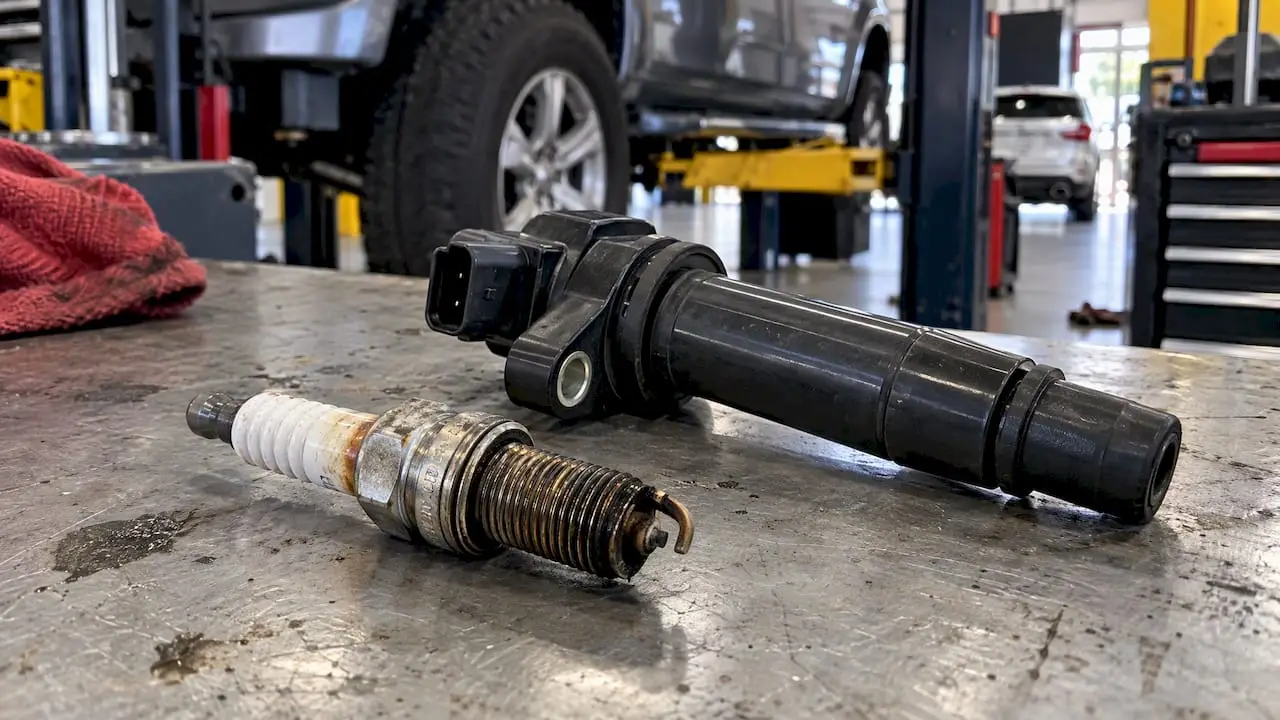
Spark plugs are a scheduled maintenance item, with replacement intervals set by the manufacturer in your owner’s manual. Skipping them is one of the more avoidable causes of hesitation.
Air intake faults and vacuum leaks
The engine computer measures incoming air and then adds fuel to match. Anything that upsets that measurement causes trouble:
- A dirty or failing mass airflow (MAF) sensor reports the wrong air volume, so the fuel calculation is wrong.
- A vacuum leak from a cracked hose or loose intake boot lets unmetered air in, leaning out the mixture.
- A clogged air filter restricts airflow, though it usually causes sluggishness rather than a sharp stumble.
Another frequent culprit is carbon buildup in the throttle body, which interferes with smooth airflow when you move the pedal. We cover that in detail in our article on throttle body cleaning and throttle response.
Sensors and engine controls
Modern cars rely on sensors for almost every decision. The throttle position sensor tells the computer how far you pressed the pedal. The oxygen sensors report what the exhaust looks like. The crankshaft and camshaft sensors track engine timing. If one gives bad data, the computer commands the wrong fuel or spark, and you feel hesitation. Sensor failures usually leave a stored code, which is why reading the codes is the first step.
A broader look at how technicians separate these causes is covered in this overview of common hesitation causes and how they are diagnosed, which follows the same fuel, air and spark logic described here.
Transmission and drivetrain problems
Not every hesitation comes from the engine. If the engine revs but the car does not respond, or you feel a jerk as the transmission shifts, the cause can be low or worn fluid, worn internal parts, or a torque converter issue. Some manufacturers have even documented specific faults. For example, a GM special coverage bulletin describes a transmission oil-temperature-sensor connection condition on certain 2016 vehicles with the 6.2L engine that can cause hesitation, with the wiring harness replaced when it is diagnosed.
Clues that point toward the transmission: the engine speed rises without a matching gain in speed (a slipping feel), shifts that bang or drag, or a delay when you move the selector into gear. Our guide on delayed engagement in your transmission walks through that last symptom, and our transmission and clutch repair page lists what we handle. With manual cars, a worn clutch can also feel like hesitation, because the engine speeds up while the car does not.
Limp mode and protection modes
Some vehicles intentionally reduce power when the computer detects a serious fault. A Hyundai service campaign for certain 2017 to 2018 Sonata Hybrid and Plug-In models describes an Engine Protection Mode that slows acceleration and limits speed and RPM to roughly 1,800 to 2,000. Other makes have their own versions. If your car suddenly feels capped, with a warning light on the dash, that is the computer protecting the engine. Do not keep pushing it.

What about diesel vehicles?
Diesels share some causes with gas engines, such as a restricted fuel filter, weak fuel supply or contaminated fuel. They also add parts that gas engines lack: turbochargers, exhaust gas recirculation valves, diesel particulate filters and high-pressure injection systems. Any of these can limit power under load. Because diesel systems are expensive to repair and sensitive to contamination, an early inspection is the smart move when a diesel hesitates. Call us first to confirm we can service your specific vehicle, since we focus on cars, SUVs and light trucks.
What can you safely check yourself?
You do not need tools for the first few steps, and none of them require getting under the car.
- Look at the dashboard. An illuminated check-engine light means the system has detected a problem. The EPA says it indicates the vehicle needs service as soon as possible, and that on-board diagnostics are designed to catch faults, often before you notice a loss in performance.
- Note whether the light is steady or blinking. EPA guidance says a steady light means seek attention soon, while a blinking light means you should minimize driving and get repair help quickly.
- Think about the last fill-up. If hesitation started right after fueling, say so. Fuel quality is a real cause.
- Track when it happens. Cold or warm engine, light or heavy throttle, low or high speed, A/C on or off, uphill or flat.
- Check the maintenance record. Overdue spark plugs, air filter or fuel filter service are easy things to find in your paperwork.
- Listen and feel for the transmission. Jerking at shift points or revving without speed points away from the engine.
What we do not suggest: spraying cleaners into the intake, unplugging sensors, or driving for weeks hoping it clears. Those can turn a small repair into a larger one.
When is hesitation a safety problem?
Hesitation is a safety concern when you rely on power at a specific moment: merging onto Highway 183 or I-35E, crossing a busy intersection, passing, or climbing an on-ramp. A car that stumbles when you need to move is unpredictable. Get it inspected promptly if:
- The check-engine light is flashing.
- The car stalls, surges or loses power at speed.
- You smell fuel, or see smoke from the exhaust or engine bay.
- Hesitation is getting worse from week to week.
- A warning light appears along with the power loss.
If the car loses power in traffic, move to a safe place and call for a tow instead of limping it home. A misfire left alone can also damage the catalytic converter, which is a far bigger bill than a set of spark plugs.
How we diagnose hesitation
Good diagnosis moves from the symptom to the proof. At our Irving shop, our ASE-certified technicians typically follow a process like this:
- Listen to your description. When, how often, and under what conditions.
- Scan for codes. Stored and pending codes show which system flagged a problem, though a code points to a circuit or system and not always to a failed part.
- Check live data. Fuel trims, airflow readings and throttle position show how the engine is behaving as it hesitates.
- Inspect and test. Fuel pressure, ignition components, intake hoses, filters and the throttle body are examined.
- Report back clearly. With a Digital Vehicle Inspection, photos, video and technician notes come to your phone, so you can see what we see before you approve anything.
We do not publish a flat price for diagnostics because the work depends on the vehicle and the symptom, so call us for a quote. If you want to see what is covered, our engine diagnostic page explains the service. A related symptom is covered in our guide to diagnosing a rough idle step by step, since hesitation and rough idle often share a cause.
Our perspective: scan first, replace second
The most expensive way to fix hesitation is the parts cannon: new plugs, then a sensor, then a filter, hoping one of them sticks. Because so many systems produce the same symptom, we think the honest approach is to confirm the cause before recommending a repair. That is why we lean on Digital Vehicle Inspections. You see the photos and the notes, we explain what is urgent and what can wait, and you decide.
We also think maintenance is the cheapest hesitation fix. Spark plugs, filters and fluids done on the manufacturer’s schedule prevent many of the causes above, which is what our factory-scheduled maintenance and tune-up services are for. When a repair is needed, qualifying repairs are backed by our 24-month/24,000-mile warranty, and we are RepairPal certified and CARFAX Top-Rated. Drivers in Irving, Las Colinas, Coppell and Grapevine should not have to wonder whether a recommendation is padded.
— Kwik Kar
Get it looked at in Irving
If your car is hesitating, stumbling or feeling sluggish, we can scan it, inspect the fuel, ignition, air and transmission systems, and send you a clear report with photos and video. Same-day service may be available depending on the schedule, so call ahead. Military members, first responders and, on Wednesdays, ladies can ask about our service discounts. See our engine diagnostic service or call (469) 276-7337.

If a larger repair is needed, third-party financing options may be available, subject to provider approval and terms.
A note on Texas inspections
A hesitating engine can also cause trouble at registration time. Since January 1, 2025, Texas no longer requires yearly safety inspections for noncommercial vehicles, but vehicles registered in emissions counties still need emissions testing, and Dallas County is on that list. Commercial vehicles are still subject to safety inspections. A misfire or an active check-engine light can interfere with emissions readiness, so fixing a hesitation problem before your test makes sense. Confirm the current rules with the Texas DMV or DPS for your vehicle.
FAQ
Can a bad fuel filter cause slow acceleration?
Yes. A clogged fuel filter restricts flow, so the engine may idle normally but starve for fuel when you press the gas. You typically notice it under heavy load, such as climbing a hill or merging. A technician can confirm it by testing fuel pressure.
Why does my car hesitate only when I first start driving?
Cold-start hesitation often points to the fuel mixture, a dirty throttle body, a sensor reporting wrong temperature or airflow data, or a vacuum leak. Because these causes overlap, a scan and live-data check separates them quickly. Tell the technician it happens only when cold.
Can a transmission problem feel like engine hesitation?
Yes. Low fluid, worn parts or a torque converter fault can cause jerking or a delay that feels like hesitation. A clue is that the engine revs up but the car does not gain speed. Get it checked soon, since transmission damage tends to grow.
Is it safe to drive with a hesitating engine?
It depends on the severity. A mild, occasional stumble can be driven to a shop. A flashing check-engine light, stalling, or power loss at speed means you should minimize driving and get help. Never rely on a car that might not accelerate when you merge.
How do I improve my car’s acceleration?
Start with the basics: keep up with spark plugs, air and fuel filters, and fluids on the manufacturer’s schedule, and fix any check-engine light promptly. If acceleration has recently dropped, a diagnostic finds the specific cause, which is better than adding parts.
Sources
- NHTSA service bulletin: normal sag or hesitation characteristic
- NHTSA service bulletin: fuel quality and driveability
- NHTSA GM special coverage bulletin: transmission harness
- NHTSA Service Campaign 982: Engine Protection Mode
- EPA fact sheet on the check-engine light and OBD
- EPA: what to do with the check engine light
- FOX 4: Texas inspections and emissions testing
- Common hesitation causes and diagnosis