A rhythmic click or pop that shows up when you turn, and speeds up as you accelerate through the turn, is the classic sound of a worn outer CV joint on a CV axle. A clunk when you shift into gear or get on and off the throttle usually points to the inner joint. A hum or growl that stays with you on a straight road is more often a wheel bearing. If you hear any of these, have the car inspected soon, because a worn joint can fail completely.
We see all three sounds at our shop on Carl Rd, and drivers often describe them the same way: “something clicks when I pull out of a parking lot.” This guide helps you sort out what you are hearing, what else it could be, and how urgent it is.
TL;DR
- Clicking or popping in turns usually means a worn outer CV joint. Clunking on acceleration or deceleration can mean a worn inner joint.
- A steady hum or growl that gets louder with speed, even when driving straight, is more typical of a wheel bearing.
- Grease flung around the inside of the wheel suggests a torn CV boot. A torn boot caught early can sometimes be handled before the joint is damaged.
- A light, unchanged click allows a short drive to a shop. Vibration, clunking, tight steering or louder clicking means stop driving and call for help.
- We can inspect it and send photos and video to your phone through a Digital Vehicle Inspection. Call (469) 276-7337.
Table of Contents
- What does a bad CV axle sound like?
- Why does it click when turning?
- CV axle noise vs. wheel bearing noise
- Other signs of a failing CV axle
- What does a torn CV boot look like?
- A simple parking-lot check
- Is it safe to drive with CV axle noise?
- What does CV axle repair involve, and what does it cost?
- Get your CV axle noise checked in Irving
- Does a Texas inspection check the CV axle?
- FAQ
- Sources
What does a bad CV axle sound like?
A CV (constant velocity) axle is the shaft that sends power from the transmission to a front wheel on most front-wheel-drive and all-wheel-drive vehicles. Each end has a flexible joint packed with grease and sealed by a rubber boot. Those joints let the wheel turn and move over bumps while still receiving power.
The sound depends on which joint is worn:
- Outer joint: a click or pop during turns. Vehicle Service Pros identifies clicking or popping while turning as an outer-joint symptom.
- Inner joint: a clunk or shudder when you accelerate, let off the gas or shift into Drive or Reverse. The same source notes that a clunk when shifting into gear or changing throttle can point to a CV joint, but that differential backlash and suspension parts can mimic it.
- Advanced wear: the click becomes more frequent and louder, and you may feel vibration that grows with speed.
Why the click happens: according to the GSP North America instruction sheet, wear or indentations in the cage, race or housing let the joint’s balls move through worn areas, and that produces the click. It is usually loudest under power in a tight turn, such as pulling out of a driveway with the wheel cranked over.
Why does it click when turning?
In a straight line, the outer joint runs nearly straight and the load on the balls is spread evenly. In a sharp turn, the joint bends to its maximum angle and the balls ride at the edges of their tracks. If those tracks are worn, the balls no longer roll smoothly, so you hear a repeating click that matches wheel speed. That is why the noise typically gets faster as you move faster, and why it is most obvious in parking lots, U-turns and tight intersections.
Most clicking when turning comes from this wear, but not all of it. Other causes include:
- A worn strut mount or suspension component
- A loose or damaged wheel cover or brake hardware
- A worn tie rod end or ball joint
- A failing wheel bearing, which tends to hum instead of click
That is why a short inspection beats guessing, especially because several of these parts are safety-related.
CV axle noise vs. wheel bearing noise
These two get confused more than any other pair. The easiest separator is when the noise happens.
| What you notice | More likely CV axle | More likely wheel bearing |
|---|---|---|
| Sound type | Click, pop or clunk | Hum, growl or grind |
| When it happens | Tight, low-speed turns; throttle on and off | Continuously, and louder as speed rises |
| Driving straight | Usually quiet | Noise is still present |
| Visual clue | Grease around the inside of the wheel | Often none |
| Feel | Vibration under acceleration | Roughness or play in the wheel |
This pattern matches what GSP North America describes: CV trouble clicks or pops in tight, low-speed turns and may vibrate under acceleration, while a failing bearing hums, grows or grinds continuously and gets louder with speed. Vehicle Service Pros adds that a constant growl or hum while driving straight is most likely a worn wheel bearing, though dry CV joints and other driveline bearings are alternative causes.
If your main complaint is a hum that changes with road speed, our guide to a humming noise at speed walks through what to report. If the steering wheel shakes on the highway, see steering wheel vibration at 55 to 75 mph.
Other signs of a failing CV axle
Noise is the headline symptom, but it is not the only one.
Grease on the inside of the wheel
Grease on the wheel or around the suspension is a common sign of a damaged boot. MOOG lists grease on the wheels from a damaged CV boot and excessive vibration, especially at higher speeds, among the signs of a failing axle.
Vibration that changes with speed
A worn or out-of-balance axle can shake the car under acceleration. This overlaps with tire balance, bent wheels and worn engine or transmission mounts, so the timing of the shake matters. Our article on transmission mount symptoms can help you separate a mount problem from a driveline one.
Tight or notchy steering
PartCatalog notes that a severely seized or worn joint can restrict steering movement or create a tight, resistant feel, sometimes with a scraping sensation in turns, according to its CV axle symptoms guide. That is a stop-driving symptom, not a wait-and-see one.
Clunking over bumps
A clunk that shows up only on rough pavement and not when turning or accelerating is usually a suspension issue instead. See causes of clunking over bumps and our shocks and struts service page.
What does a torn CV boot look like?
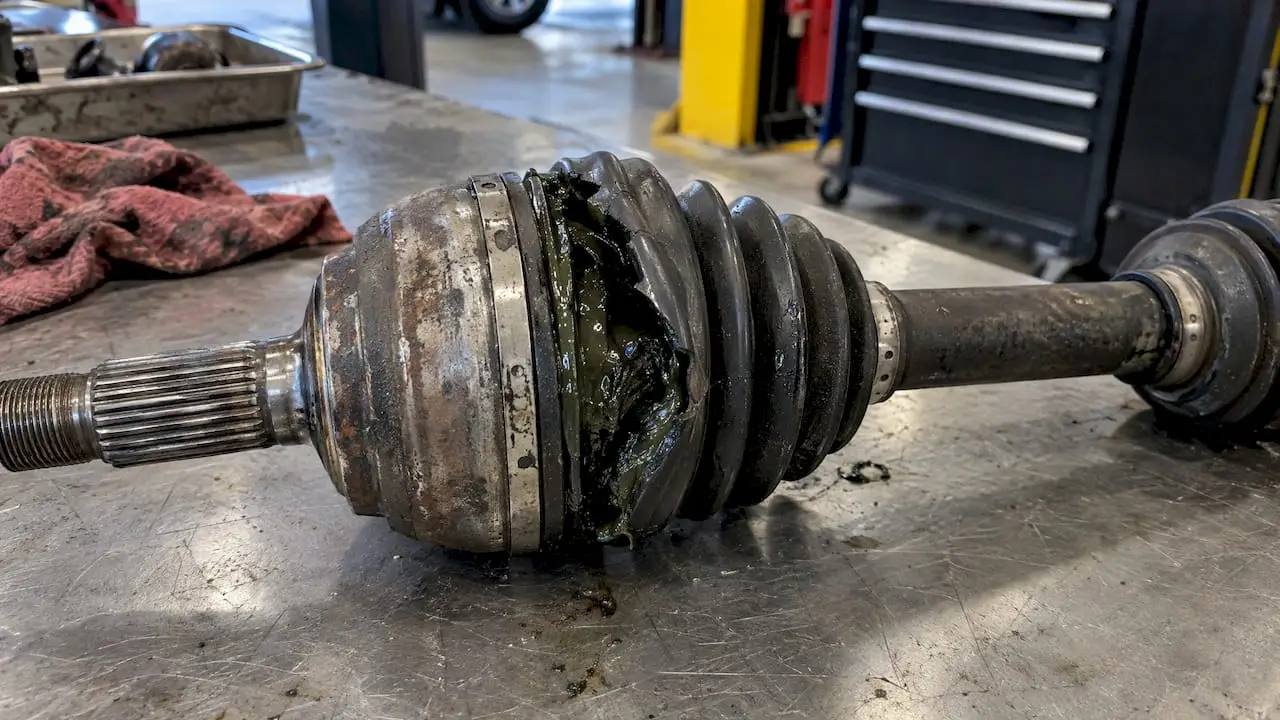
The rubber boot keeps grease in and dirt out. When it splits, grease leaks out and dirt gets in, and the joint wears faster. Haynes recommends inspecting the boot for cracks, splits, clamps, pliability and grease leakage.
Signs of a damaged boot include:
- A visible crack or split in the ribbed rubber
- Dark grease on the inside of the wheel, the knuckle or nearby components
- A loose or missing clamp
- Grease flung in a circular pattern around the joint’s rotation area
Not every smudge matters. BMW’s service guidance, published through NHTSA’s technical service bulletin database, calls for replacing a CV boot or half-shaft if the boot is cracked or torn, or if grease is visibly slinging onto surrounding components. Ordinary external dirt or normal grease buildup is a different situation.
A torn boot by itself does not always mean the joint has failed. Whether the boot can be addressed alone or the whole axle needs replacing depends on whether dirt has already gotten into the joint, and that is a judgment made with the wheel off the vehicle. AutoZone notes that if dirt has entered, replacing the complete axle may be necessary instead of just the boot. That is the strongest argument for checking a torn boot early.
A simple parking-lot check
You can gather useful information before you call. Do this only in an empty lot, at walking speed.
- With the car in Reverse, turn the wheel fully one way and move in a slow circle. Listen for clicking.
- Repeat in the other direction. CarParts.com suggests low-speed reverse circles in both steering directions to test an outer joint.
- For an inner joint, the same guide suggests alternating gentle acceleration and deceleration in reverse and listening for a clunk.
- Note which side the sound seems to come from, whether it is louder in left or right turns, and whether it changes when you accelerate.
- Look behind the front wheels with a flashlight for grease spray.
Pronounced clicking or clunking suggests wear. A quiet result does not rule anything out, so if the symptoms persist, have it checked. Write down what you noticed, because the pattern helps a technician narrow the cause quickly.
Is it safe to drive with CV axle noise?
It depends on how far along the wear is. Treat this as a ladder:
- Silent torn boot, no noise: schedule an inspection soon. This is the cheapest point to act.
- A light click that stays the same: short, local driving to a shop is reasonable. Engine Auditor suggests that a mild, unchanged click may allow short, local driving to a shop.
- Click getting louder or more frequent, or new vibration or clunking: avoid normal driving and arrange an inspection right away.
- Binding or notchy steering, grinding, or loss of power to the wheel: stop driving and arrange a tow.
PartCatalog’s guidance is to avoid driving with a suspected bad axle, especially on long trips or at highway speeds, and to treat vibration, grinding or loss of power as urgent. AutoZone adds that a severe failure can separate the joint so power no longer reaches the wheel, which may require a tow.
In Irving, that matters because many of us drive on I-35E, Highway 183 and the George Bush Turnpike. A joint that is merely noisy at 20 mph in a parking lot is a different risk at 70 mph with traffic around you. If the noise started recently and you have a highway trip planned, get it looked at first.
What does CV axle repair involve, and what does it cost?
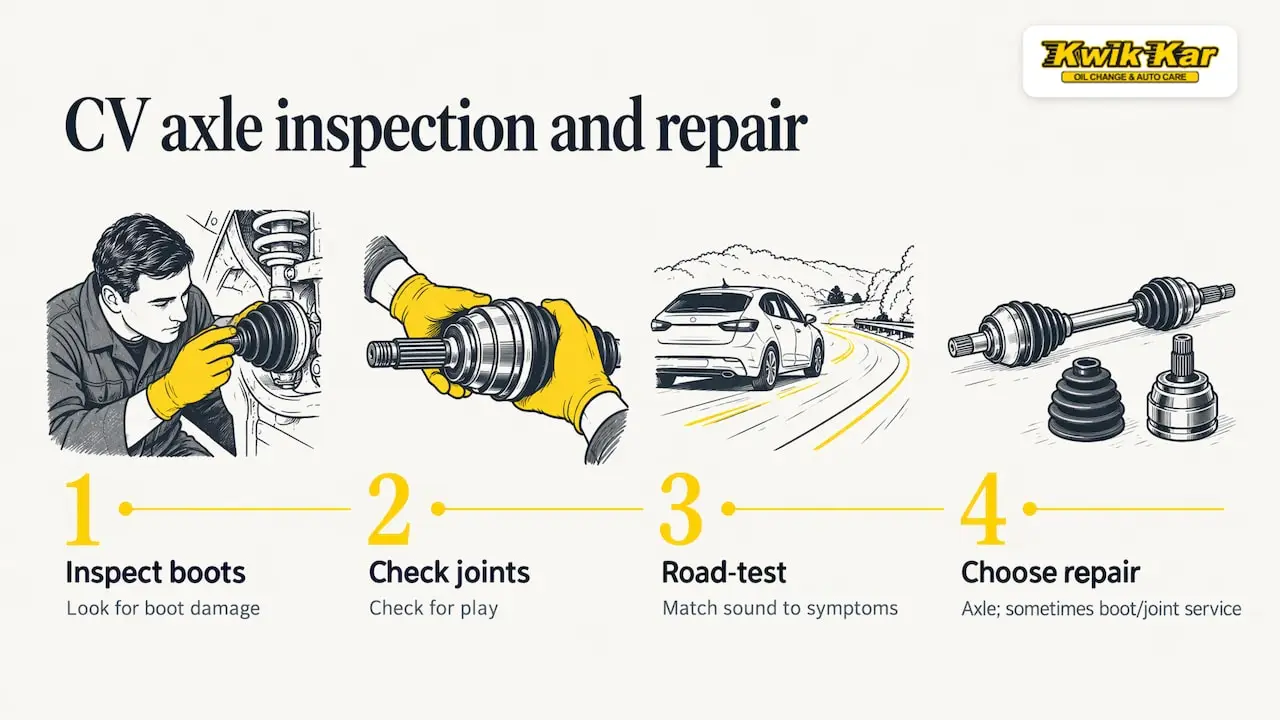
Typically a shop inspects the boots, checks the joints for play, and road tests to match the sound to the symptoms. Depending on what is found, the repair may be a new axle assembly or, in some cases, a boot and joint service. Replacing the full axle is common because it includes a new joint, boot and fresh grease as one unit.
Cost varies a lot by vehicle: front-wheel-drive economy cars, all-wheel-drive SUVs and trucks all use different parts, and one axle versus two changes the total. Wheel bearings, brake parts or a damaged boot nearby can add to the job. We do not publish a flat price for this repair, and we will not guess over the phone. We give you the price after we inspect your vehicle, and you approve the work before we start.
A related point: sometimes a noise that looks like a CV problem turns out to be a differential or transmission issue. Our differential service page and the article on delayed engagement in a transmission cover those cases.
Our perspective
We would rather show you a worn joint than describe it. When a car comes in with a click in turns, our ASE-certified technicians inspect the boots, joints, wheel bearings and nearby suspension, then send a Digital Vehicle Inspection to your phone with photos, video and notes. You can see the split boot or the grease spray yourself and decide with the facts in front of you.
The cheapest CV repair is the one you do early. A torn boot with no noise is a far easier conversation than a joint that has been clicking for months. That is why we recommend a quick look as soon as you notice grease or a new click, not after the noise gets loud.
Qualifying repairs at our shop are backed by a 24-month/24,000-mile warranty, and we hold RepairPal certification and CARFAX Top-Rated recognition. Our goal is simple: an honest recommendation, written down, with no pressure.
Kwik Kar
Get your CV axle noise checked in Irving
If you are hearing clicking, clunking or humming, we can road test the car, inspect the boots and joints, and tell you plainly what is worn and what is not. Same-day service may be available, so call ahead. For wider driveline or noise concerns, our engine diagnostic team can look beyond the axle, and our transmission and clutch page lists related drivetrain work.

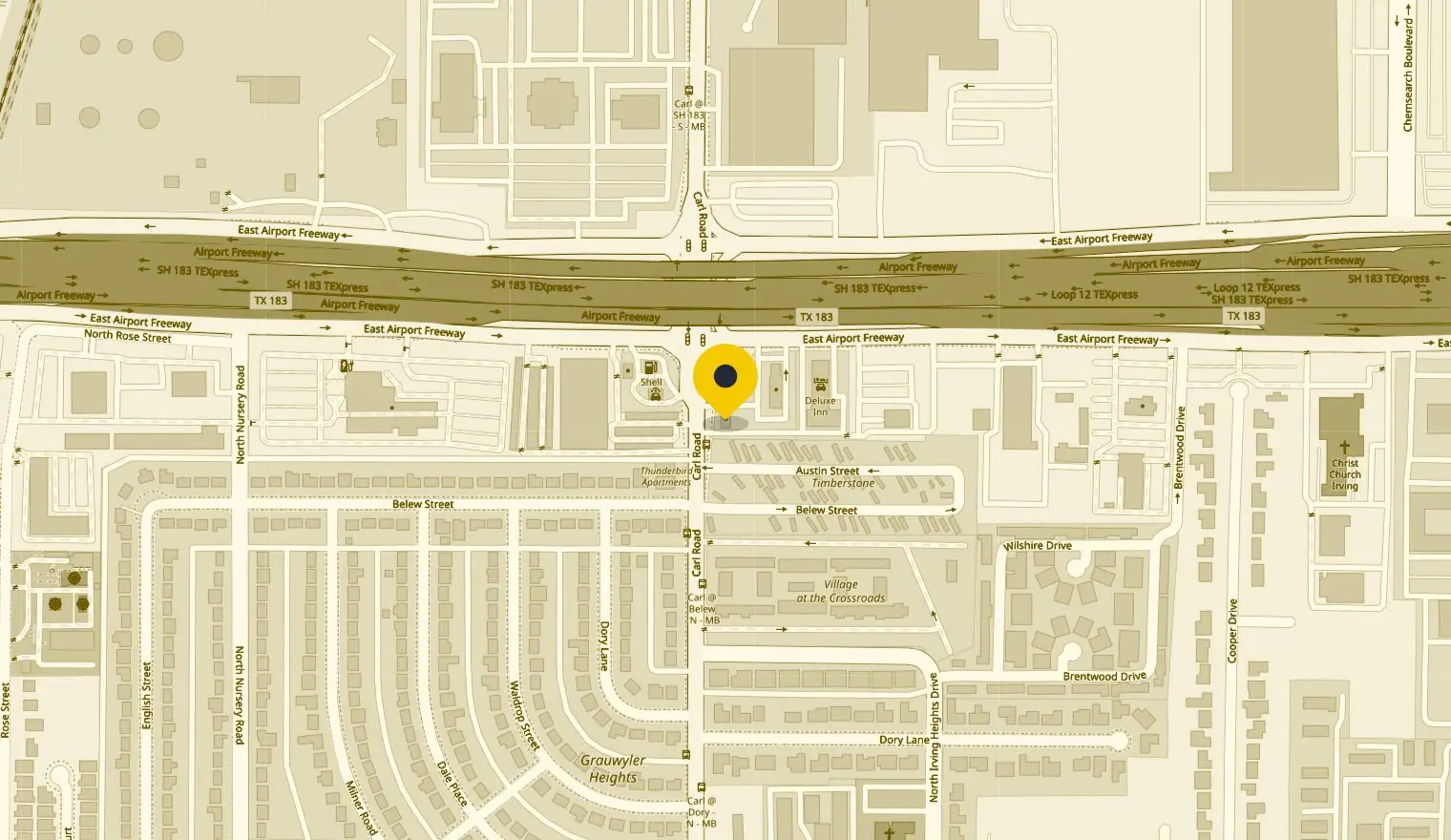
Visit us at 2100 Carl Rd, Irving, TX 75061, or see our website to schedule. We also welcome drivers from Las Colinas, Grand Prairie, Euless, Coppell and Grapevine. Military members and first responders can ask about our service discounts.
Does a Texas inspection check the CV axle?
Texas stopped requiring annual safety inspections for most non-commercial vehicles on January 1, 2025, according to the Texas Department of Public Safety. Vehicles registered in emissions counties, which include Dallas County, still need an emissions test before registration, and qualifying commercial vehicles still need a safety inspection. So there is no longer a yearly check that would catch a torn boot for you. Catching it is now up to you and your regular maintenance. Ask for a boot and axle look during an oil change or scheduled maintenance visit, especially at higher mileage.
FAQ
Can a bad CV axle make a noise like a bad wheel bearing?
Sometimes the sounds overlap, especially in late-stage wear, but the pattern usually differs. A CV axle tends to click or pop in turns or clunk with throttle changes, while a wheel bearing hums or growls and gets louder with speed. Because the two can feel alike, a technician should confirm by road test and inspection.
Is it safe to drive with CV joint noise?
A mild click that has not changed may allow a short drive to a shop. Vibration, louder clicking, clunking or tight steering means stop driving, because a joint that separates can cut power to the wheel. Do not take a noisy axle on a highway trip.
Can I just replace the CV boot?
Sometimes, if the boot is torn but the joint is quiet and has not been contaminated with dirt. If the joint is already clicking, or dirt has entered, replacing the full axle is often the better route. We will show you the condition in a Digital Vehicle Inspection.
Why does my car click only when I turn?
A click in turns is typical of a worn outer CV joint, because the joint is bent at its sharpest angle and the worn tracks let the balls click. Worn suspension or steering parts can also click, so have it inspected. If the car clicks and then will not start, that is a different problem; see car clicks but won’t start.
Sources
- Vehicle Service Pros: CV joint tech, overview of joint design and service tips
- Vehicle Service Pros: CV joint tech, a primer on constant velocity drive joints
- GSP North America: instruction sheet
- GSP North America: CV axle vs wheel bearing noise
- MOOG: why CV axles fail
- PartCatalog: signs your CV axle is failing
- Haynes: how to check and maintain CV joint boots
- NHTSA: BMW technical service bulletin on diagnosing front axle issues
- AutoZone: how to tell if your CV axles are going bad
- Engine Auditor: how long can you drive with a clicking CV joint
- Texas Department of Public Safety: vehicle inspection news and updates