If you turn the key or press the button and hear clicking but the engine never cranks, the cause is almost always electrical. Rapid clicking usually means the battery is too weak to turn the starter. One loud click usually points to the starter or its solenoid. Corroded or loose battery cables, a failing alternator and a faulty neutral safety switch can all produce the same symptom. Below, we explain how to tell them apart, what is safe to check in a parking lot, and when it is time to have a technician test it.
TL;DR
- Rapid, repeating clicks most often mean a weak or dead battery, or a poor connection at the battery terminals.
- One loud click more often points to a failed starter or starter solenoid, though a bad connection can still be the culprit.
- A jump-start that works once does not prove the battery is fine. The battery may be worn out, or the alternator may not be recharging it.
- Get the car to a safe spot first. If the engine stalls, power brakes and steering get harder to operate.
- In Irving, we can test the battery, starter and charging system and send you photos and notes from a Digital Vehicle Inspection before you approve any repair.
Table of Contents
- What the clicking sound is actually telling you
- Rapid clicking: the weak battery scenario
- Clean connections first: the cheap fix that fools people
- One loud click: starter, solenoid or something else
- Battery or alternator? Why a jump-start can mislead you
- What to do right now when your car clicks and won’t start
- Texas heat, short drives and your battery
- Our perspective: test first, replace second
- Get a no-start diagnosed in Irving
- How to avoid the next click
- FAQ
- Sources
What the clicking sound is actually telling you
When you turn the key, the battery sends current to the starter solenoid. The solenoid pushes a gear into place and closes a heavy circuit so the starter motor can spin the engine. The click you hear is usually that solenoid, or a relay, trying to do its job without enough power behind it.
So the sound is a clue about how much power is getting through, and from there about where it is being lost. According to AAA’s guide to why a car won’t start, rapid, repetitive clicking typically points to a low battery, while a single loud click often indicates a failed starter solenoid or a starter that gets power but fails to turn the engine.
Use the sound, plus what else the car does, to narrow it down:
| What you notice | Most likely cause | What to check first |
|---|---|---|
| Fast, machine-gun clicking, dim dash lights | Weak or discharged battery | Battery age, terminals, jump-start |
| Fast clicking, lights bright, battery fairly new | Corroded or loose terminals or cables | Clean and tighten the clamps |
| One loud click, lights stay bright | Starter or solenoid failure | Starter test by a technician |
| One click, then the car starts on a second or third try | Aging starter or marginal battery | Battery and starter load test |
| Nothing but a click in Drive, works in Park | Neutral safety switch or shifter issue | Try Park and Neutral, then see a shop |
| Starts after a jump, dies again after being shut off | Worn-out battery or weak alternator | Battery and charging system test |
Rapid clicking: the weak battery scenario
A dead or dying battery is by far the most common reason a car won’t start. AAA’s roadside advice notes that batteries generally last 3 to 5 years, so an older battery that gives up on a cold morning, or a hot afternoon, is no surprise.
The starter needs a lot of current. AAA also reports that when battery voltage falls below roughly 11.4 volts, the starter may not be able to engage. Interior lights and the radio need far less power, which is why they can still work while the engine refuses to turn. That is why “my lights are on, so the battery must be fine” is a trap.
Signs your battery is the problem:
- The engine cranked slowly for days before the no-start.
- Headlights dim sharply when you try to start.
- The battery is past the 3 to 5 year range.
- A battery warning light has come on recently.
- The car sat for a week or more, or you mostly make short trips.
Why short trips and accessory mode wear a battery down
Your alternator recharges the battery while you drive, and a quick run to the store may not replace what the starter took. Consumer Reports notes that frequent short trips that don’t allow a full recharge can shorten battery life significantly.
There is a modern-car twist too. Sitting in the driveway with the engine off and the screen, radio and climate fan running pulls power from the battery without any charging. Do that often and you can end up with a weak battery that people blame on “a bad starter” or “an electrical gremlin.” If you wait in the car with the engine off, keep accessory use brief.
If you do regular short hops, a smart maintenance charger can help keep a battery topped up between drives. Something like a 12V smart battery charger is one option for a car that sits. It does not replace testing, though. A battery that is already worn out will not be rescued by a charger.
Clean connections first: the cheap fix that fools people
A battery can read a healthy 12 volts and still fail to start the car. Corrosion on the posts or loose cable clamps adds resistance, and the starter’s heavy current can’t get through. AAA’s guidance points out that cleaning the battery posts and cable clamps with a wire brush is a sensible first step, because corrosion alone can stop the starter from engaging.
What to look for, with the engine off and the key out:
- White, blue-green or crusty buildup around the posts and clamps.
- Clamps you can twist or wiggle by hand.
- Cables that look frayed, swollen or damaged.
- A battery case that is bulging or leaking. If you see this, do not touch it. Call a shop or roadside service.
If the terminals look rough, cleaning them can be quick. Wear eye protection and gloves, disconnect the negative cable first, and reconnect it last. If you are not comfortable with that, don’t force it. A technician can do it in minutes and test the battery at the same time.
One loud click: starter, solenoid or something else
When the click is single and solid, the battery may be doing its job while the starter is not. AAA’s starter replacement article lists clicking, grinding or smoking at startup among the concerning signals of a starter problem.
Things that point toward the starter:
- Dash lights and headlights stay bright when you turn the key.
- You hear one click, or a whir with no engine movement.
- The car starts sometimes, then fails on another try with no pattern.
- Tapping on the starter helps (a classic sign of worn internals, not a fix).
One cause people overlook is the neutral safety switch. It keeps the starter circuit open unless the transmission is in Park or Neutral, according to AAA. If the car only starts when you jiggle the shifter or move it to Neutral, tell the technician. It changes the diagnosis.
For the details on starter symptoms, see our guide on how to tell if your starter is bad. If testing confirms it, we handle alternator repair and starter replacement in Irving.
Battery or alternator? Why a jump-start can mislead you
A jump-start gets you moving, but it is not a diagnosis. Consumer Reports explains that if a car runs fine after a jump yet won’t start again after being shut off, the alternator may not be recharging the battery, or the battery may no longer hold a charge.
Here is a rough way to think about it:
- Starts after a jump and keeps running fine, but dies after you shut it off: suspect the battery first.
- Starts after a jump, then stalls or dims while driving: suspect the alternator or charging system.
- Battery light on while you drive: treat it as a charging problem until a test says otherwise.
AAA’s comparison of bad alternators and bad batteries explains that the alternator turns engine power into electricity to recharge the battery, and its internal parts can wear out. Our own articles go deeper on alternator failure symptoms and what to do when the battery light comes on while driving.
If the battery keeps going flat for no clear reason, something may be drawing power while the car is off. We explain how that is tested in shop tests for parasitic battery drain.
What to do right now when your car clicks and won’t start
- Make the spot safe. If you are in a traffic lane or a busy lot, get help moving the car. Consumer Reports quotes AAA that once the engine is off, the brake pedal gets harder to press and the steering heavier. If the car stalled while rolling, steer to a safe place before you worry about the click.
- Put the car in Park and set the parking brake. Try Neutral too, in case the neutral safety switch is involved.
- Turn off lights, fan and radio, then try again once. Repeated cranking attempts only drain what is left.
- Look at the battery terminals for corrosion or looseness.
- Try a jump-start only if you know how to do it safely. AAA walks through the safety checks you should do before connecting any cables. Do not jump a battery that is cracked, leaking or frozen, and follow your owner’s manual, because some vehicles have specific jump points.
- If one jump gets you running, drive straight to a shop instead of shutting the engine off. Ask for a battery and charging system test.
- If nothing works, call roadside assistance or a tow. Do not keep cranking.
Stop and call for help if you smell burning, see smoke, notice a swollen battery, or hear grinding. Those are not click-and-retry situations.
Texas heat, short drives and your battery
Irving drivers often deal with long commutes on I-35E, Highway 183 and the George Bush Turnpike, but also with stop-and-go errands and parked cars sitting in summer sun. Both patterns matter. Short, repeated trips can leave a battery undercharged, as noted above, while age is the biggest factor in when it quits. Because batteries commonly last 3 to 5 years according to Consumer Reports, it is worth having a battery tested once it is in that window, before it picks a bad moment to quit.
A simple habit helps: have the battery tested at an oil change or scheduled maintenance visit. It takes little time and tells you whether you have a healthy battery, a weak one, or a charging problem.
Our perspective: test first, replace second
The most expensive mistake we see with a click-no-start is guessing. People replace a starter when the battery was weak, or buy a battery when a cable clamp was corroded. Each guess costs a part, an hour, and sometimes a second no-start the next morning.
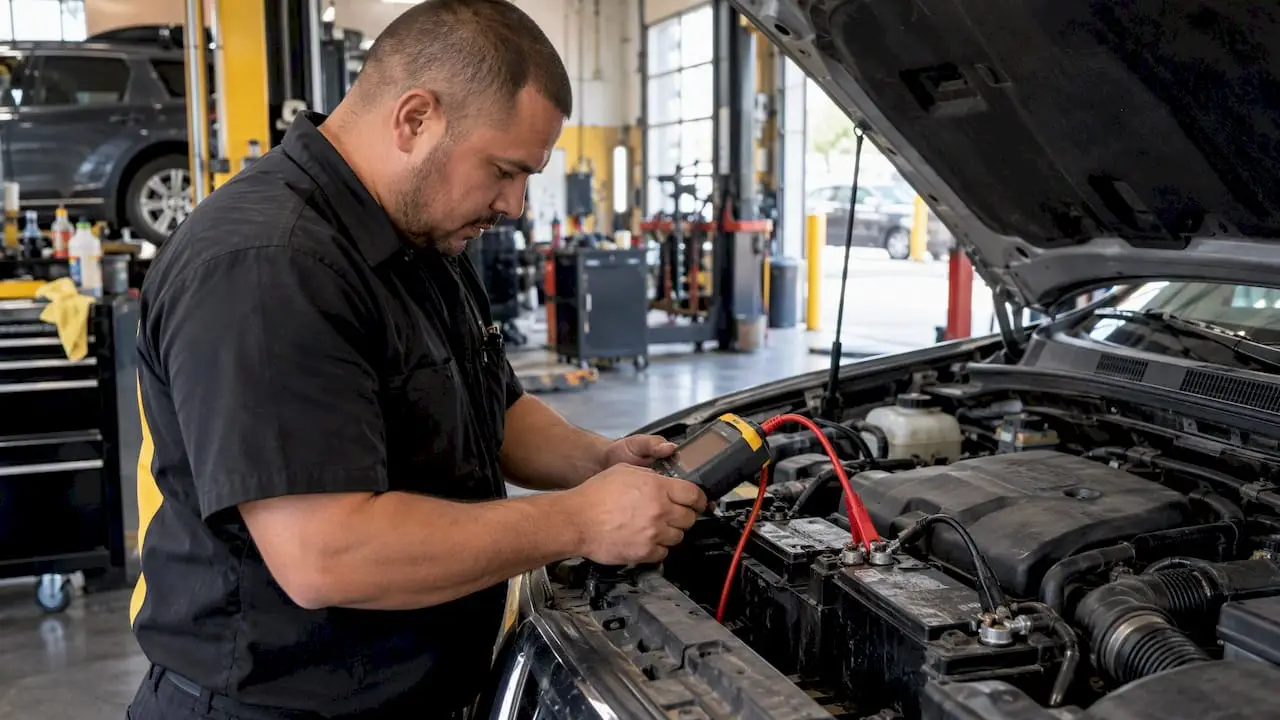
Our approach is simple. We test the battery, check the terminals and cables, test the charging system, and only then look at the starter. Our ASE-certified technicians document what they find in a Digital Vehicle Inspection, with photos, videos and notes sent straight to your phone. You see the corroded clamp or the failing part yourself, and you decide what to approve.
A no-start is stressful, and we know it usually happens at the worst time: before a shift, at school pickup, or with groceries in the trunk. We would rather tell you the fix is a cleaned terminal than sell you a part you do not need. That is what an honest recommendation looks like to us.
— Kwik Kar
Get a no-start diagnosed in Irving
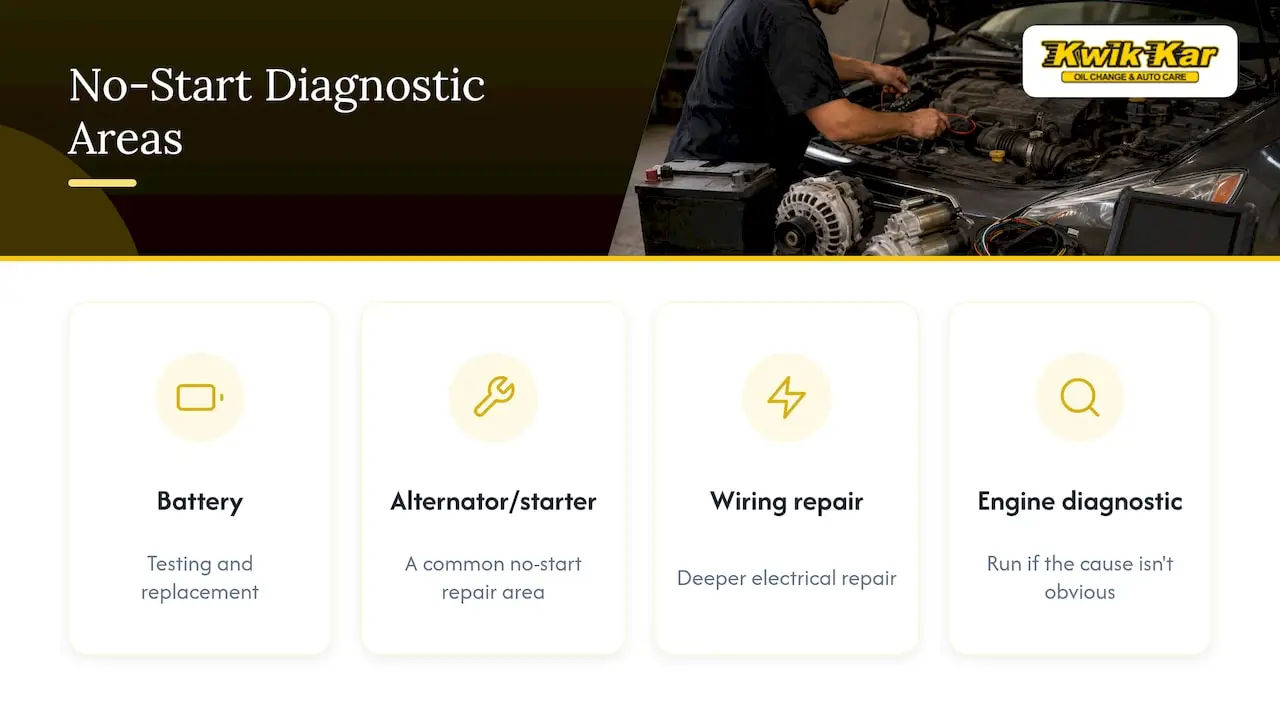
If your car is clicking and you can get it to us, or you can safely arrange a tow, our team can test the battery, charging system and starter and show you the results on your phone. Most no-start problems sit in one of three places: battery testing and replacement, the alternator and starter, or deeper wiring and electrical repair. If the cause is not obvious, we can run an engine diagnostic.
Our repairs carry a 24-month/24,000-mile warranty, and we offer service discounts for military and first responders. Call or stop by Kwik Kar in Irving, or start at kkirvingtx.com to book.
How to avoid the next click
- Test the battery yearly once it is past about three years old.
- Take a longer drive weekly if most of your trips are short, so the alternator can recharge the battery.
- Limit engine-off accessory use, such as running the radio and screen while parked.
- Keep terminals clean and tight. Look at them whenever you check under the hood.
- Don’t ignore early signs: slow cranking, dimming lights and a battery light are warnings.
- Keep up with scheduled maintenance. An inspection visit is the easiest time to catch a weak battery or a loose cable. See our oil change service for an easy time to add a battery check.
FAQ
Why is my engine clicking but not starting?
The starter is not getting enough current, or it is failing to engage. The usual causes are a weak battery, corroded or loose battery terminals, or a bad starter or solenoid. Rapid clicks lean toward the battery or connections, while one loud click leans toward the starter.
Does clicking mean a dead battery or a bad alternator?
Clicking itself points to the battery or starter side more often than the alternator. But a failing alternator can leave the battery too drained to start the car, so the click can be a downstream symptom. If the car starts with a jump and then dies again after being shut off, have both the battery and the charging system tested.
How can I tell if it’s the battery, alternator or starter?
Check the sound and the lights. Rapid clicking with dim lights suggests the battery. One loud click with bright lights suggests the starter. A car that runs after a jump but won’t restart later, or a battery light while driving, suggests the alternator. A shop test is the only sure way to separate them.
Can I keep trying to start the car if it clicks?
Try once or twice at most. Repeated attempts drain the battery further and can make the situation worse. Check the terminals, consider a safe jump-start, and call for help if it still won’t start.
Should I drive to a shop after a jump-start?
Yes, and keep the engine running until you arrive. A jump-start does not tell you why the battery went flat. Ask for a battery and charging system test so you know whether the battery, the alternator or something else needs attention.
Sources
- 14 Reasons Why Your Car Won’t Start, AAA Automotive
- Top Reasons My Car Won’t Start, AAA Club Alliance
- How Much Does a Starter Replacement Cost?, AAA Automotive
- 8 Signs Of A Bad Alternator Vs Bad Battery, AAA Club Alliance
- How to Jump a Battery and Get Yourself Back on the Road, AAA Automotive
- How to Make Your Car Battery Last Longer, Consumer Reports
- What to Do When Your Car Stalls, Consumer Reports