
If your car battery is dead every morning but starts fine after a jump, something is drawing power while the vehicle sits off, a parasitic battery drain. A draw consistently above roughly 75 to 100 milliamps after the vehicle has fully gone to sleep is considered abnormal. Before you chase wiring, check the battery itself: a weak or sulfated battery often mimics a drain and wastes hours of testing.
TL;DR:
- A parasitic drain above 75 to 100 milliamps after the vehicle fully sleeps indicates an abnormal power draw requiring investigation.
- Normal sleep current for modern vehicles ranges from 25 to 85 milliamps, depending on the number of electronic modules installed.
- A weak or sulfated battery can mimic a parasitic drain, so testing the battery’s health is the essential first step before wiring inspection.
- Intermittent drains are common and may require extended monitoring or professional diagnostic tools to accurately identify the culprit.
- Fixes include checking and adjusting interior and exterior switches, removing aftermarket accessories, and consulting a professional when wiring or control modules are involved.
Table of Contents
- What counts as normal parasitic drain?
- Signs it’s time to test for parasitic draw
- Safety and prep before you start testing
- How to run the multimeter parasitic draw test
- Finding the circuit causing the drain
- Fixes you can try, and when to call a shop
- Preventing a repeat parasitic drain
- What a professional parasitic drain check includes
- What technicians wish drivers knew before testing
- Get your battery drain diagnosed the right way
- Sources
- FAQ
What counts as normal parasitic drain?
Every modern car pulls some current when the key is out and the doors are shut. Computers, alarms, clocks, and infotainment modules stay in a low-power standby state so they can wake instantly when you unlock the door or hit the remote start. That baseline hum of electricity is normal and expected, and it has grown as cars have added more electronics.
According to the UTI explainer on parasitic battery drain, normal sleep current on many modern vehicles falls somewhere between about 25 and 85 milliamps, depending on how many modules the car carries and how they’re configured. Anything that settles well above that range, and stays there after the vehicle has had time to power down fully, points to a genuine parasitic drain rather than normal standby load.
A few things typically make up that baseline draw:
- The body control module and infotainment system staying partially awake to monitor for a key press or remote signal.
- A factory alarm or keyless entry receiver listening continuously for a signal.
- Aftermarket add-ons like dash cameras, GPS trackers, or amplifiers that draw current even when parked.
A weak battery can look exactly like a parasitic drain. A battery with failing internal plates loses charge on its own, so the car acts drained even when current draw is normal. That’s why checking battery condition, not wiring, is the first real step.
Signs it’s time to test for parasitic draw
Not every dead battery means a hidden drain. Sometimes it’s just an old battery, a loose terminal, or a headlight left on overnight. But a pattern of symptoms points more clearly toward a genuine parasitic draw worth testing for.
- The car is dead after sitting overnight or over a weekend, with no lights or doors left open.
- You’ve needed two or more jump starts in the past couple of weeks with no other obvious cause.
- The clock, radio presets, or other settings reset themselves, meaning the battery dropped low enough to lose memory.
- The problem started right after installing a dash cam, alarm, amplifier, or other aftermarket accessory.
- The drain seems to come and go, which usually points to an intermittent fault rather than a simple stuck light.
A home multimeter test costs nothing but time and typically takes 30 minutes to a few hours if you have to wait for the vehicle to sleep. A shop diagnostic adds the benefit of scan tools and a documented Digital Vehicle Inspection. This matters most when the drain is intermittent or the culprit turns out to be a module or alternator rather than a simple accessory.
Safety and prep before you start testing
A car battery holds enough current to cause a spark, a burn, or worse if you’re careless, and it can vent hydrogen gas that’s flammable near an open flame or spark. Wear eye protection, remove jewelry, and keep the area ventilated before you touch the terminals.
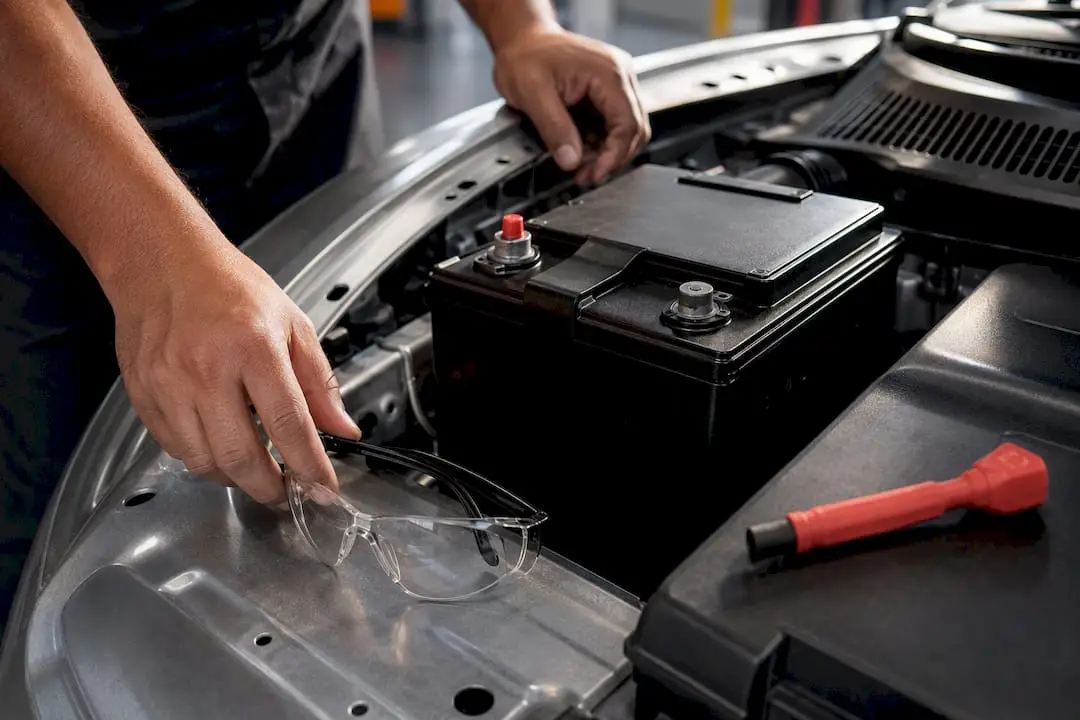
Before measuring anything, confirm the battery and charging system are actually healthy. A shop conductance test, or a quick check on a bench, tells you whether the battery holds a proper charge. It’s also worth confirming the alternator isn’t overcharging or undercharging, since either problem can produce symptoms that look like a drain.
Gather these before you begin:
- A digital multimeter rated for at least 10 amps on its high-current input.
- An amp clamp meter as an alternative if you don’t want to break the circuit.
- Your vehicle’s fuse diagram, usually printed on the fuse box cover or in the owner’s manual.
- A flashlight, since most testing happens with the hood up and the cabin dark.
Pro Tip: Always start your multimeter on its highest amp range before switching down to milliamps, so an unexpectedly high draw doesn’t blow the meter’s fuse or damage the display.
How to run the multimeter parasitic draw test
This test measures every milliamp leaving the battery while the car sits off, so you need the vehicle fully asleep and the meter set up correctly before you trust any number you see.
- Turn off the ignition, close all doors, and remove the key from range of the vehicle so proximity sensors don’t stay active.
- Disconnect the negative battery cable and set your multimeter to its highest DC amp range, using the dedicated high-current input jack.
- Connect the meter in series: one lead to the negative battery post, the other to the disconnected negative cable, so all current has to pass through the meter.
- Wait for the vehicle to fall fully asleep before reading anything. Some OEM procedures recommend waiting up to two hours for full sleep state on vehicles with several control modules, since interior lights, alarms, and door modules all take time to power down after the last door closes.
- Once the reading stabilizes, switch the meter down to the milliamp range for a more precise number, watching for the display to settle rather than jumping around.
- Log the reading, and if your meter supports Min/Max recording, leave it connected for a while to catch any spikes from a component cycling on and off.
The Fluke guide to finding parasitic battery drain walks through this same series-connection method and stresses starting on the high-amp scale first, since an unexpected surge on the milliamp scale can trip the meter’s internal fuse.
A stabilized reading of roughly 75 to 100 milliamps or higher, after the wait, is generally considered abnormal parasitic draw. Anything close to that line but not clearly over it is borderline, and worth a second test on a different night before you assume it’s a real problem. A reading that reads “OL” or pegs at the top of the scale usually means a short or a component that never went to sleep at all, and it’s worth double-checking your meter’s connections before assuming the worst.
If the number doesn’t hold steady, that’s usually a sign of an intermittent fault, something cycling on and off rather than staying on. That’s when Min/Max logging over several hours, or even overnight, becomes useful, since a stepwise DIY parasitic drain guide notes that intermittent drains often only show up with extended monitoring rather than a single snapshot reading.
Finding the circuit causing the drain
Once you’ve confirmed an abnormal draw, the next job is finding which circuit is responsible. Pulling fuses one at a time while watching the meter is the classic method, but it has a catch: removing and reinserting fuses can wake the vehicle’s control modules back up, resetting your sleep state and giving you a false reading on the next fuse.
A cleaner approach is the voltage-drop method: measuring millivolts across each fuse without pulling it, which lets you spot which circuit is carrying current without disturbing the CAN bus. OEM diagnostic guidance recommends this mV-across-the-fuse approach specifically because it avoids waking modules that a manual fuse pull would disturb.
Pro Tip: If the draw doesn’t change no matter which fuse you pull, stop pulling fuses and isolate the alternator instead, since the current may be coming from an unfused main line or a leaking alternator diode.
Common places the drain turns out to live:
- A trunk, glovebox, or interior light stuck on because a switch failed to release.
- An aftermarket dash cam, alarm, or amplifier wired directly to the battery.
- A body control module or infotainment head unit that won’t fully power down.
- A relay stuck closed, keeping a circuit powered that should be off.
If fuse isolation comes up empty, disconnect the alternator’s output wire or its fuse. A drain that disappears when the alternator is isolated points to a leaking alternator diode, which lets current bleed back into the battery even with the engine off.
Fixes you can try, and when to call a shop
Some causes are simple enough to fix in the driveway. Others need a lift, a scan tool, and a technician who can trace a wiring harness without guessing.
- Check and adjust interior, trunk, or glovebox light switches that fail to click off fully.
- Unplug or add a low-voltage cutoff to any hardwired dash cam, alarm, or amplifier you installed yourself.
- Clean corroded battery terminals, which can create resistance that skews readings and stresses the charging system.
Bring the car in when the isolation points to an alternator diode, a control module that won’t sleep, or wiring damage you can’t safely access. A shop can bench test the alternator, run a full scan of the CAN bus, and trace a damaged harness, work that goes beyond what a fuse box and a multimeter can confirm on their own. Kwik Kar’s engine diagnostic process covers exactly this kind of module and wiring investigation.
Preventing a repeat parasitic drain
A parasitic drain that goes untreated doesn’t just leave you stranded once. Repeated deep discharges shorten battery life and push the plates toward sulfation, which is one more reason a drain left unresolved ends up costing more than the fix would have.
- Use a smart battery maintainer during long storage periods instead of letting the battery sit unmonitored.
- Add a low-voltage cutoff to any dash cam or accessory that records in parking mode.
- Have the battery’s conductance tested periodically and keep the terminals clean and tight.
- Take longer drives occasionally rather than only short trips, since short hops rarely let the alternator fully recharge the battery.
Pro Tip: If you park for extended stretches, a small trickle charger costs far less than a jump start service call and a replacement battery combined.
What a professional parasitic drain check includes
A shop visit adds tools most driveways don’t have. Kwik Kar’s ASE-certified technicians test battery conductance, check alternator diode output, and isolate circuits using fuse and voltage-drop methods rather than blind fuse pulling.
Every finding gets documented through a Digital Vehicle Inspection, meaning you get photos, video, and written notes sent to your phone rather than a verbal guess. If the drain traces back to the battery or alternator itself, Kwik Kar’s battery testing and replacement service and alternator and starter service cover the repair without a separate diagnostic stop.
What technicians wish drivers knew before testing

The most common mistake we see is skipping the wait for sleep state and testing too soon, which produces a reading that looks alarming but is really just the car still winding down. The second is skipping the battery health check entirely and spending hours chasing a wiring fault that was really a tired battery all along.
Diagnostic time varies. A simple stuck light might take twenty minutes to find. A module that won’t sleep or an intermittent short can take considerably longer, which is part of why a documented DVI matters: it shows you exactly what was tested and ruled out, not just a final bill.
— Kwik Kar
Get your battery drain diagnosed the right way
Chasing a parasitic drain yourself can save a diagnostic fee if the fix is simple, but a stubborn or intermittent drain eats hours you probably don’t have. Technicians run conductance testing, alternator checks, and circuit isolation described above, then send photos and notes through a Digital Vehicle Inspection so you see exactly what was found before any repair begins.

- Battery testing and replacement backed by conductance testing, not guesswork.
- Alternator and starter diagnostics to catch a leaking diode before it drains your battery again.
- Electrical diagnostics for modules, wiring, and CAN-bus faults that go beyond a home multimeter test.
If your battery has been dying overnight or you’ve already pulled a few fuses without answers, schedule a battery and electrical diagnostic at Kwik Kar Oil Change & Auto Care in Irving and get a documented answer instead of another guess.
Sources
These sources back the testing steps and thresholds above.
- What Is Parasitic Battery Drain and How to Test It
- How to Find Parasitic Battery Drain with a Multimeter
- Battery, Discharged, Diagnosis for Excessive Static Current Draw (OEM technical bulletin)
- How to Find Parasitic Battery Drain: The Complete DIY Test Guide
FAQ
How do I solve a parasitic battery drain?
Start by confirming the battery and alternator are healthy, then run a multimeter series test after the vehicle has fully gone to sleep. If the reading is above roughly 75 to 100 milliamps, isolate the circuit using the voltage-drop across fuses method, then repair or disconnect whatever is drawing power.
What are the most common causes of parasitic battery drain?
The most frequent culprits are interior or trunk lights stuck on, aftermarket accessories like dash cams and alarms wired directly to the battery, and control modules that fail to enter sleep mode. A leaking alternator diode is a less common but more serious cause that shows up when the drain persists even after every fuse is pulled.
How much does it cost to fix a parasitic battery drain?
The cost depends entirely on what’s causing the drain, from a simple switch adjustment to an alternator replacement, so there’s no single price to quote. Kwik Kar’s engine diagnostic service can pinpoint the cause first, and any pricing for repair is provided after that inspection.
How can I tell if I have a parasitic drain versus a bad battery?
A parasitic drain shows up as a normal battery that keeps dying because something is pulling current while the car is off, while a bad battery loses charge on its own even with no draw present. Testing battery conductance first is the fastest way to tell the two apart, since a weak battery can mimic a parasitic drain and waste hours of unnecessary wiring checks.