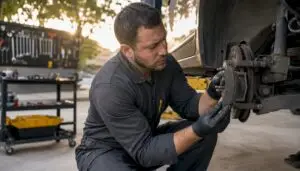
A clunk over bumps most often means a worn or loose suspension or steering component, such as a sway bar link, bushing, ball joint, or strut mount. If the sound is new, getting louder, or shows up alongside a handling change like pulling or wobble, schedule an inspection promptly rather than waiting for it to worsen.
TL;DR:
- Note whether the clunk occurs on every bump, at one wheel, while turning, or under braking; these patterns help technicians distinguish likely causes.
- Stop driving and arrange a tow if steering control is lost, the wheel wobbles severely, or a suspension part appears broken or disconnected.
- For a mild clunk with normal handling, drive only short distances at lower speeds, avoid potholes and heavy loads, and book an inspection promptly.
- Repair costs depend on the failed part and vehicle, so request a written parts and labor estimate after diagnosis, not a general price.
- A focused inspection can often identify the source within an hour; common repairs may fit within a shop day when parts are available.
Table of Contents
- How to recognize a suspension clunk and describe it accurately
- Most common parts that make clunking noises over bumps
- How pros narrow the cause: the NVH approach and symptom matrix
- Safety thresholds and how quickly to book service
- What a professional suspension inspection includes
- Safe checks you can do and what to tell the shop
- Estimated repair costs for clunking-related repairs
- Typical timelines for diagnosis and repair
- Preventing suspension wear through regular maintenance
- Our approach: ASE-led diagnostics and transparent DVI reporting
- Book a suspension inspection at Kwik Kar Irving
- FAQ
- Sources
How to recognize a suspension clunk and describe it accurately
A suspension clunk usually sounds different from an engine knock or a loose heat shield rattling against the exhaust. Drivers tend to describe it the same handful of ways.
- A dull thud when a tire drops into a pothole or crosses a seam.
- A sharper, metallic clunk that sounds like two hard parts knocking together.
- A single knock on one specific bump, versus repeated knocking over washboard or rippled pavement.
Where and when the sound happens tells a technician almost as much as what it sounds like. A clunk from the front usually points to the strut assembly, sway bar links, or control arms. A clunk that only shows up in a turn often means a strut mount or a sway bar link under more load. A clunk under braking can point toward worn control arm bushings or loose brake hardware shifting as the suspension compresses.
You can gather useful details safely before your appointment. Drive slowly and deliberately over a bump you know produces the noise, with the windows down, and have a passenger listen for whether it comes from the front, rear, left, or right. Recording a short video with your phone propped near the wheel well, if you can do it safely parked or with a passenger filming, gives a technician something concrete to reference.
Most common parts that make clunking noises over bumps
Several suspension and steering components can produce a clunk, and the signature clues for each help narrow down the cause before a technician even puts the vehicle on a lift. ASE automobile study guide materials list these same parts as the standard inspection points for diagnosing suspension noise.
- Sway bar (stabilizer) links and bushings. These connect the sway bar to the suspension and tend to clunk as the suspension compresses or as the body rolls through a turn. They are one of the more affordable and straightforward parts to replace.
- Control arm bushings. Worn rubber bushings let the control arm shift slightly under load, producing a thud that is often side-specific and easiest to hear over small, repeated bumps.
- Ball joints. A worn ball joint can clunk and also allow play in the wheel assembly. Because ball joints connect the wheel to the suspension and affect steering control, excess play is treated as a safety concern rather than a comfort issue.
- Strut mounts and bearings. These sit at the top of the strut and can clunk when the suspension compresses or when turning the wheel; a creak during slow steering input often accompanies a failing mount.
- Shocks or struts. A heavy, hollow thud paired with a bouncier ride after a bump usually means the shock or strut has lost its damping ability. Our shocks and struts service covers inspection and replacement for this group.
- Wheel hubs and bearings. A failing hub tends to produce a grinding or humming sound that changes with speed, but a clunk combined with noticeable looseness in the wheel can also point to hub or bearing wear.
- Loose suspension hardware or subframe mounts. Fasteners that have backed out or a subframe mount that has separated slightly can cause an intermittent, heavier clunk that is harder to reproduce on command.
- Less common causes. A broken spring perch or a worn rear suspension bushing can produce similar sounds from the back of the vehicle, so a clunk that seems to come from behind the driver deserves the same attention as a front-end noise.
Pro Tip: Note whether the clunk happens on every bump or only on sharp impacts, since that detail alone often separates a bushing problem from a hardware or mount problem.
How pros narrow the cause: the NVH approach and symptom matrix
Technicians treat a clunking complaint as a noise, vibration, and harshness (NVH) problem rather than guessing from the sound alone. ASE’s introduction to NVH diagnostics explains that sound location by itself is not enough information, since noises travel through the chassis and can seem to come from a different spot than their actual source. A structured approach combines what the driver reports, a hands-on visual inspection, load checks on individual components, and a road test designed to reproduce the exact conditions that trigger the noise.
A simple symptom matrix helps frame what is likely happening before the vehicle is even inspected:
- Clunks on nearly every bump, regardless of speed: often bushings or worn shocks and struts.
- Clunk isolated to one wheel: frequently a control arm or hub issue on that corner.
- Clunk only while turning: commonly a strut mount or sway bar link under lateral load.
- Clunk combined with noticeable play when the wheel is pushed and pulled by hand: often a ball joint or hub bearing issue.
Because several parts can produce similar sounds, shops reproduce the noise under controlled conditions on a lift or during a road test rather than relying on a description alone.
Safety thresholds and how quickly to book service
Most clunks over bumps are not an emergency, but a few signs mean you should stop driving and arrange a tow rather than continue to a shop. Pull over and call for help if you lose steering control, feel a severe wobble through the wheel, or can see a broken or disconnected suspension part underneath the vehicle.
AAA’s guidance on vehicle noises identifies a heavy clunk over bumps as a sign the suspension needs attention and recommends prompt service when the clunk is new or the ride has become noticeably harsher. Car Care Council guidance similarly points out that steering and suspension problems affect how the vehicle handles and should be checked right away rather than monitored over time.
Short of those red flags, you can usually drive cautiously to a shop. Keep speeds lower, avoid hauling heavy loads, and steer around obvious bumps and potholes until the vehicle has been inspected.
What a professional suspension inspection includes
A thorough inspection starts with a conversation, not a lift. Car Care Council recommends bringing vehicle details and a clear symptom history to the shop so the technician can reproduce the noise efficiently rather than guessing at it.
From there, a typical visit includes:
- A symptom interview covering when the noise started and what triggers it.
- Visual and hands-on checks of bushings, sway bar links, strut mounts, shocks and struts, wheel hubs, and fasteners.
- A controlled road test over a known surface to reproduce the sound.
- Documentation of any worn or damaged parts found during the inspection.
One source of documentation that has become standard at many shops is the Digital Vehicle Inspection, which uses photos and videos to show exactly what a technician found underneath the vehicle. Seeing a cracked bushing or a worn ball joint boot in a photo makes it easier to understand why a repair is recommended before agreeing to the work.
Exact time and cost always depend on which component failed and which vehicle is involved, which is why a diagnosis comes before a quote.
Safe checks you can do and what to tell the shop
You can gather helpful information without touching any suspension component yourself. Log the noise by noting your speed, the road surface, whether you were turning or braking, and whether it comes from one side or both. Mention if it started suddenly, especially right after hitting a pothole or curb, since AAA notes that pothole impacts can damage multiple suspension components at once.
- Look underneath for anything obviously loose, hanging, or dragging, without removing or touching suspension parts.
- Check for recent damage near the wheel wells if you recall hitting something hard.
- Write down whether the noise is constant or only happens occasionally.
Pro Tip: Tell the service advisor exactly how to reproduce the noise, whether handling feels different, and whether it is constant or intermittent. Those three details often cut diagnostic time significantly.
Estimated repair costs for clunking-related repairs
There is no single price for fixing a clunk, because the cost depends entirely on which part failed and how many related components were affected. Car Care Council guidance confirms that no reliable national price exists until the specific failed component is identified, which is why shops diagnose before quoting labor and parts.
A sway bar link or bushing replacement is often on the lower end of the cost range, since the parts are relatively simple and the labor is straightforward. Ball joint and control arm bushing repairs tend to cost more, since they involve more labor time and sometimes require an alignment check afterward. Strut and shock replacement typically falls in a higher range, especially if both sides are replaced together, which is often recommended since these parts wear at a similar rate. Wheel hub and bearing replacement costs vary significantly by vehicle, since some designs require more disassembly than others.

Our shocks and struts service page outlines what that specific repair covers. For any clunk-related repair, ask for a written estimate that breaks down parts and labor after the inspection, so you know exactly what you are paying for and why.
Typical timelines for diagnosis and repair
Diagnosing a clunk usually takes less time than fixing it. A focused road test and hands-on inspection can often identify the source within an hour, especially when you have already given the shop clear details about when and how the noise happens. Vehicles with multiple worn components, or noises that are hard to reproduce, can take longer to pin down.
Repair time depends heavily on the part. A sway bar link or bushing swap is often a same-day repair. Ball joints, control arm bushings, and strut assemblies usually also fit into a single shop day once the part is confirmed and in stock, though less common parts may need to be ordered, which adds a day or more. If a pothole impact damaged several components at once, such as a control arm, a strut, and a wheel hub, AAA notes that technicians typically address the parts affecting steering control before the ones affecting ride comfort, which can extend the repair into a second visit if parts for both are not immediately available.
Asking your service advisor for a time estimate once the diagnosis is complete gives you a realistic window for planning around the repair.
Preventing suspension wear through regular maintenance
Suspension and steering components wear gradually, and a few habits slow that process down. Avoiding potholes and speed bumps when you can, and slowing down when you cannot avoid them, reduces the repeated impact stress that wears out bushings, links, and mounts over time.
Routine inspections catch wear before it turns into a clunk you can hear from the driver’s seat. Having the suspension checked during regular maintenance visits, rather than only after a noise appears, lets a technician spot a cracked bushing or a worn boot while it is still an inexpensive fix. Keeping up with factory-scheduled maintenance intervals also means related systems, like the transmission and cooling system, get checked at the same time, which helps catch unrelated issues before they compound.
Paying attention to your vehicle’s load limits matters too. Consistently hauling heavy loads or towing beyond the vehicle’s rated capacity accelerates wear on shocks, struts, and control arm bushings. If your vehicle’s cameras or sensors were recently serviced or disturbed, it is also worth confirming with a specialist whether ADAS calibration is needed, since some suspension-related sensors tie into those systems on newer vehicles.
Our approach: ASE-led diagnostics and transparent DVI reporting
We rely on ASE-certified technicians to work through suspension noise complaints methodically, starting with your description of the sound and ending with a controlled road test to confirm it. Digital Vehicle Inspections document findings with photos and video, so you can see the worn bushing, loose link, or damaged mount before deciding on a repair. That documentation shortens diagnosis time and helps avoid replacing parts that are not actually the problem, and we walk through clear estimates with you before any work begins.
— Kwik Kar
Book a suspension inspection at Kwik Kar Irving
A clunk you cannot explain is worth getting checked before it turns into a bigger repair or a handling problem. ASE-certified technicians inspect sway bar links, bushings, ball joints, strut mounts, and shocks and struts, documenting everything found with a Digital Vehicle Inspection so you can see what needs attention, often with same-day availability.

Here is where to start, depending on what you already suspect:
- Engine diagnostic service if you want a broader NVH check alongside the suspension inspection.
- Full auto repair services page to see everything we offer and book an appointment.
When you call or book online, have your vehicle’s year, make, model, and mileage ready, along with a quick description of when the clunk started and how to reproduce it. That information lets us get straight to the inspection instead of spending time guessing.
FAQ
Can I drive with clunking suspension?
Short trips at lower speeds are usually possible if the clunk is mild and handling feels normal, but you should get it inspected promptly rather than keep driving on it. Stop immediately and arrange a tow if you notice a severe wobble, loss of steering control, or a visibly broken suspension part.
What sound does a bad ball joint make on bumps?
A worn ball joint typically produces a clunk over bumps along with noticeable play in the wheel, which a technician can confirm by checking for movement when the wheel is pushed and pulled by hand. Because ball joints affect steering control, this combination is treated as a safety concern rather than a minor noise issue.
What does failing suspension sound like?
Failing suspension parts commonly produce a dull thud or a sharper metallic clunk over bumps, sometimes paired with a bouncier ride or a creak when turning. The exact sound and location depend on which component, such as a bushing, strut mount, or shock, has worn out.
Does clunking always mean suspension?
Not always. While suspension and steering parts are the most common source of a clunk over bumps, loose exhaust hardware, a dragging heat shield, or loose interior or trunk items can occasionally produce a similar sound, which is why a hands-on inspection and road test are used to confirm the actual source.
Sources
- Vehicle noises you should never ignore — AAA Club Alliance
- ASE automobile study guide (suspension and NVH topics)
- Cone Zone season can be tough on vehicles — Car Care Council