
A 60,000-mile service is not one standard package. It is the set of maintenance items your vehicle’s manufacturer lists for that mileage, and the list differs by make, model, engine and how you drive. The most reliable way to know what your car needs is the maintenance schedule in your owner’s manual. A good shop reads that schedule with you, inspects the car, and tells you what is due now, what is coming, and what is optional.
We are Kwik Kar Oil Change & Auto Care at 2100 Carl Rd in Irving, TX, and this is how we approach the 60,000-mile mark with drivers from Irving, Las Colinas, Grand Prairie, Euless, Coppell and the rest of the area.
TL;DR
- “60k service” is a shop’s label, not a standard. Your owner’s manual or the manufacturer’s maintenance guide defines what is actually due at 60,000 miles.
- Typical items around this mileage include oil and filter, tire rotation, brake inspection, air filters, belts, coolant, transmission fluid and spark plugs, but each depends on your vehicle.
- Time counts as well as miles, and hot Texas summers, stop-and-go traffic and towing can move you onto the “severe” schedule.
- Ask for an itemized estimate and sort it into required now, condition-based and optional. Safety items such as brakes and tires come first.
- You can split the work across visits instead of doing everything at once.
Table of Contents
- What is a 60,000-mile service?
- What usually gets done at 60,000 miles?
- What is 30-60-90 maintenance?
- How do I find my factory maintenance schedule?
- Normal or severe: which schedule are you on?
- How to tell what is due now and what can wait
- How our inspection helps you decide
- Texas inspection rules at 60,000 miles
- Where our services fit in a 60,000-mile visit
- Schedule your 60,000-mile service in Irving
- FAQ
- Sources
What is a 60,000-mile service?
Think of it as a checkpoint. By 60,000 miles most vehicles have a few years of commuting behind them, and several wear items and fluids reach their listed intervals around the same time. Shops bundle those items and call the bundle a “60k service,” “60,000-mile check-up” or “factory-scheduled maintenance.”
The bundle is only as good as its match to your car. Consumer Reports says the owner’s manual is the most accurate source for basic information about a specific model, including service intervals. That same guidance makes clear that reminders from a dealer or shop do not replace following your schedule.
So when someone quotes you a 60,000-mile service, the useful follow-up is: “Which items does my manufacturer’s schedule list at 60,000 miles?”
What usually gets done at 60,000 miles?
The exact list varies, but these are the categories that most commonly come up. Treat them as things to check against your manual, not a universal checklist.
| Item | What it involves | Where it depends on your vehicle |
|---|---|---|
| Engine oil and filter | Fresh oil and a new filter | Interval and oil type are set by the manufacturer |
| Tire rotation and tread check | Moving tires to even out wear | Rotation pattern differs for front-, rear- and all-wheel drive |
| Brake inspection | Measuring pads and rotors, checking fluid and lines | Replacement depends on measured wear, not mileage |
| Engine and cabin air filters | Swapping filters that clog with dust and pollen | Interval differs, and dusty roads shorten it |
| Drive belts and hoses | Checking for cracks, glazing and leaks | Many belts are condition-based |
| Coolant | Testing and, if due, replacing | Some makes specify a long interval, others shorter |
| Transmission fluid | Inspection or exchange | Some manufacturers call it “lifetime,” others list a mileage |
| Spark plugs | Replacement on a listed interval | Long-life plugs can run well past 60,000 miles |
| Timing belt | Replacement on belt-driven engines | Chain-driven engines do not have this item |
A general list of items often inspected or addressed near 60,000 miles, including brakes, filters, belts, cooling components, transmission fluid and spark plugs, comes with the same caveat: whether each one is included depends on the manufacturer’s manual.
Timing belts deserve a separate look
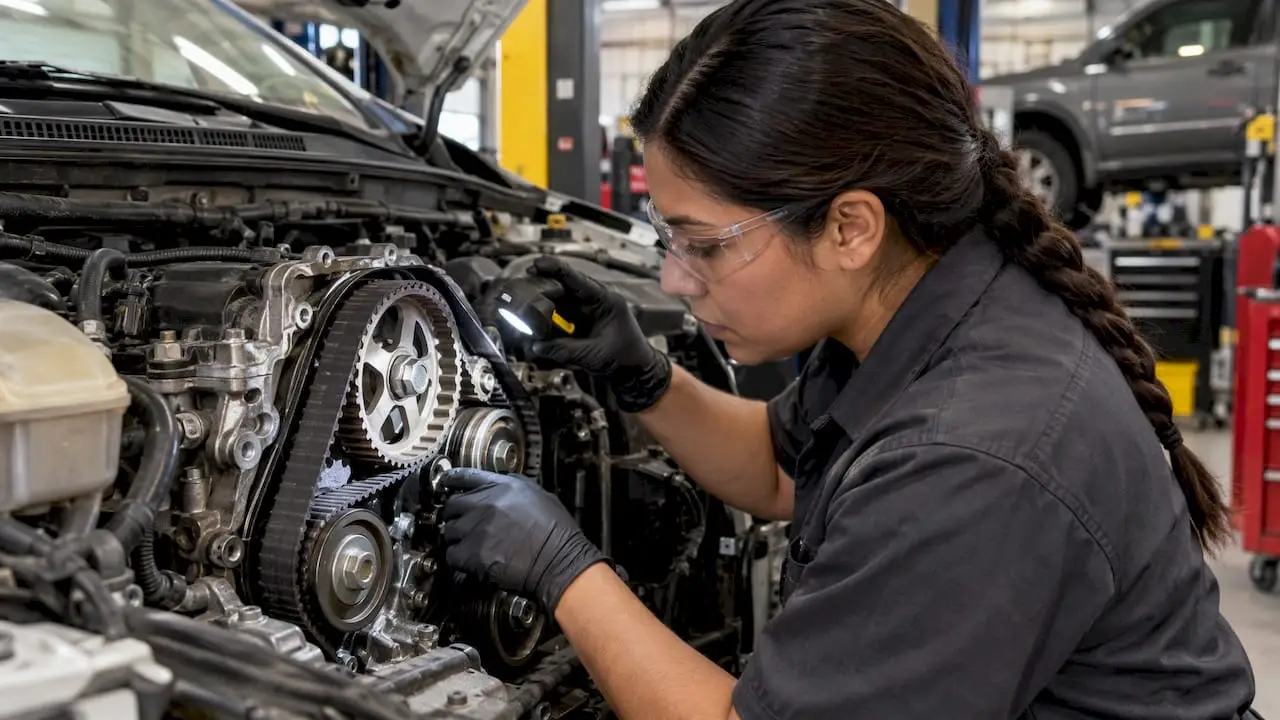
The timing belt is the item where guessing costs the most. Consumer Reports notes that vehicles with timing belts commonly specify replacement at roughly 60,000 to 100,000 miles, while many newer vehicles use timing chains instead. Check your manual to see which you have. If your engine has a belt, and your schedule lists it near this mileage, read about timing belt symptoms and service before the interval passes.
What is 30-60-90 maintenance?
It is shorthand for mileage-based service tiers: a lighter service at 30,000 miles, a larger one at 60,000, and another at 90,000. The idea is that some items repeat every 30,000 miles, while others fall on a longer cycle, so the 60,000-mile visit is often the “bigger” one in the middle.
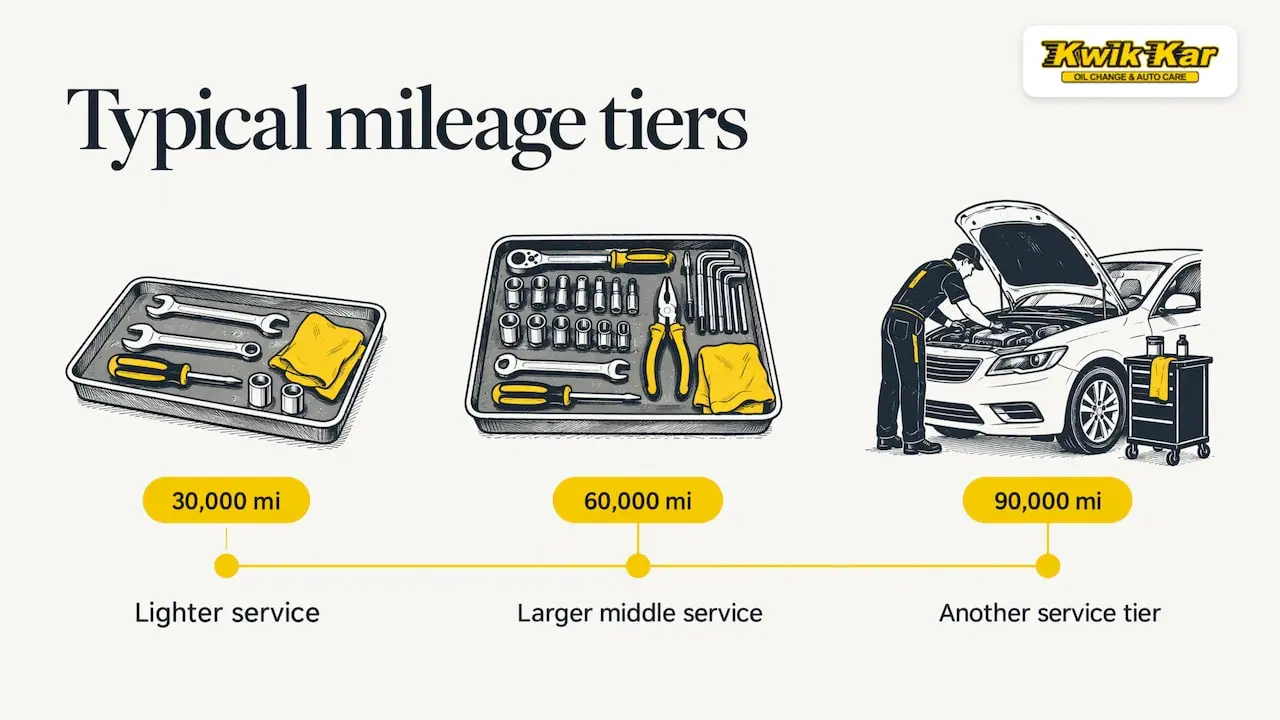
In practice, not every manufacturer follows a 30-60-90 rhythm. Some use a maintenance monitor that tells you when service is due based on how the engine has been driven. Others publish a fixed table. Either way, the tiers are a convenient way to think about the schedule, but your manual is the authority.
If you are heading toward the next tier, our 100,000-mile service checklist covers what typically follows.
How do I find my factory maintenance schedule?
There are three places to look, in this order:
- The owner’s manual. The maintenance section lists services by mileage and time. Many manufacturers also publish the manual online for your model year.
- A separate warranty and maintenance guide. Some brands print the schedule in a booklet. Toyota’s guide, for example, describes the maintenance requirements for a specific model year and ties service to mileage or time intervals, whichever comes first.
- An on-board monitor. Honda’s Maintenance Minder, for one, ties services to codes and, in the 2021 Pilot guide, calls for brake fluid replacement every three years if a particular code has not appeared by 36 months. In a car like that, the dashboard decides what is due, not a round number.
Bring whichever applies when you come in. We can compare it with what we see on your vehicle.
Normal or severe: which schedule are you on?
Most manuals publish two tracks. Ford, for example, distinguishes normal scheduled maintenance from special operating conditions maintenance. Severe or special conditions generally include frequent towing, dusty environments, extreme temperatures, repeated short trips and heavy stop-and-go driving, and they call for more frequent fluid or filter changes.
That matters here. A commute from Irving into Dallas on a hot afternoon, with long idling on the highways, can look a lot like the conditions some manuals describe. If you tow a trailer or mostly drive short hops, read the severe schedule in your manual and ask us how it applies to you. We do not decide this for you, the manual does, and we help you read it.
Miles or months, whichever comes first
If you drive only 8,000 miles a year, you might reach 60,000 miles in about seven and a half years. Fluids age with time, not just distance, so many schedules list both a mileage and a time interval and apply whichever is reached first. A low-mileage car can be overdue on time alone.

How to tell what is due now and what can wait
This is where most people feel pressure, and where a clear process helps. Consumer Reports once compared 60,000-mile quotes and found that some included extra work beyond the owner’s manual, such as flushes, and advised asking for a price without those items. The lesson is not to be suspicious of every shop. It is to ask for the quote in a form you can check.
Ask for a line-item estimate
Every item should have its own line, so you can match it to your manual. Advice for owners managing these costs is to separate factory-required, condition-based and shop-recommended services and compare each against the manual. Ask which category each line falls into.
Sort the list into three buckets
- Required now. The manual lists it at or before your mileage or time, or it affects safety.
- Condition-based. The manual says inspect, and replace if worn. Ask to see the measurement or the photo.
- Optional or recommended. Not in the manual. Fuel-system flushes and injector cleaning, for example, are sometimes marketed as preventive maintenance, although their benefit on cars with no symptoms may be marginal. If you are considering one, we suggest a diagnostic first. Our articles on fuel system cleaning after 60,000 miles and fuel induction service explain why.
Prioritize when you cannot do everything at once
Spreading the work across two visits is a perfectly normal way to handle the budget. A sensible order:
- Safety first. Brakes, tires, steering and suspension wear. If an inspection shows thin pads or a leaking line, that goes to the top. See our guides on brake pad replacement and squeaking brakes.
- Items that can cause breakdowns or major damage. A timing belt on an engine that has one, coolant that is past its interval, a weak battery heading into summer or winter.
- Fluids and filters on the schedule. Oil and filter, transmission fluid if your manual lists it, air filters.
- Everything else. Items that are optional or have no symptoms can wait for the next visit.
A worked example: a family SUV arrives at 61,000 miles. The manual lists an oil change, tire rotation, brake inspection, cabin and engine air filters, and transmission fluid. The inspection shows the front pads have good life left, the cabin filter is dirty, and the battery tests weak. Reasonable plan: oil, rotation, battery and cabin filter today, with transmission fluid scheduled next month if the budget needs it. That is an illustration of the process, not a quote or a finding on any real vehicle.
How our inspection helps you decide
Every visit can include a Digital Vehicle Inspection. Our ASE-certified technicians document the vehicle with photos, videos and notes sent straight to your phone, so you can see a worn part for yourself rather than take our word for it. You can read it at your desk in Las Colinas or on a break in Coppell, then approve what you want and defer the rest.
The point of the DVI is a decision you feel good about: what is urgent, what is monitored, and what is simply on the horizon.
Our perspective on the 60,000-mile mark
We think the best 60,000-mile service is the one built around your car, not a printed menu. When a driver pulls into our Irving shop, we start with the manufacturer’s schedule, then look at the vehicle itself: how the brakes measure, what the fluids look like, how the battery tests.
That is why we send Digital Vehicle Inspections with photos and video. We would rather you approve three repairs you understand than a package you do not. Our recommendations are meant to be transparent, and you can ask us why any line is on the estimate.
Work that qualifies is backed by our 24-month/24,000-mile warranty, and we are RepairPal certified and CARFAX Top-Rated. Most of all, we want you driving a safe, reliable car in Irving traffic and Texas heat without paying for work that is not due.
Kwik Kar
Texas inspection rules at 60,000 miles
Many drivers assume the 60,000-mile visit includes a state inspection. Since January 1, 2025, Texas has eliminated the safety inspection requirement for non-commercial vehicles, following House Bill 3297. Non-commercial vehicles still pay a $7.50 inspection program replacement fee at registration, per the same DPS notice.
Two things are different:
- Emissions testing is separate. Eligible vehicles registered in emissions counties, which include Dallas County, still need an emissions test. Check the DPS page for your vehicle’s rules.
- Commercial vehicles. Qualifying commercial vehicles remain subject to the applicable safety inspections. If you manage a fleet, see our fleet management services.
Because this no longer drives a visit, the real reason to get a 60,000-mile service is the manufacturer’s schedule and your own safety.
Where our services fit in a 60,000-mile visit
Depending on what your manual lists and what the inspection shows, these are the services most likely to be part of the visit:
- Oil changes, with the interval based on your manual. Our oil change interval guide explains why 3,000 miles is rarely the number.
- Tire rotation, usually at the same time as an oil service.
- Brake service when measurements show wear.
- Battery testing and replacement and charging-system checks.
- Transmission service and our guide to a transmission fluid change.
- A/C, heating and cooling checks before the hot months.
- Engine diagnostics if a warning light is on or the car runs rough.
- Spark plugs and other tune-up items, as the schedule requires. Our article on the tune-up interval explains how to judge it.
A warning light is a reason to come in sooner, whatever your mileage. Brakes that grind, a pulling steering wheel, overheating or a soft pedal are safety problems, and we recommend a professional inspection promptly.
Schedule your 60,000-mile service in Irving
Bring your owner’s manual, or just tell us the year, make and model, and we will work from the manufacturer’s schedule. We offer factory-scheduled maintenance along with the repairs that may turn up, and you decide what to approve from the inspection we send your phone.
If you are comparing options, ask us about discounts for military members and first responders, and Ladies’ Day on Wednesdays. See the current Ladies’ Day oil change offer or visit kkirvingtx.com to get started. If a larger repair comes up, third-party financing options may be available, subject to provider approval and terms.
FAQ
Is a 60,000-mile service necessary?
It is necessary to the extent your manufacturer’s schedule lists items at that mileage. Many vehicles list several, such as fluids, filters or a belt, and skipping them can shorten component life. Your owner’s manual is the document that settles which items apply.
How much does a 60,000-mile service cost?
There is no single price, because the cost depends on which items your vehicle needs. A package with a few inspections costs much less than one that includes a timing belt or transmission service. Ask for a line-item estimate so you can see what each part of the total covers.
Can I split the 60,000-mile service into two visits?
Yes, in most cases. Start with safety items and anything your manual lists as due now, such as brakes, tires, oil and a weak battery. Items that are condition-based or optional can wait for the next visit once the inspection shows how much life they have left.
Does Texas require an inspection at 60,000 miles?
No mileage triggers it. Non-commercial vehicles no longer need an annual safety inspection as of January 1, 2025, but eligible vehicles registered in Dallas County still need emissions testing, and qualifying commercial vehicles remain subject to safety inspections. Check the DPS website for your situation.
Do I need a 60,000-mile service if I drive very little?
Possibly. Schedules usually apply whichever comes first, miles or months, because fluids degrade with time. If your car is several years old with low mileage, check the time intervals in your manual.
To book, call us at (469) 276-7337 or stop by 2100 Carl Rd, Irving, TX 75061.
Sources
- How to Use Your Car’s Owner’s Manual, Consumer Reports
- How to Make Your Car Last 200,000 Miles and More, Consumer Reports
- Save Hundreds on Auto Maintenance by Shopping Around, Consumer Reports
- Warranty & Maintenance Guide, Toyota
- Maintenance Minder, Honda
- Scheduled Maintenance, Ford
- The 60,000-Mile Service: What Should Be Inspected
- Dealer 30K, 60K or 90K Service, Mechanic Insights
- Vehicle Safety Inspection Program Changes Now in Effect, Texas DPS