Most cars and trucks on Irving roads use one of two oil filter types: a spin-on filter, which is a sealed metal canister you replace whole, or a cartridge filter, where only the filter element is replaced and the housing stays on the engine. Magnetic and centrifugal filters exist too, but they are add-ons or specialty designs. The right one for your vehicle is the one your manufacturer specifies, and a technician can confirm that in minutes.
TL;DR
- Spin-on and cartridge are the two filter types most drivers will ever meet. Spin-on replaces the whole canister. Cartridge replaces only the element and its seals.
- Magnetic and centrifugal filters are supplementary or specialty designs, and centrifugal types are seldom found outside high-performance and racing use.
- Synthetic oil does not require a special filter, but your engine’s specification and warranty requirements decide which filter fits.
- Micron and beta ratings describe what size particles a filter catches and how efficiently. Smaller and higher is not automatically better for every engine.
- Change the filter with every oil change unless your owner’s manual or a long-life filter’s rating says otherwise.
Table of Contents
- What does an oil filter actually do?
- The main oil filter types
- Cartridge vs. spin-on: which is better?
- Does synthetic oil need a special oil filter?
- What does an oil filter micron rating mean?
- How long does an oil filter last?
- How to choose the right oil filter for your vehicle
- Signs your oil filter may need attention
- Perspective: why we treat the filter as part of the service, not an afterthought
- Oil change service in Irving
- Texas inspections and your oil service
- FAQ
- Schedule your oil change in Irving
- Sources
What does an oil filter actually do?
Every time your engine runs, oil picks up tiny bits of metal, carbon and dirt. The filter keeps those particles out of the bearings and cylinder walls. According to a Purdue University Extension publication on engine oils and filters, oil is drawn from the pan through a wire-cloth strainer, pumped to the filter, pushed through the filter media that traps debris, and then sent back to the engine through the center port.
That same publication describes a fail-safe bypass valve. If the filter clogs, the valve opens so oil keeps flowing, because unfiltered oil is better than no oil. The catch is that in bypass mode the oil is no longer being cleaned. A filter that is overdue is not a harmless leftover. It is a part that may have quit doing its job.
If you want the bigger picture on timing, our guide to correct oil change intervals explains why the old 3,000-mile rule no longer fits most modern engines.
The main oil filter types
Spin-on filters
A spin-on filter is the familiar canister. The filter media, base plate, gasket and housing come as one unit, and the whole thing is replaced at each service. FRAM’s comparison of cartridge and spin-on filters notes that spin-on filters are straightforward to install and carry a built-in anti-drainback valve. That valve keeps oil from draining out of the filter when the engine is off, so the engine is not running dry for the first seconds after a cold start.
Spin-on filters are still the most common design on the road, especially on older and mid-age vehicles.
Cartridge filters
A cartridge filter is a paper or synthetic filter element that drops into a reusable housing on the engine. Only the element and its gaskets or O-rings are replaced. The same FRAM source explains that the anti-drainback valve for a cartridge setup is usually part of the housing or the engine itself, and that cartridge filters carry a greater risk of installation errors, such as a pinched or missing O-ring.
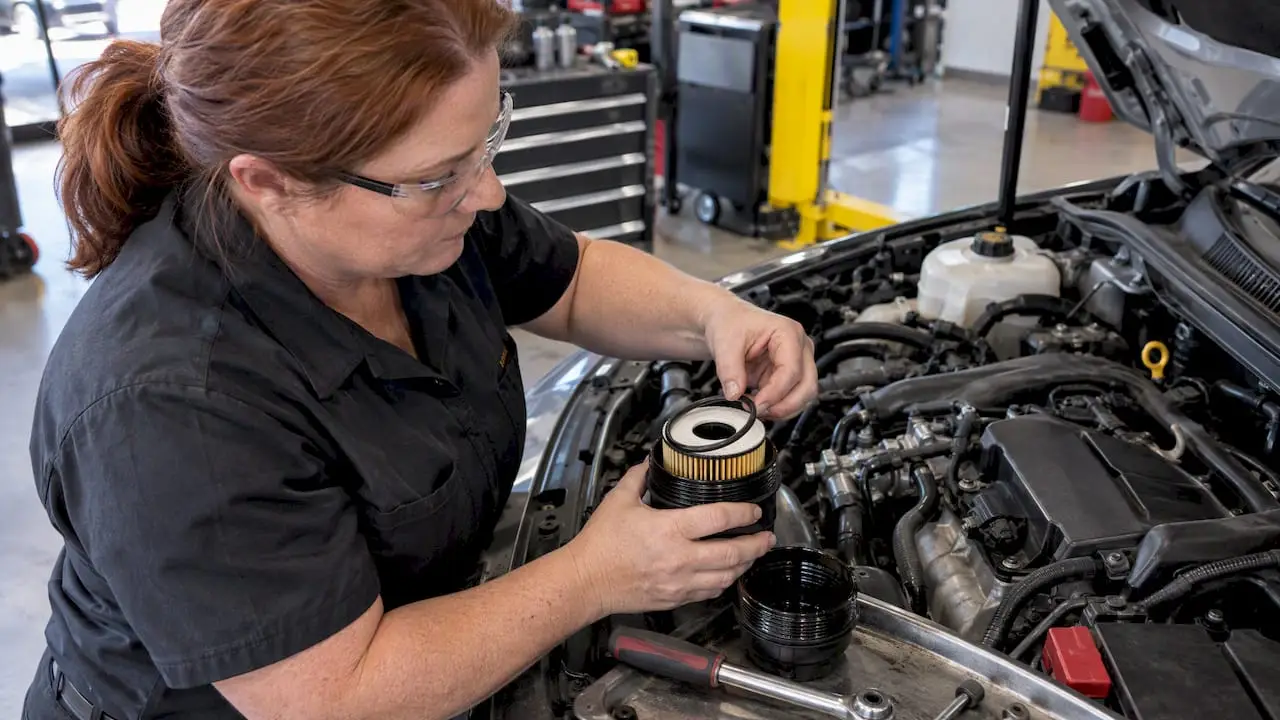
Automakers like cartridge designs for a few reasons. They reduce weight and increase reusable content, and a trade publication, Counterman, reports that spin-on filters are falling out of favor with manufacturers partly over environmental concerns, since cartridge elements contain no metal and are easier to recycle or dispose of. The same article cautions that plastic housings can be damaged if handled improperly, which is one reason cartridge jobs reward a careful technician and the correct torque.
Magnetic filters
Magnetic filters attract and hold metallic particles. AutoZone’s overview of oil filter types describes them as capturing metal bits that might otherwise circulate. In practice you will most often see magnets as a feature on a drain plug or as an add-on, working alongside a conventional filter rather than replacing it.
Centrifugal filters
Centrifugal filters spin oil at high speed so heavier contaminants are thrown outward and separated. The same source says they are seldom found outside high-performance and racing applications. If you drive a typical commuter car, SUV or half-ton pickup, you will not run into one.
Full-flow versus bypass systems
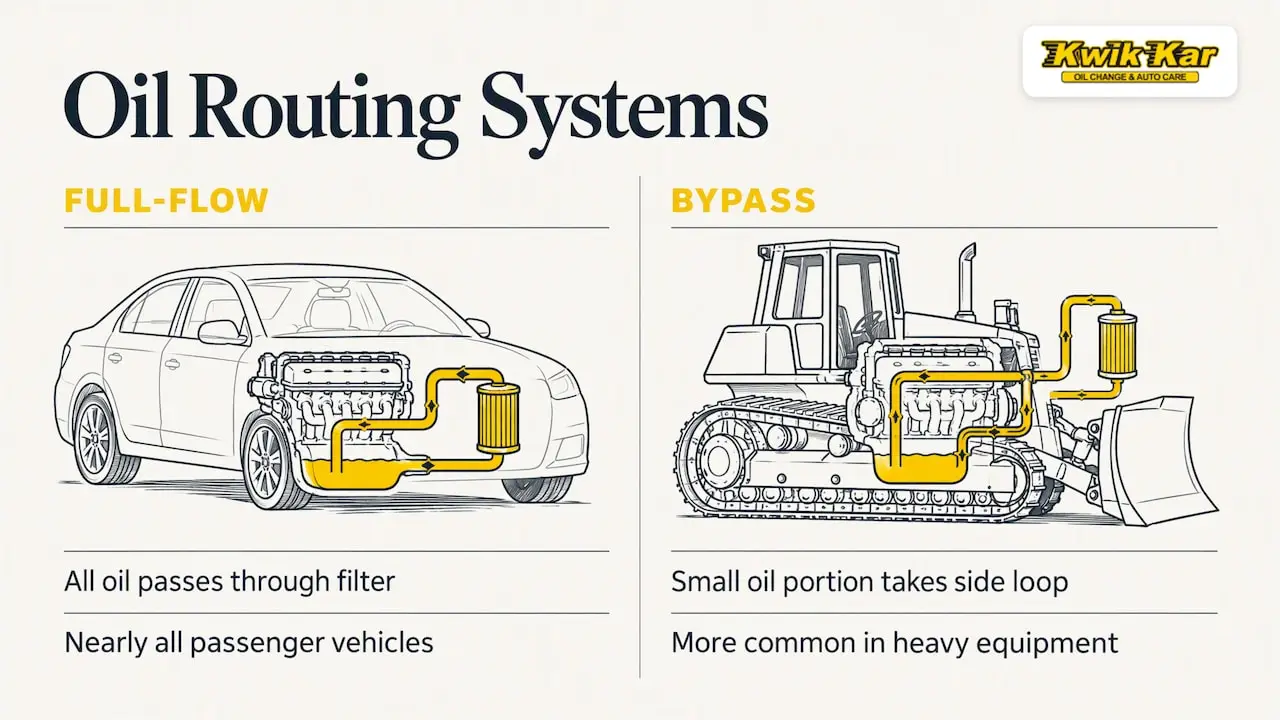
You may also see “full-flow” and “bypass” in search results. These describe how the filter is plumbed, not the physical shape. A full-flow filter sees all the oil on its way to the engine, which is how nearly every passenger vehicle is set up. A bypass filter cleans a small portion of the oil on a side loop and is more common in heavy equipment.
Cartridge vs. spin-on: which is better?
Neither wins in general. The better filter is the one designed for your engine. Your vehicle has a housing, a mounting position and a sealing design built around one style, and swapping styles is not something you can do with an adapter and hope for the best.
| Feature | Spin-on | Cartridge |
|---|---|---|
| What gets replaced | Whole canister, including housing | Element and seals only |
| Anti-drainback valve | Built into the filter | Usually in the housing or engine |
| Installation | Straightforward | More steps, more room for error |
| Waste | Metal can, needs recycling | No metal, easier to dispose of |
| Typical use | Wide range of older and current vehicles | Many newer vehicles from certain manufacturers |
The practical difference for you shows up at service time. A cartridge job takes attention to detail: new O-rings seated correctly, housing cap torqued to spec, no old seal left behind. That is the sort of detail we check on every oil change.
Does synthetic oil need a special oil filter?
Not necessarily. The test is whether the filter meets your vehicle manufacturer’s requirements. Mobil’s guidance on choosing oil filters says to study a filter’s specifications for suitability to the vehicle and application, and to consider whether it is compatible with the manufacturer’s requirements and warranty. Some extended-life filters are rated to work with conventional, high-mileage, synthetic blend and full synthetic oils, according to Mobil’s oil filter product page.
Where synthetic oil changes the picture is the service interval. If you run full synthetic and stretch your oil change interval, the filter has to last just as long. Filters built for longer intervals hold more debris, and Mobil says some synthetic filters use special rubber blends for gaskets and drainback valves and have larger bodies for greater capacity.
So when someone asks for the best oil filter for synthetic oil, the honest answer has two parts:
- Pick a filter that meets your engine’s specification.
- Match the filter’s rated life to the oil interval you plan to follow.
Using a bargain filter with a 10,000-mile synthetic interval is the mismatch to avoid. You can read more about conventional and synthetic service on our oil change page.
What does an oil filter micron rating mean?
A micron is one-millionth of a meter. A human hair is far wider than the particles a filter is built to catch. A micron rating tells you the particle size a filter targets, but on its own it is an incomplete number, because it does not say how much of that size gets caught.
That is where the beta ratio comes in. Per the Purdue publication, a beta ratio measures capture efficiency at a specified particle size, and a higher ratio at a given size means better efficiency. A beta ratio of 100 corresponds to 99% capture efficiency for particles 10 microns or larger.
A few things to keep in mind:
- Media matters. Counterman reports that synthetic filter elements can capture particles as small as 10 microns, while paper elements may filter to 40 microns.
- Finer filtration reduces wear. Purdue cites a General Motors finding that a filter capturing particles 15 microns or larger reduces engine wear by 70% compared with a 40-micron filter.
- Finer is not free. A very fine element in an undersized body can clog sooner. Capacity and flow matter as much as the micron figure.
The takeaway: compare micron ratings only when they come with an efficiency figure at that size, and treat the manufacturer’s filter specification as the starting point.

How long does an oil filter last?
The short rule is to replace it at every oil change. FRAM gives that as the general rule of thumb, along with following the interval in your owner’s manual. Purdue adds the engineering reason: a filter’s dirt-holding capacity determines how long it works before it goes into bypass mode, and filters meant for longer intervals must hold more debris.
Some premium filters are rated for far longer. Mobil states that its Extended Performance filter provides one full year or 25,000 miles of protection, whichever comes first, when used with its Extended Performance or Extended Performance High Mileage motor oil. That rating applies to that filter and oil pairing, not to filters in general.
Conditions that wear filters out sooner
AutoZone notes that frequent short trips and extreme heat or cold make filters work harder, and that cold engines produce more harmful combustion by-products that may not burn off. In Irving that translates to:
- Summer stop-and-go traffic on I-35E, Highway 183 and the George Bush Turnpike, with heat soaking the engine.
- Short hops between home, school and errands where the engine rarely warms up fully.
- Towing or hauling, which raises oil temperature.
If your driving looks like this, ask us about the interval that fits your engine rather than pushing a filter to its limit. Our post on engine oil consumption also helps if you find yourself topping off between changes.
How to choose the right oil filter for your vehicle
Use this order. It keeps you from buying on price alone.
- Check the owner’s manual for the filter specification, oil grade and interval.
- Match the style. If your engine has a cartridge housing, you need a cartridge element. A canister will not fit.
- Match the oil plan. Longer synthetic intervals need a filter rated for them.
- Look for a published efficiency rating, not just a micron claim.
- Keep your warranty in mind. Use parts that meet the manufacturer’s requirements and keep your service records.
- Replace seals and gaskets as the filter style requires, and never reuse an old O-ring.
A quick example
Say you drive a late-model crossover that calls for full synthetic oil and a cartridge filter, and you commute from Las Colinas to Grapevine. The manual lists an interval, and you are well within it. The correct service is a matching cartridge element, new O-rings, the proper oil grade and a torque-checked housing cap. Using a spin-on adapter, or skipping the O-ring because the old one “looks fine,” is how slow leaks start.
Signs your oil filter may need attention
A failing filter rarely announces itself clearly, but these are worth checking:
- Oil pressure warning light or low pressure at idle.
- Dirty, gritty or very dark oil soon after a fresh change.
- Oil leaking around the filter base or housing.
- Increased engine noise, especially on cold starts.
- Overdue service. If you cannot remember the last change, the filter is overdue too.
An oil pressure warning is a safety-critical sign. Stop driving as soon as it is safe and have the vehicle inspected rather than driving on it.
Perspective: why we treat the filter as part of the service, not an afterthought
We see oil changes every day, and the filter is the part customers ask about least and the part that can cause the most trouble when it is wrong. A mismatched filter, a missing O-ring or an over-tightened housing can turn a simple service into a leak or a low-oil situation.
That is why our ASE-certified technicians confirm the filter style and specification for your vehicle before the oil goes in. We also use Digital Vehicle Inspections, so you get photos, video and technician notes on your phone and can see what we see, including the condition of what we removed.
Our recommendations are meant to be honest and to fit how you actually drive. If your commute is mostly short trips, or you tow, we will say so and talk through the interval. If your vehicle is fine, we will tell you that too.
Kwik Kar
Oil change service in Irving
If you want the right filter installed and checked the first time, we handle conventional and synthetic oil changes for cars, SUVs and light trucks at 2100 Carl Rd, Irving, TX 75061. Drivers from Las Colinas, Grand Prairie, Euless, Coppell and nearby communities stop in as well. Your visit includes a Digital Vehicle Inspection so you can see the vehicle’s condition and decide what to do next.
See the details on our oil change service page, or check what an oil change typically costs so you can plan your budget. We also offer a Ladies’ Day oil change coupon on Wednesdays, and service discounts for military and first responders. Ask us for current terms.
Texas inspections and your oil service
Oil filters are not part of any state inspection, but drivers often ask about inspections when they come in. Under House Bill 3297, Texas ended the safety inspection requirement for non-commercial vehicles on January 1, 2025, and non-commercial vehicles still pay a $7.50 inspection program replacement fee at registration, according to the Texas Department of Public Safety. The same notice stresses that emissions tests are different from safety inspections: vehicles registered in emissions counties, which include Dallas County, still need them. Qualifying commercial vehicles remain subject to applicable safety inspections. Check the DPS page for current requirements before you renew your registration.
FAQ
What are the four types of oil filters?
The four you will see most often are spin-on, cartridge, magnetic and centrifugal. Spin-on and cartridge filters handle everyday filtration in nearly all passenger vehicles. Magnetic filters add metal-particle capture, and centrifugal filters are mostly limited to high-performance and racing use.
Can I use a cartridge filter in place of a spin-on filter?
No, not unless your engine was designed for it. Each style needs its own housing, mounting and sealing arrangement. Use the style your owner’s manual or parts catalog lists for your exact engine.
Should I change the oil filter every time I change the oil?
Yes, that is the general rule. A fresh filter keeps new oil from mixing with a loaded filter full of old debris. Premium extended-life filters carry their own rated mileage, but they are meant to be paired with the matching oil and interval.
Is a higher-micron or lower-micron filter better?
Neither number tells the whole story. Look at the efficiency rating at a given particle size, such as a beta ratio, along with the filter’s capacity. The best filter is the one that meets your engine’s specification and your oil change plan.
How can I tell what filter my car uses?
Check the owner’s manual, or bring the vehicle in and we will confirm the filter style and specification for your make, model and engine. Call us at (469) 276-7337 to ask before your visit.
Schedule your oil change in Irving
If you are not sure which filter your vehicle takes, or you are due for service, bring it in. Call Kwik Kar Irving at (469) 276-7337, visit us at 2100 Carl Rd, Irving, TX 75061, or schedule online at kkirvingtx.com. We will confirm the right filter, explain what we find and let you decide what comes next.
Sources
- ENGINE OILS AND THEIR FILTERS, Purdue University Extension
- Cartridge vs. Spin-On Oil Filters, FRAM
- Cartridge vs. Spin-on Oil Filter, Counterman
- Types of Oil Filters and Their Functions, AutoZone
- Different types of oil filters and how they work, Mobil
- Oil Filters, Mobil
- Vehicle Safety Inspection Program Changes Now in Effect, Texas DPS