Most modern engines use very little oil between changes, and burning roughly one quart every 1,500 to 2,000 miles is often considered a reasonable upper limit (consult manufacturer guidelines) before you need a closer look, according to Motorservice’s technical documentation. If your engine is using more than that, start with a baseline consumption test and a visual leak check. Pull over and stop driving only if you see an oil pressure warning light or notice a sudden, rapid drop in level.
TL;DR:
- Record the level, odometer reading, oil brand, and viscosity, then drive about 1,000 miles and recheck cold on level ground using the same oil and filter.
- Ask shops to inspect visible leaks and the PCV system before compression or leak down tests, since a ventilation fault is common and inexpensive to fix.
- Blue smoke timing helps narrow the cause: cold start puffs suggest valve seals, while smoke under acceleration with low compression points toward ring wear.
- Consumption above one quart per 1,000 miles warrants prompt diagnosis; prolonged severe burning can foul spark plugs, damage the catalytic converter, and reduce performance.
- A documented consumption test may be required for warranty approval, so keep readings and inspection evidence before authorizing internal engine repairs.
Table of Contents
- How to measure engine oil consumption accurately
- Normal vs excessive oil consumption: benchmarks and context
- Common causes and the symptom each one leaves behind
- Diagnostic sequence a shop uses to pinpoint the cause
- When oil consumption becomes a repair issue
- Preventing future oil consumption problems
- How we diagnose and document oil consumption
- What local technicians want you to know before a repair
- Get your oil consumption checked at Kwik Kar in Irving
- FAQ
- Sources
How to measure engine oil consumption accurately
Guesswork is the enemy of a good diagnosis. Before anyone opens up your engine, you need a documented baseline that proves what is actually happening between fill-ups, according to a diagnostic breakdown from Apex Tech Nation.
- Fill the crankcase to full on level ground with the engine cold, and write down the exact odometer reading, oil brand, and viscosity.
- Drive a defined interval, commonly 1,000 miles, under your normal mix of driving.
- Recheck the level cold, on level ground, after the engine has sat for about 15 minutes.
- Record how much oil you had to add and note any fresh spots, stains, or smoke you noticed during the interval.
- Keep the same oil and filter for the test so the numbers aren’t skewed by a product switch.
- Check for visible leaks at the start and end of the interval, not just the final number.
This kind of documentation matters beyond curiosity. Many manufacturers require a formal, recorded consumption test before approving warranty work or internal engine repairs, which means skipping this step can cost you time and money later.
Normal vs excessive oil consumption: benchmarks and context
Oil consumption isn’t one-size-fits-all. A tight, low-mileage four-cylinder and a high-mileage turbocharged truck engine don’t play by the same rules.
- Many passenger car engines burn well under 0.05% of the fuel they consume as oil, a figure Motorservice treats as typical for healthy engines.
- A practical shop rule of thumb flags anything above one quart per 1,000 miles as abnormal and worth diagnosing.
- Older engines, high-mileage vehicles, and turbocharged engines often tolerate somewhat higher consumption due to normal wear on rings, seals, and turbo bearings.
- Aggressive driving, towing, and sustained high RPM use all increase oil demand even in a healthy engine.
For example: if your owner’s manual allows one quart per 2,000 miles and you’re adding a quart every 600 to 800 miles, that gap is the signal to move from watching the dipstick to running real diagnostics.
Common causes and the symptom each one leaves behind
Different problems leave different fingerprints, and matching the symptom to the cause saves you from paying for repairs you don’t need.
- PCV system faults: A clogged or failed PCV valve often shows up as oil mist in the intake and gradually rising consumption without dramatic smoke. It’s a common, inexpensive cause and should be ruled out before anyone talks about rings or seals, according to CarXplorer’s diagnostic guide.
- Valve stem seals: Worn seals typically produce a brief puff of blue smoke on cold start that clears up within a minute or two as the engine warms and seals expand.
- Piston rings and cylinder wear: This shows up as blue smoke under acceleration or deceleration, often paired with blow-by and lower compression on the affected cylinders, a pattern confirmed through compression and leak-down testing according to Apex Tech Nation.
- Turbo or charge piping leaks: Oil pooling in the intercooler or charge pipes, along with smoke that appears specifically under boost, points to a turbo seal issue rather than the rings or valves.
- Overfilling or wrong viscosity: Too much oil in the pan causes aeration and foaming that can overwhelm the PCV separator and push oil into the intake, creating consumption that looks internal but isn’t, according to CarParts’ overfilling guide. Draining the excess or correcting the viscosity often solves it outright.
Pro Tip: Note exactly when smoke appears, cold start, acceleration, or under boost, since that timing alone narrows the likely cause before any tool touches the engine.
For a closer look at ventilation-related symptoms, our PCV valve symptoms guide walks through what to watch for at home.
Diagnostic sequence a shop uses to pinpoint the cause
A good diagnosis moves from cheapest and least invasive to most involved, so you’re not paying for teardown work before ruling out simple fixes.
- Visual leak and undercarriage inspection: separates an external leak from true internal consumption before any further testing.
- PCV valve and ventilation path check: the first mechanical test, since a clogged PCV system is common and inexpensive to correct.
- Smoke timing and spark plug inspection: cold start puffs, acceleration smoke, and plug fouling patterns each point toward a different likely source.
- Compression and wet compression test: if compression rises after oil is added to a cylinder, that points to ring sealing loss on that cylinder, according to Apex Tech Nation.
- Leak-down test: confirms where air is escaping, whether past the rings, the valves, or a head gasket.
- Crankcase pressure measurement: confirms the severity of blow-by and helps decide whether a full engine overhaul is warranted.
| Test | What it checks | Typical result range |
|---|---|---|
| Crankcase pressure (hot idle) | Blow-by severity | Negative crankcase pressure is typical; readings near zero suggest heavy blow-by |
| Wet compression test | Ring sealing vs. valve/head issue | Compression rise after adding oil points to worn rings |
These steps follow the stepwise sequence outlined in a service bulletin on oil consumption diagnosis, which also covers oil-in-coolant checks and intake cleaning as part of the same process. If you want a shop to walk through this with you, our engine diagnostic service covers this full sequence.
When oil consumption becomes a repair issue
Not every bit of oil use needs immediate action, but a few signs mean it’s time to stop monitoring and start fixing.
- A sudden jump in consumption, especially crossing that one quart per 1,000 mile line, warrants prompt diagnosis.
- Any oil pressure warning light means stopping the vehicle rather than continuing to drive; our low oil pressure guide explains why that warning shouldn’t wait.
- Repair scope varies widely: a PCV service is quick and affordable, valve seal replacement is moderate, and ring or cylinder work is the most involved.
Severe consumption rates are considered high-risk and increase the chance of catalytic converter damage, fouled spark plugs, and reduced performance the longer it goes unaddressed, according to CarXplorer. Waiting rarely makes these repairs cheaper. For symptoms specific to a burning smell, our burning oil smell checklist covers the five checks our technicians run first.
Preventing future oil consumption problems
A handful of maintenance habits go a long way toward keeping consumption low and predictable.
- Stick to the manufacturer’s recommended oil-change interval and use the specified viscosity and grade every time.
- Replace the PCV valve and related hoses on schedule, and have the intake cleaned periodically on direct-injection engines.
- Top off in small increments and recheck the level cold, on level ground, after about 15 minutes to avoid overfilling.
- Favor moderate acceleration and keep the cooling system in good shape, since overheating accelerates oil breakdown and wear.
Pro Tip: Check your dipstick monthly, not just at oil changes. Catching a trend early turns a potential repair into a routine fix.
How we diagnose and document oil consumption
Technicians follow the same evidence-first sequence covered above: visual inspection, PCV check, smoke timing, and compression or leak-down testing when warranted. Every step is documented with a Digital Vehicle Inspection process, sending photos, video, and technician notes straight to your phone so you can see exactly what was found.
- A documented consumption test provides a clear record if warranty coverage or a dealer conversation becomes necessary.
- Digital Vehicle Inspections show the actual condition, oil residue, intake deposits, leak points, rather than just a verbal description.
- When testing points to internal wear rather than a simple fix, scheduling a full engine diagnostic before committing to major work is recommended.
What local technicians want you to know before a repair
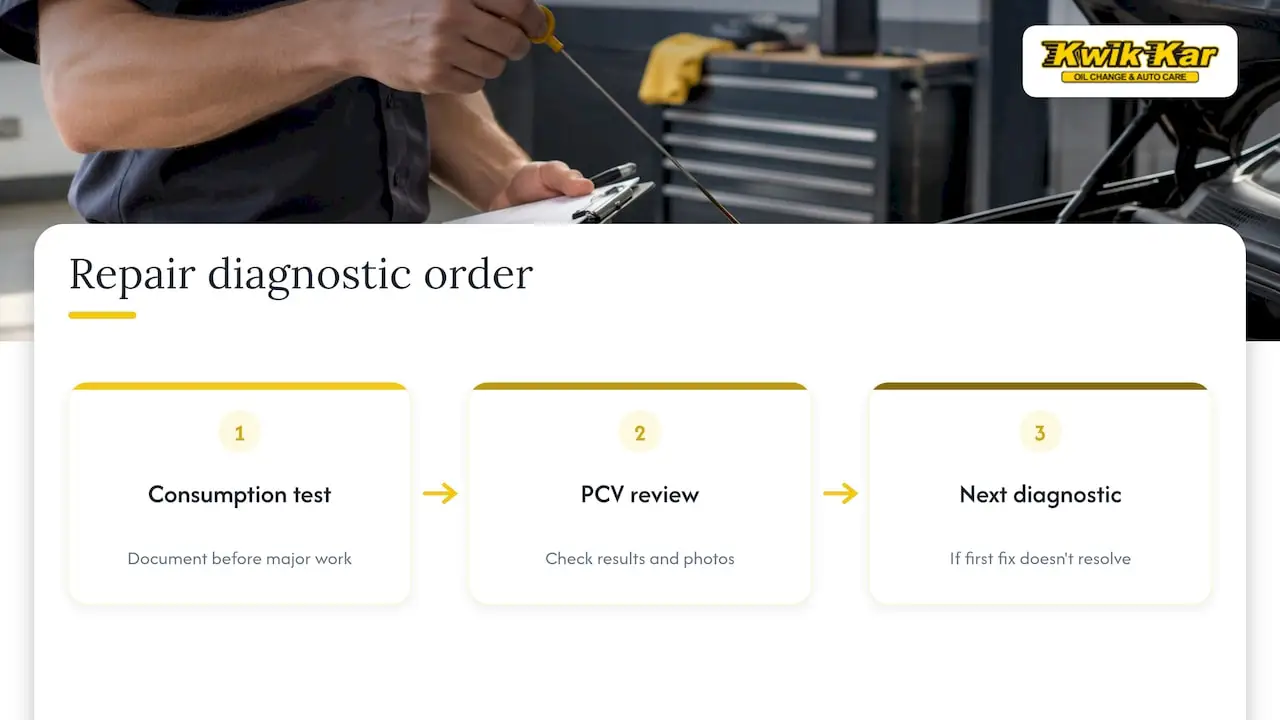
Insist on a documented consumption test before anyone recommends major engine work. Ask to see PCV inspection results and photo evidence, and confirm what the next diagnostic step is if the first fix doesn’t resolve it. Diagnosed in the right order, most cases turn out far less expensive than owners expect.
Get your oil consumption checked at Kwik Kar in Irving
If your dipstick readings have you second-guessing, we offer the full diagnostic path in one visit: PCV inspection, engine diagnostic testing, and a proper oil change with the correct viscosity for your vehicle.
Every visit includes a Digital Vehicle Inspection with photos and notes so you can see exactly what we found, not just take our word for it. Schedule a documented consumption test or diagnostic appointment with our Irving team today.
FAQ
How to stop excessive oil consumption?
Start with a PCV valve inspection, since a clogged or failed valve is a common and inexpensive cause that can resolve consumption without any internal repair, according to CarXplorer. If the PCV system checks out, further testing like compression and leak-down will identify whether seals or rings need attention.
How to calculate oil consumption?
Fill the engine to full cold on level ground, record the exact mileage, then drive a defined interval, commonly 1,000 miles, before rechecking the level the same way. The amount you need to add back tells you your consumption rate for that interval, a method detailed by Apex Tech Nation.
How much oil does a car burn per 1,000 miles?
Many healthy modern engines use well under a quart per 1,000 miles, with roughly one quart per 1,500 to 2,000 miles treated as a reasonable upper bound in technical guidance from Motorservice. Consumption above one quart per 1,000 miles is generally considered abnormal and worth diagnosing.
What year does Equinox have oil consumption problems?
This guide focuses on general diagnostic steps rather than model-specific recall histories, and we don’t have a sourced figure for a specific model year here. If you drive a vehicle with a known consumption pattern, a documented test and PCV inspection are still the right starting point.
Sources
- Diagnosing Oil Consumption: Valve Seals, Rings, and PCV
- Car Burning Oil Causes and Diagnosis Piston Rings to PCV Valve – CarXplorer
- Oil consumption and oil loss | Motorservice (MS Motorservice)
- PIP5197E Possible Oil Consumption – Oil Leaks – Blue Smoke From The Exhaust – MIL – Or Fuel Trim