
Most car batteries last three to five years. In a hot place like Irving, plan on the short end of that range, and have the battery tested every year once it passes the three-year mark. Consumer Reports, citing AAA data, puts the typical U.S. battery at three to five years, with averages running from at least 58 months in the northernmost regions to under 41 months in the southernmost. North Texas sits on the hot side of that map.
Below, we cover why heat shortens battery life, how to tell a battery is fading, what to do with a seven-year-old battery, what replacement typically costs, and how to stretch the life of the one under your hood.
TL;DR
- A typical car battery lasts three to five years. Southern heat pulls the average toward the low end, so a Texas battery is often living on borrowed time by year four.
- Summer heat is harder on a battery than winter cold. Failures often show up in the first cold morning or the first long trip, after the heat has already done the damage.
- Slow cranking, dim headlights at idle and a battery warning light can point to the battery, but also to the alternator or a corroded cable. A test tells you which.
- Expect to pay roughly $187 on average for the battery alone, according to Consumer Reports’ ratings. Premium and AGM models cost more.
- A battery that is seven years old is overdue. Replace it on your schedule, not the tow truck’s.
Table of Contents
- How long does a car battery last?
- Why do car batteries die sooner in Irving?
- How do you know your car battery is going bad?
- Should you replace a 7-year-old car battery?
- How much does a car battery replacement cost?
- How can you make a car battery last longer?
- Our perspective: test before you replace
- Get your battery tested in Irving
- FAQ
- Sources
How long does a car battery last?
The three-to-five-year figure is an average, not a promise. A few things move your battery up or down within it:
| Factor | Effect on lifespan |
|---|---|
| Hot climate | Shortens it. Heat speeds up the chemical wear inside the battery. |
| Short trips only | Shortens it. The alternator rarely gets time to fully recharge the battery. |
| Long periods parked | Shortens it. A battery that sits discharged degrades. |
| Loose hold-down or corroded terminals | Shortens it. Vibration and poor connections add stress. |
| Heavy electronics | Shortens it. Dash cams, aftermarket audio and chargers draw power when the engine is off. |
| Battery type and quality | Varies. Premium and AGM designs are built for heavier electrical loads. |
Battery type matters too. Many newer vehicles, especially those with start-stop engines and lots of electronics, use AGM (absorbent glass mat) batteries. They are built for heavier demands than a conventional flooded battery, and they cost more. If your car came with an AGM, replace it with an AGM. Downgrading can cause charging and electrical trouble.
Why do car batteries die sooner in Irving?
Most people blame winter. The research points the other way. Consumer Reports says summer heat is tougher on automotive batteries than winter cold because higher temperatures hit the chemistry that generates power. Heat also raises under-hood temperatures, and the same report notes that AAA answers nearly two million battery-related service calls every summer.
To see how punishing a hot engine bay is, look at how batteries are tested for ratings: Consumer Reports cycles them repeatedly at about 167°F for 15 weeks or until performance is unacceptable. Your engine compartment in an Irving August, after a parking lot in Las Colinas or a stop-and-go commute on I-35E, is not far from that kind of stress.
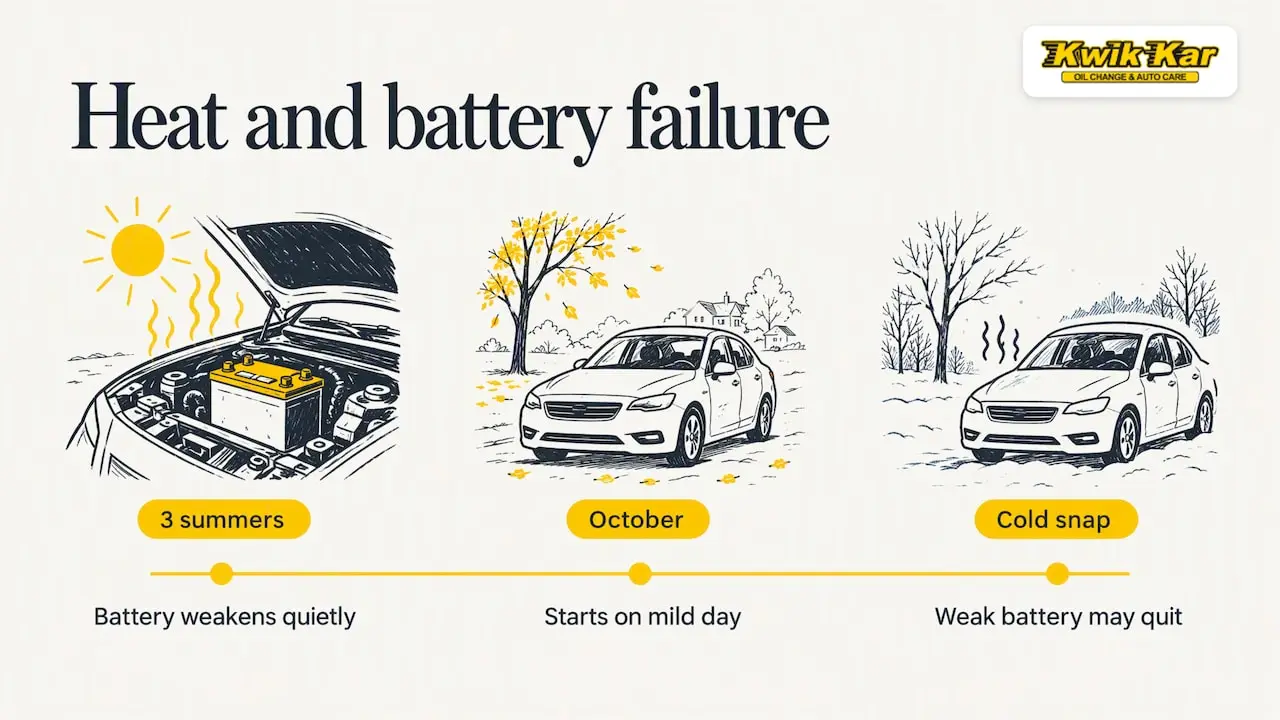
The damage builds quietly. A battery weakened over three summers can start the car fine on a mild October day, then quit on the first cold snap, because a cold engine needs more power to turn over and a weak battery has less to give. That is why a failure “out of nowhere” in winter often has a summer cause.
How do you know your car battery is going bad?
Watch for these:
- Slow, labored cranking. The engine turns over more sluggishly than it used to.
- Dim headlights at idle. Lights that brighten when you rev the engine suggest the system is struggling to keep up.
- A battery warning light. It can mean the battery, but it often means the charging system.
- Clicking and no start. Often a very weak battery or a bad connection.
- Swollen case, leaking, or a rotten-egg smell. Treat these as urgent. Stop using the battery and have it looked at.
- Crusty buildup on the terminals. Our guide to corroded battery terminals explains what it means and how to deal with it.
The catch is that these symptoms overlap. Consumer Reports notes that slow cranking, dim lights and a warning light can come from the battery, but also from the charging system or bad cables. Replace a battery without checking the rest and you may be back in a month with the same problem and a new battery that is now being undercharged.
That is why a proper check covers the whole starting-and-charging system: the battery’s condition, the alternator’s output, the cables and connections, and whether something is draining power overnight. If the battery warning light is on, our article on what to do when the battery light comes on while driving walks through it. For a failing charger, see alternator failure symptoms and starter failure symptoms. If the battery keeps going flat even though it tests fine, parasitic drain is the usual suspect.

Should you replace a 7-year-old car battery?
Yes, in nearly every case. A seven-year-old battery is at least two years beyond the high end of the typical range. Some batteries do last that long, especially in mild climates with long, regular drives. In Texas heat, one that old is on a countdown.
The trouble is that a worn battery usually still starts the car, right up until it doesn’t. You can’t tell its remaining reserve by how the engine sounds on a good day. A load test can show how much capacity is left, but even a passing grade at that age doesn’t buy much time.
A practical rule for North Texas drivers:
- Year three: start having the battery tested once a year, ideally before summer.
- Year four to five: expect to replace it soon, and don’t wait for symptoms.
- Anything older: replace it on your own schedule, before a road trip, before summer, and before it strands you in a parking lot.
If you drive a vehicle that sits a lot or a car with heavy electrical demands, shorten those intervals.
How much does a car battery replacement cost?
Two costs make up the total: the battery and the installation. On the battery itself, Consumer Reports reports an average price of $187 across its latest ratings, with one model above $362. Its listings show how wide the spread is: examples run from $90 for a budget group-24 battery to $220 for several premium models, $247 for an AGM group 35 and $260 for an AGM group 24F.

So is $200 expensive for a car battery? Not by those numbers. It is close to the average and well inside the normal range. What matters more than the sticker is the fit: the right size, the right type (AGM if your car calls for it), enough cold-cranking power, and a manufacturer warranty you can actually use.
What shapes your final bill:
- Battery type. Standard flooded batteries cost less than AGM.
- Vehicle. Some cars put the battery in the trunk, under a seat or behind a panel, and some need the vehicle’s computer to register the new battery.
- Related repairs. If testing shows the real culprit is a worn alternator or corroded cables, the battery alone won’t fix it.
We don’t publish a flat battery price because it depends on your vehicle and the battery it needs. Call us at (469) 276-7337 with your year, make and model, and we can tell you what to expect.
How can you make a car battery last longer?
You can’t beat the Texas sun, but you can take some of its edge off. These steps come from Consumer Reports’ battery-care guidance and its hot weather advice:
- Park in shade or a garage when you can.
- Test the battery at least twice a year. In Irving, make one of those before summer.
- Keep terminals clean and connections tight. Corrosion and loose clamps waste power.
- Don’t run lights or accessories with the engine off. Accessory mode drains the battery fast.
- Unplug add-on devices like dash cams and chargers if the car sits.
- Drive at least 20 minutes about every two weeks if the vehicle sits, or use a smart charger when it will be parked for more than a week.
If you travel often or keep a second car in the garage, the guide to protecting a vehicle that sits for a while covers driving frequency, smart chargers and accessory use in more detail.
The Texas Department of Insurance also advises checking the alternator charge rate at every service and inspecting the battery for cracks, corrosion and loose wires at oil changes. It is an easy habit to build in: ask for a battery check whenever the car is in for an oil change.
Our perspective: test before you replace
The most expensive battery mistake we see is not buying a cheap one. It is replacing a battery that was never the problem, or skipping a test until the car won’t start. A dead battery rarely picks a convenient time, and in this climate the heat has usually been working on it for years.
Our approach is to test the whole system first: battery, alternator, starter draw and connections. We perform Digital Vehicle Inspections, so you receive photos, videos and technician notes on your phone and can see what we see. If the battery is fine, we say so. If it is failing, you see the reading, and you decide. Our technicians are ASE-certified, and we aim for honest recommendations over upsells. For drivers who want a heads-up before a breakdown, a yearly battery test is the cheapest insurance on the car.
— Kwik Kar
Get your battery tested in Irving
We test and replace batteries at 2100 Carl Rd, Irving, TX 75061, and we serve drivers from Las Colinas, Grand Prairie, Euless, Coppell, Grapevine and Dallas. Start on our battery testing and replacement page, or check the current $20 off battery replacement offer for terms. If the problem turns out to be charging or starting, we also handle alternators and starters and full engine diagnostics. Ask about our warranty on qualifying repairs when you book. We also look after business vehicles through our fleet maintenance programs.
FAQ
How long do car batteries last in Texas?
Expect roughly three years, and sometimes less, in sustained heat, versus up to five years or more in cooler states. Consumer Reports’ regional data shows averages under 41 months in the farthest southern regions. Yearly testing after year three catches a weak battery before it fails.
Does an AGM battery last longer than a standard battery?
Often, but not always. AGM batteries are designed for vehicles with heavy electrical demands, such as start-stop systems, and they tend to cost more. Heat still wears them down, so they need testing too. Use the type your vehicle was built for.
Can a car battery be bad even if the car starts?
Yes. A battery can start the car on a mild day and still have little reserve left. Dim lights, slow cranking and repeated jump starts are warning signs, and a shop load test shows how much capacity remains.
Is it the battery or the alternator?
The symptoms overlap, so you can’t always tell by feel. A battery that tests weak points to the battery. A battery that keeps going flat after replacement, or a warning light while you drive, points to the charging system. A full starting-and-charging test settles it.
How often should I have my car battery checked?
At least twice a year, with one check before summer. Adding a battery check to routine service, such as oil changes, makes it easy to remember.
Sources
- Best Car Battery Buying Guide, Consumer Reports
- How Hot Weather Affects Your Car Battery, Consumer Reports
- Car Batteries: Which Ones Do Best?, Consumer Reports
- How to Make Your Car Battery Last Longer, Consumer Reports
- Best Car Batteries for the Money, Consumer Reports
- Car Battery Ratings & Reviews, Consumer Reports
- Vehicle Battery Safety Fact Sheet, Texas Department of Insurance