Expect roughly $150 to $500 per strut in parts, or $700 to $1,300 for a front pair with labor at an independent shop, and closer to $1,119 to $1,328 as a general average once you include both parts and installation. A full four-corner job often lands between $1,300 and $2,500, plus an alignment. Luxury vehicles and adaptive suspension systems push well past those numbers, sometimes into the thousands, because of specialized parts and required calibration.
TL;DR:
- Replacing a pair of struts on a typical vehicle costs between $700 and $1,300, including parts, labor, and alignment, with higher prices for luxury or adaptive suspension systems.
- Quick-strut assemblies usually cost more upfront but save time and reduce risk compared to bare-strut swaps, which involve spring compression and longer labor.
- Replacing struts in pairs ensures even damping and prevents uneven tire wear, as most shops avoid individual side replacements unless recent.
- A full four-corner job with alignment generally costs between $1,300 and $2,500, depending on vehicle class and additional components like mounts or springs.
- Signs of worn struts include bouncing, nose diving, swaying, clunking noises, fluid leaks, and irregular tire wear, making prompt inspection essential for safety.
Table of Contents
- Strut Replacement Cost Breakdown: Parts, Labor, and Alignment
- How Strut Replacement Cost Varies by Vehicle Type
- Quick Strut Assemblies vs. Individual Strut Components
- Why Struts Get Replaced in Pairs
- How Long Strut Replacement Takes and What Drives the Labor Bill
- Signs Your Struts Are Worn and Why It’s Not Safe to Wait
- DIY Strut Replacement: When It’s Reasonable and When It’s Risky
- Dealer vs. Independent Shop: Where the Price Gap Comes From
- What a Transparent Strut Inspection Looks Like at Kwik Kar Irving
- Six Questions to Ask Before You Approve a Strut Quote
- Book Your Strut Inspection at Kwik Kar Irving
- Sources
- FAQ
Strut Replacement Cost Breakdown: Parts, Labor, and Alignment
A strut quote is really three separate line items stacked together, and knowing what each one covers helps you spot a fair price from an inflated one.
Parts make up the biggest swing in the total bill. A bare strut, the metal cylinder alone, might run $50 to $150 each, but almost no shop installs bare struts anymore because it means compressing and transferring the coil spring by hand. Most quotes instead use a loaded or “quick strut” assembly, which bundles the strut, spring, mount, and bearing into one preassembled unit. Those run $150 to $500 or more per corner depending on the brand. Choosing a quality aftermarket brand tends to hit a good middle ground between price and how long the part lasts.
Labor depends on how many hours the job takes and your local shop’s hourly rate. Quick-strut swaps are faster since they avoid spring compression; bare-strut jobs take longer due to additional steps.
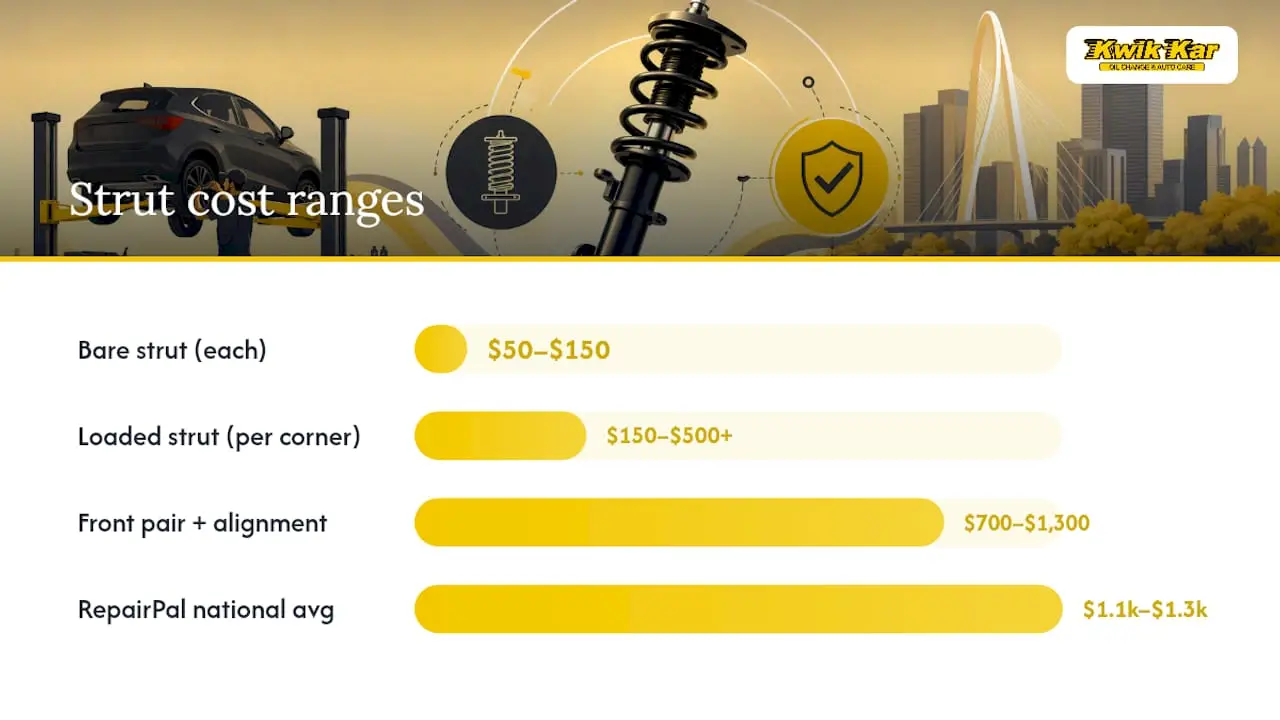
Alignment is the line item people forget to budget for. Strut replacement changes ride height and suspension geometry, and a front-pair strut job on a mainstream vehicle commonly falls within the $700 to $1,300 range at an independent shop once alignment is folded in. Skipping the alignment often causes scalloped, uneven tire wear within a few thousand miles.
Typical additions that show up on a strut quote include:
- Strut mounts and bearings, often replaced alongside the strut itself since they wear at a similar rate
- Coil springs, if yours are cracked, sagging, or the shop is switching to a different spring rate
- Sway bar end links, especially on vehicles with 60,000+ miles
- Shop supplies and disposal fees, usually small but present on most invoices
RepairPal’s estimator places a typical suspension shock or strut replacement average between $1,119 and $1,328 nationally, with both parts and labor contributing and regional rates shifting the total up or down.
How Strut Replacement Cost Varies by Vehicle Type
Your vehicle class tells you almost as much about price as the parts themselves. Struts for a Honda Civic and struts for a Cadillac Escalade with adaptive dampers are not competing in the same category.
- Economy compacts and midsize sedans (Corolla, Civic, Camry, Accord): front-pair replacement typically runs toward the lower end of the $700 to $1,300 independent-shop range, since parts are widely available and labor is straightforward.
- Crossovers and SUVs (RAV4, CR-V, Explorer): expect the same general range to run slightly higher, since taller ride height and heavier curb weight sometimes call for beefier struts.
- Full-size trucks (F-150, Silverado): parts cost more due to higher load ratings, and some trims with leveling kits or heavier suspension components add to the labor time.
- Luxury and performance vehicles (BMW, Mercedes, Audi): parts alone can exceed $500 per corner before labor, and many of these models use suspension components that require specific tools.
- Adaptive and air suspension systems (many higher trims of Range Rover, Mercedes E-Class, Cadillac Escalade): this is a separate cost category entirely. Each damper can run several hundred to well over a thousand dollars, and the job often needs module recalibration afterward, which adds both time and cost.
These are approximations meant to help you find your car’s likely bracket, not a quote for your exact vehicle. Mileage, trim level, and whether you’ve already got worn mounts or springs will move the number in either direction.
Quick Strut Assemblies vs. Individual Strut Components
A quote built around loaded quick-strut assemblies and one built around bare-strut component swaps can look wildly different, and both can be legitimate depending on the shop and the vehicle.
- Quick/loaded assemblies come pre-built with the strut, spring, mount, and bearing already combined. A technician unbolts the old unit and bolts in the new one, no spring compressor required.
- Bare-strut swaps require compressing the original coil spring under high tension and transferring it, along with the mount and bearing, onto the new strut body. It’s more labor and carries real risk if done without the right compressor tool.
- Cost trade-off: loaded assemblies cost more upfront in parts but often save money overall once you factor in the reduced labor hours and eliminated spring-compression risk.
Shops sometimes default to bare-strut swaps on older or less common vehicles where a loaded assembly isn’t readily stocked. Watch for hidden costs here: if a bare-strut quote doesn’t clearly state whether new mounts and bearings are included, ask before you approve the work.
Pro Tip: Ask your shop point-blank whether the quote uses loaded assemblies or bare struts. The answer changes both your labor line and your risk exposure, and a good shop should explain the choice without hesitation.
Why Struts Get Replaced in Pairs
Shops almost always quote strut work by the axle, front pair or rear pair, rather than one side at a time, and there’s a real mechanical reason behind it.
- A widely followed industry practice is replacing shocks or struts in axle pairs, since a new strut on one side paired with a worn one on the other creates uneven damping.
- Uneven damping means the car leans differently side to side under braking and cornering, and that imbalance accelerates uneven tire wear and speeds up wear on the “good” side’s bushings and mounts.
- A single-side replacement is technically possible if the other strut was replaced very recently and shows no wear, but most shops will decline the job anyway to avoid a comeback complaint about handling.
If your struts are more than a couple of years apart in age, expect your shop to recommend the full pair rather than a spot fix.
How Long Strut Replacement Takes and What Drives the Labor Bill
A quick-strut assembly swap generally takes about 1 to 1.5 hours per axle, while a bare-strut job using a spring compressor takes closer to 2 to 3 hours per axle because of the extra disassembly and reassembly steps. Add roughly 30 to 45 minutes for the alignment, which most shops bill as a separate charge.
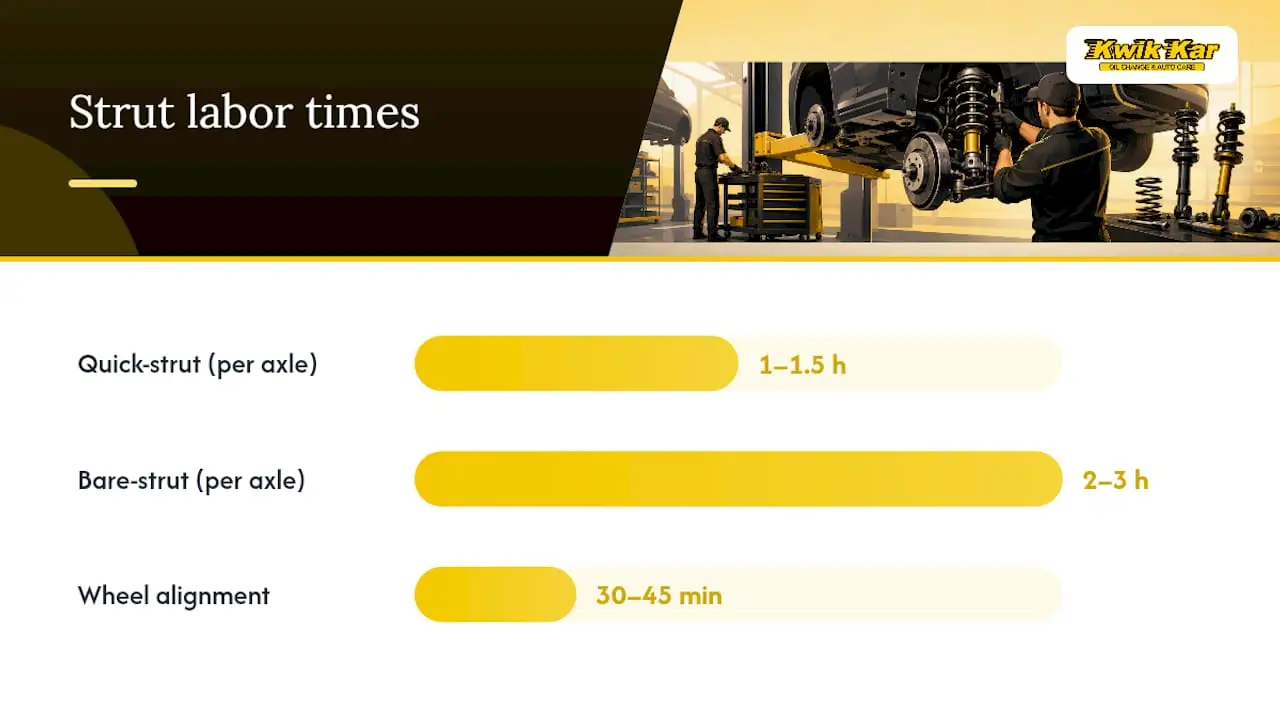
To estimate your own labor cost, multiply your shop’s hourly rate by the expected hours for your job type, then add the alignment fee. A front-axle quick-strut job at a typical independent shop rate might run one to two hours of labor total, while a full four-corner bare-strut job with alignment could tie up a bay for most of a day.
Signs Your Struts Are Worn and Why It’s Not Safe to Wait
Struts fail gradually, which is exactly why so many drivers keep driving on them long after they should have booked service.
Watch for these driving symptoms:
- A bouncy, floaty ride that doesn’t settle after hitting a bump
- Nose diving forward hard when you brake
- Swaying or leaning excessively through turns
- Clunking or knocking noises over potholes and speed bumps
And these visual clues, easiest to catch during an oil change or tire rotation:
- Oily residue or visible fluid streaks on the strut body, a sign the internal seal has failed
- Uneven or cupped tire wear patterns, often scalloped along the tread
Monroe’s technical resources list these exact symptoms, from bounce and nose dive to clunking and hydraulic leaks, as the standard warning signs of failing struts.
The safety concern is real: struts don’t just cushion bumps, they keep your tires in consistent contact with the road during braking and steering. Driving on a broken or badly worn strut is unsafe and can accelerate damage to related steering and braking components, so a car that sways badly in turns or dives hard under braking deserves an inspection appointment, not a “wait and see.”
DIY Strut Replacement: When It’s Reasonable and When It’s Risky
Replacing struts yourself is doable for someone with the right tools and mechanical experience, but the danger is concentrated in one specific step.
- A coil spring under compression stores enough energy to cause serious injury if the compressor tool slips or is used incorrectly. This is the single riskiest part of a DIY strut job.
- Using a loaded/quick-strut assembly sidesteps that risk entirely, since there’s no spring to compress. It costs more in parts but removes the most dangerous part of the job.
- DIY parts cost for a quick-strut pair might land in the $150 to $400 per side range, meaningfully less than a full shop quote, since you’re only paying for parts.
- Cases that should always go to a professional shop: adaptive or air suspension systems, vehicles under warranty where DIY work could void coverage, and any job where you don’t own a proper spring compressor.
Pro Tip: If you’re on the fence about DIY, price out loaded assemblies instead of bare struts. The parts cost more, but you skip the spring compressor entirely, which is where most home strut jobs go wrong.
Dealer vs. Independent Shop: Where the Price Gap Comes From
Dealers and independent shops both do strut work well, but they price it differently, and knowing why helps you decide which one fits your situation.
- Dealer labor rates and OEM parts premiums can make the same strut job 30% to 80% more expensive than an independent shop, depending on the vehicle and whether OEM parts are required.
- The dealer is worth the premium when your vehicle is still under warranty, when you have adaptive or air suspension that needs manufacturer-specific calibration, or when a recall or service bulletin ties directly to the suspension.
- Independent shops using quality aftermarket brands can match OEM performance for most daily-driven vehicles at a lower price point.
- Before booking anywhere, ask what brand of parts they use and whether their technicians hold ASE certification. That single question tells you a lot about how the shop operates.
What a Transparent Strut Inspection Looks Like at Kwik Kar Irving
When you bring a suspension concern to Kwik Kar Oil Change & Auto Care in Irving, our shocks and struts service starts with a physical inspection of the strut body for leaks, the mounts for play, and the tires for cupped wear patterns that hint at how long the problem has existed.
We back that inspection with a Digital Vehicle Inspection, a report with photos, video, and technician notes sent straight to your phone so you can see exactly what our ASE-certified technicians found instead of taking a verbal word for it. A typical transparent quote breaks out strut assemblies, mounts if needed, and the alignment as separate, clearly labeled line items, so nothing gets bundled into a vague “suspension work” charge. If you’re scheduling ahead, mention any symptoms you’ve noticed, bouncing, clunking, uneven tire wear, so we can plan the right amount of shop time for your visit.
Six Questions to Ask Before You Approve a Strut Quote
A cheap strut quote isn’t automatically a bad one, but it’s worth checking a few things before you sign off.
Ask what brand the replacement parts are, whether the quote uses loaded assemblies or bare struts, and how many labor hours are included. Ask directly whether an alignment is part of the price, because a quote that skips it isn’t actually complete. Ask what warranty covers the parts and the labor separately, since those terms often differ. And ask whether the shop can show you photos or video of the worn components, not just tell you they’re bad.
Red flags worth pausing over: a quote with no alignment listed anywhere, parts described only as “struts” with no brand or type specified, and a total that seems too low for a four-corner job with alignment included. A higher quote is often justified when it includes OEM parts for a warranty situation, adaptive suspension calibration, or a documented multi-point inspection you can actually review.
Book Your Strut Inspection at Kwik Kar Irving
Struts don’t fail on a convenient schedule, and driving around Irving on a bouncy, nose-diving suspension isn’t something to put off until it gets worse. Kwik Kar Oil Change & Auto Care gives you what a lot of quotes leave out: a documented inspection with real photos and video, ASE-certified technicians who can walk you through exactly why a part needs replacing, and a quote broken into clear line items instead of one vague total.
Our shocks and struts repair service covers the inspection, the parts conversation, and the alignment your car will likely need afterward, all explained before we touch a wrench. If cost is a concern, check our current coupons and specials before you book, since seasonal offers can take a bite out of the total. Call your nearest Kwik Kar Irving location or book online to get a Digital Vehicle Inspection and a straightforward, itemized estimate for your suspension.
Sources
For model-specific numbers beyond the ranges in this guide, RepairPal’s cost estimator lets you enter your exact vehicle for a tailored range. Monroe’s technical resources cover strut and shock symptoms in more depth, and Empire Auto Protect’s 2026 pricing breakdown offers additional context on dealer versus independent shop pricing gaps.
- Suspension shock or strut replacement cost — RepairPal estimator
- Symptoms of worn shocks & struts — Monroe technical resources
- Strut replacement cost in 2026 — Empire Auto Protect
FAQ
Can you still drive a car with bad struts?
You can physically drive it, but it’s not safe to keep doing so. Driving on a broken or severely worn strut can accelerate damage to steering and braking components, so an inspection should happen as soon as symptoms show up.
What are the signs of a bad strut?
The most common signs are a bouncy ride, nose diving under braking, swaying in turns, clunking over bumps, oily residue on the strut body, and uneven, cupped tire wear.
How long does it take a mechanic to replace a strut?
A quick-strut assembly swap typically takes about 1 to 1.5 hours per axle, while a bare-strut job with a spring compressor takes closer to 2 to 3 hours per axle, plus 30 to 45 minutes for the required alignment.
How long do struts last?
Most struts last a range of miles depending on driving style, road conditions, and vehicle weight.
How much does strut replacement cost for a full four-corner job?
A complete four-corner strut replacement, including alignment, commonly falls between $1,300 and $2,500 at an independent shop, with luxury or adaptive suspension vehicles running well above that.