
Solid rotors are single-piece discs best suited to light daily driving or rear-axle duty, while vented rotors use internal vanes that move air through the disc and resist heat fade under heavy or repeated braking. Daily commuters often do fine with solid rotors in the rear, towing and performance driving usually call for vented rotors, and the two types are often not a direct swap, so fitment needs checking first.
TL;DR:
- Keep the manufacturer’s original rotor specification; towing, downhill driving, and track use place greater demands on cooling, so upgrades should match verified fitment.
- Solid and vented rotors are generally not interchangeable: confirm caliper clearance, rotor thickness, pads, and brackets against the vehicle’s factory setup before buying.
- A computational fluid dynamics comparison found modified vanes moved up to 35% more air through a rotor than straight radial vanes.
- Replace a rotor if a crack opens under braking or material is missing; resurfacing is safe only when machining leaves it above minimum thickness.
Table of Contents
- What Is a Solid Rotor?
- What Is a Vented Rotor and How Do the Vents Cool It?
- Heat, Fade, Wear, and Cost: the Differences That Matter
- Fitment and Interchangeability: What to Check Before Swapping
- Choosing the Right Rotor for How You Drive
- Rotor Maintenance: Symptoms and When Service Is Needed
- How a Shop Actually Decides Between Solid and Vented
- Get a Brake Inspection in Irving Backed by Photo Proof
- FAQ
- Sources
What Is a Solid Rotor?
A solid rotor is a flat disc of cast iron with no internal passages. Installers commonly find them on the rear axle of passenger cars and light trucks, where braking demand is lower than up front, and on some older or economy vehicles across both axles.
Because solid rotors lack internal airflow channels, they cool mainly through surface exposure to passing air, which means they hold heat longer during repeated stops. That heat soak can translate into a slightly softer pedal feel after hard or sustained braking.
- Simpler casting, often with a lower parts cost than a vented equivalent.
- Lighter in some rear-axle applications, which can modestly reduce unsprung weight.
- Fewer surfaces prone to cracking since there are no internal ribs to stress.
What Is a Vented Rotor and How Do the Vents Cool It?
A vented rotor is built from friction surfaces separated by internal ribs or vanes, forming channels that pull air through the disc as it spins. That internal airflow is the main reason vented rotors show up on front axles and heavier vehicles, where braking loads and heat buildup are highest.
Thermal and computational fluid dynamics studies back up what shops see in daily use. A 2020 thermo-structural study found that ventilated and hybrid ventilated disc designs dissipate more heat and run cooler at the surface than solid discs under comparable braking conditions. Separate CFD work on vane geometry found that modified vane shapes can move substantially more air than straight radial vanes, which translates directly into better heat transfer.
- Disc construction with internal vanes that create cooling air passages.
- CFD research shows certain vane shapes move significantly more air than straight radial designs.
- Common on front axles and heavier vehicles that see frequent or sustained braking.
Heat, Fade, Wear, and Cost: the Differences That Matter
The gap between solid and vented rotors comes down to how each manages heat, and heat is what drives fade, wear, and service costs.
- Heat dissipation and fade: vented designs increase airflow through the disc, which CFD and thermal research ties to lower surface temperatures and reduced fade risk during repeated hard stops.
- Thermal mass and pad wear: a rotor that sheds heat faster cools between applications, which helps keep pad material from glazing or overheating during stop-and-go braking.
- Service implications: both types face machining limits and minimum-thickness specs, but vented rotors carry the added consideration of internal vane condition, since cracking there is harder to see than on a solid face.
- Cost trade-offs: vented rotors and their added machining complexity typically cost more than a comparable solid rotor, a difference worth paying where sustained heat is a real factor, as explained in this rotor replacement cost guide.
One CFD comparison found that a modified vane shape allowed up to 35% more mass flow through the rotor than a straight radial vane design, according to SAE research on vented disc airflow. That gap shows how much vane geometry, not just the presence of vents, shapes real-world cooling performance.
Fitment and Interchangeability: What to Check Before Swapping
Most vehicles are engineered for one rotor type per axle, and that choice drives caliper clearance, rotor thickness, and the hub interface. A vented rotor is thicker than a solid one built for the same hub, so dropping a vented disc in where a solid one belongs, or the reverse, usually means the caliper won’t clear or the pads won’t seat correctly. An aftermarket knowledgebase article confirms that solid and vented rotors are generally not interchangeable without checking calipers, pads, and brackets first.
Before considering a swap, confirm:
- Caliper piston travel and whether it accommodates the new rotor’s thickness.
- Rotor thickness against the vehicle’s stock specification, not just overall diameter.
- Minimum thickness stamped on the rotor, since a worn replacement candidate may already be out of spec.
- Bracket and pad compatibility with the new rotor profile.
Any rotor with an external crack that opens under brake application, or with a portion of material missing, must be replaced under recommended performance rotors and pads standards, regardless of rotor type.
Pro Tip: Bring your old rotor and the vehicle’s year, make, and model to a parts counter or shop before buying a replacement, since thickness and vane design vary even within the same model line.
Choosing the Right Rotor for How You Drive
Matching rotor type to driving style keeps braking predictable and avoids paying for cooling capacity you don’t need, or skimping on it where you do.
- Daily driving: solid rear rotors paired with vented fronts are standard on many vehicles and work well within the manufacturer’s original spec.
- Towing or sustained downhill driving: vented rotors handle the repeated heat cycles better, which is why most factory setups put them up front where braking load is highest.
- Track or performance driving: vented rotors, sometimes paired with cooling ducts, better withstand sustained high-temperature braking, though slotted or drilled variants need extra scrutiny for thermal stress cracking over time.
- Every case: following the vehicle manufacturer’s rotor spec and confirming fitment protects both braking performance and warranty coverage.
Rotor Maintenance: Symptoms and When Service Is Needed
A rotor rarely fails without warning signs. Squeal often points to a wear indicator or glazed pad, pulsation in the pedal or steering wheel usually signals an uneven rotor surface, and vibration under braking can mean warping or thickness variation. A closer look at warped rotor symptoms breaks down what each sensation typically means.
- Any external crack that opens when the brakes are applied, or missing material on the rotor face, requires replacement under federal inspection guidance.
- Heat checking, which looks like fine surface cracks, differs from a flexural crack that runs through the rotor; a technician checks which one is present before deciding on repair.
- Resurfacing is only an option when the rotor stays above its minimum thickness spec after machining; once it’s too thin, replacement is the only safe path.
Coordinating rotor service with pad replacement keeps wear even across the new surface.
How a Shop Actually Decides Between Solid and Vented
Our technicians start with the manufacturer’s original rotor specification, not a guess about what sounds tougher. That spec already accounts for the vehicle’s weight distribution and braking demand, so it’s the first checkpoint before anything else gets considered.
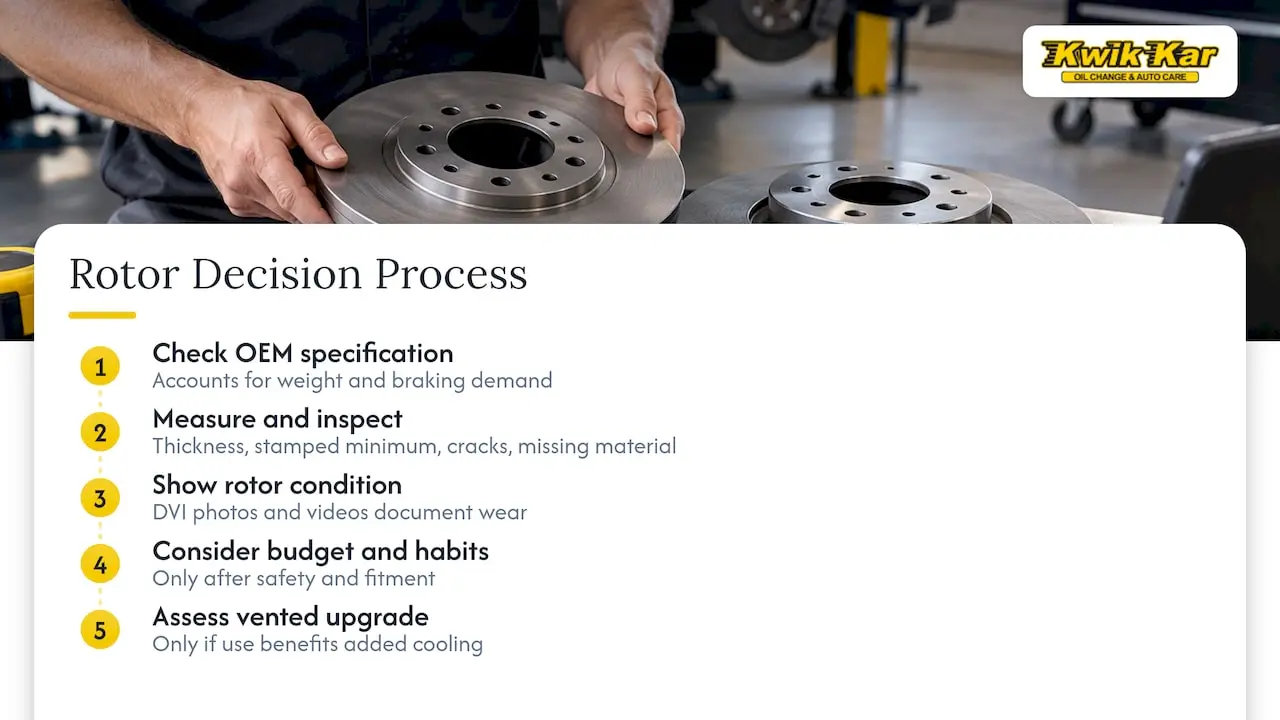
From there, measurements matter more than assumptions: current rotor thickness, minimum thickness stamped on the part, and any visible cracking or missing material. Digital Vehicle Inspections with photos and videos let us show a customer exactly what a worn or cracked rotor looks like before recommending replacement, rather than asking for trust on a verbal description.
Budget and driving habits come last in the decision, once safety and correct fitment are settled. A vented upgrade only makes sense when the vehicle’s use actually benefits from the added cooling capacity.
— Kwik Kar
Get a Brake Inspection in Irving Backed by Photo Proof
Guessing whether your rotors are solid, vented, or due for replacement isn’t something you should have to do from the driver’s seat. We check rotor thickness, condition, and fitment during every brake visit and back up what we find with Digital Vehicle Inspection photos and videos sent straight to your phone.
- Request a brake inspection through our brake repair page and see your rotor condition before any work starts.
- Ask about our current brake replacement coupon when you schedule.
- Bring your vehicle to our Irving shop and we’ll walk you through the photos and recommendation together.
Schedule your brake repair appointment today and get a clear, documented answer on your rotors.
FAQ
Can you replace vented rotors with solid rotors?
Usually not without changes, since vented rotors are thicker and built for different caliper clearance than solid ones. An aftermarket knowledgebase source recommends checking calipers, pads, and brackets before attempting the swap, and a qualified shop should confirm fitment first.
Are vented brake rotors worth it?
For front axles, towing, and performance driving, yes: vented rotors move more air through internal vanes, which thermal research ties to lower surface temperatures and better fade resistance than solid discs. For light rear-axle duty, a solid rotor built to factory spec is usually sufficient.
What type of rotors are best for daily driving?
Most daily drivers do well with the factory setup, often vented fronts paired with solid rears, since that combination already matches typical commuting heat loads. Sticking to the manufacturer’s original spec is the safest route rather than upgrading without a clear need.
Which brands of brake rotors should I avoid?
There’s no verified list of rotor brands to avoid, and the safer approach is checking that any replacement meets your vehicle’s thickness, fitment, and material spec rather than judging by brand name alone. A technician can confirm whether a specific rotor matches your vehicle’s requirements during a brake inspection.
Sources
- eCFR :: Appendix A to Part 396, Title 49 – Minimum Periodic Inspection Standards
- 2020-28-0477: Numerical Investigations on Thermo-Structural Behavior of Various Cut Patterns for Ventilation on Automobile Brake Discs – Technical Paper
- 2008-01-0822: Flow and Heat Transfer Analysis of a Ventilated Disc Brake Rotor Using CFD – Technical Paper
- What is a vented rotor?