R-134a and R-1234yf are two different automotive A/C refrigerants, and they are not interchangeable. R-134a has been the standard in U.S. vehicles since 1994, while R-1234yf is the newer, lower-impact refrigerant found in many recent models. The two cool in a similar way, but they differ in climate impact, flammability, compressor oil, fittings and service equipment. The refrigerant your car was built for is the one it needs, and the label under your hood tells you which that is.
This guide explains how the two compare, what that means for your A/C service in Irving, and how to avoid the mistakes that turn a simple recharge into an expensive repair.
TL;DR
- R-134a has a global warming potential (GWP) of 1,430. R-1234yf has a GWP of 4 and is rated mildly flammable (A2L), according to the EPA.
- Do not convert a system from one to the other. The fittings, oil and service equipment are different by design.
- Check the under-hood A/C label to see which refrigerant your car uses before you buy anything or book service.
- Service costs can differ because R-1234yf needs dedicated equipment and trained technicians.
- A/C that blows warm needs a leak and system check, not just a top-off.
Table of Contents
- What is the difference between R-134a and R-1234yf?
- Do they cool the same?
- Are the operating pressures the same?
- Can you put R-134a in a car designed for R-1234yf?
- How do you know which refrigerant your car uses?
- Why can R-1234yf service cost more?
- Can I use my old R-134a gauges on an R-1234yf system?
- Is it legal to release refrigerant?
- Our perspective
- What to do when your A/C stops cooling
- A/C service at Kwik Kar Irving
- Common mistakes to avoid
- Frequently asked questions
- Schedule your A/C check in Irving
- Sources
What is the difference between R-134a and R-1234yf?
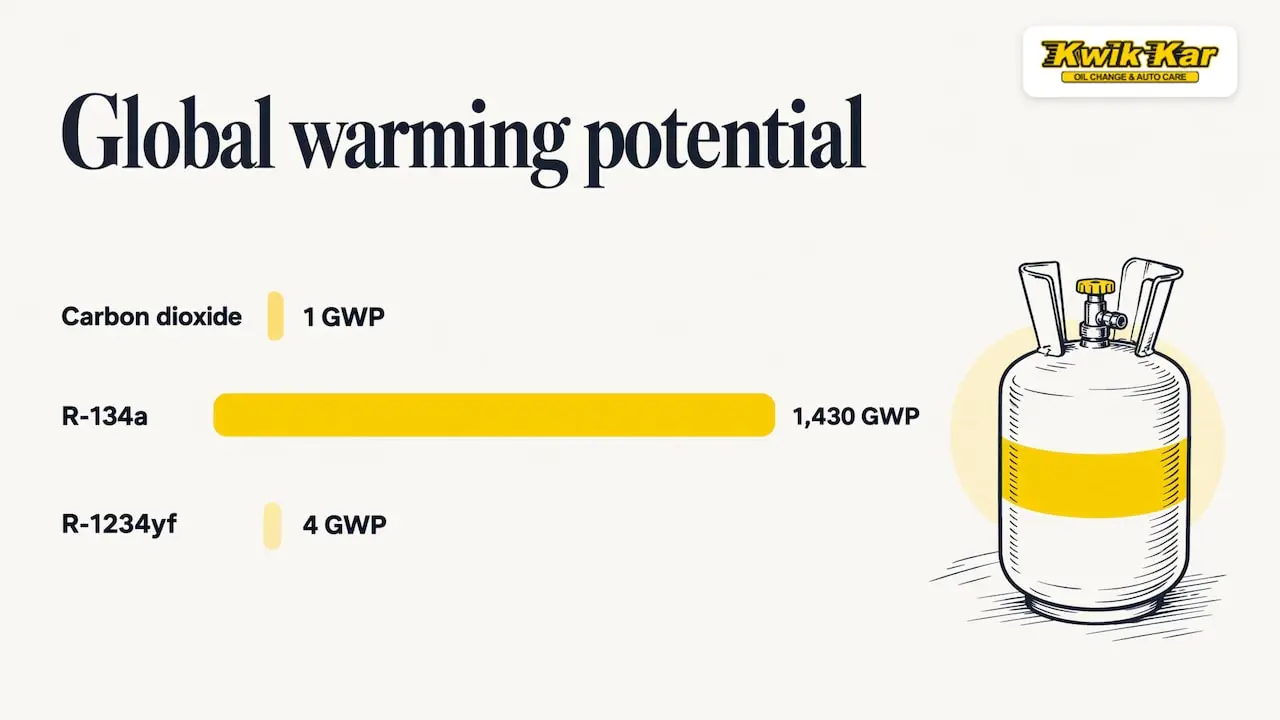
The biggest difference is environmental. The EPA lists R-134a with a GWP of 1,430 and R-1234yf with a GWP of 4. GWP measures how much heat a gas traps in the atmosphere compared with carbon dioxide. That gap is the reason automakers moved to R-1234yf.
The second difference is flammability. The same EPA page describes R-1234yf as mildly flammable, with an ASHRAE safety rating of A2L. Regulators allow it for vehicle use subject to use conditions, and the system, fittings and service equipment are designed around that rating.
Here is a side-by-side view:
| Feature | R-134a | R-1234yf |
|---|---|---|
| GWP | 1,430 | 4 |
| Flammability | Not flammable | Mildly flammable (A2L) |
| U.S. history | Most common car A/C refrigerant since 1994 | Newer, used in many recent models |
| Service fittings | Its own couplers | Unique fittings, different from R-134a |
| Compressor oil | Oil suited to R-134a | Specific oils required |
| Service equipment | R-134a equipment | Dedicated equipment designed for A2L |
If you want the oil side of the story in detail, our article on PAG vs. ester oil and why R-134a oil can harm an R-1234yf system goes through it.
Do they cool the same?
For most drivers, the cabin feels about the same. Industry guidance from the Australian Refrigeration Council notes that the two refrigerants have similar thermodynamic properties, which is why automakers could adapt existing A/C designs rather than starting over.
Lab results are more nuanced. In one 2020 study, an R-1234yf system showed 5% to 25% lower cooling capacity and a coefficient of performance 14.5% lower on average than an R-134a system under the same test conditions. Other engineering work suggests that optimizing heat exchanger circuitry can help R-1234yf systems close that gap. Automakers do exactly that when they design a system for R-1234yf from the start.
The practical takeaway: a system engineered for R-1234yf is built to cool well with it. The problems come from putting the wrong refrigerant in the wrong system.
Are the operating pressures the same?
Close, but not identical. The ARC booklet lists saturation pressures of 580 kPa gauge for R-134a versus 567 kPa gauge for R-1234yf at 25°C, and 2,400 versus 2,490 kPa gauge at 80°C. It describes the operating pressures as essentially the same.
That similarity is exactly why people get into trouble. Because the pressures look familiar on a gauge, it is tempting to assume the refrigerants can be swapped. Pressure is only one piece. The oil, the seals, the fittings and the flammability rating all differ, and a pressure reading alone cannot tell you which refrigerant is in a system.
Can you put R-134a in a car designed for R-1234yf?
No. Systems built for R-134a were not designed for flammable R-1234yf and should not be converted to use it, and the two refrigerants use different service couplers. The reverse holds as well: an R-1234yf system is built around its own refrigerant, its own oil and its own safety assumptions.
There are several reasons mixing is a bad idea:
- Oil compatibility. R-1234yf systems require specific A/C compressor oils. The wrong oil can shorten compressor life.
- Contamination. Federal safety documents warn that different refrigerant and oil types should never be mixed, and that sharing service equipment between R-134a and R-1234yf systems can contaminate both the systems and the equipment.
- Safety design. An A2L refrigerant calls for components and equipment designed for it.
- Fittings. The EPA states that R-1234yf systems require unique fittings consistent with SAE J639. Those fittings exist to stop cross-charging.
If someone offers a “drop-in” can that claims to work on any system, treat it with caution. A mismatched refrigerant can hide a leak for a few weeks, then leave you with a damaged compressor and a larger bill.
How do you know which refrigerant your car uses?
Start under the hood. Vehicles carry a label near the A/C components that names the refrigerant and the charge amount. A federal service bulletin covering MINI vehicles built from July 2016, which use R-1234yf, points owners to the under-hood label to identify the refrigerant. The same approach works on other makes.
A simple routine:
- Open the hood and look near the radiator support, the strut tower or the A/C lines for a sticker that lists the refrigerant type.
- Check the owner’s manual under the air conditioning or capacities section.
- Look at the service port. R-1234yf systems use fittings that differ from R-134a ones, so an R-134a hose will not connect.
- When in doubt, ask a shop to confirm it from the label and the VIN before any refrigerant goes in.
As a rough guide, R-134a is common in vehicles from the mid-1990s through the 2010s, and many newer models use R-1234yf. Model years vary by manufacturer, though, so the label is the reliable answer, not the year.

Why can R-1234yf service cost more?
The refrigerant itself is part of it, but equipment and training matter too. R-1234yf service requires dedicated equipment designed for a mildly flammable refrigerant, and the industry recommends suitable trade training in handling flammable refrigerants. In the U.S., technicians who service motor vehicle A/C systems must be trained and certified by an EPA-approved organization.
Purity checks matter as well. The EPA strongly recommends that technicians use a refrigerant identifier to verify refrigerant purity, because contaminated refrigerant can damage a system and the equipment used to service it.
So a quote that looks higher for an R-1234yf car usually reflects the refrigerant, the equipment and the verification steps behind a proper service. The only way to know your actual cost is a system inspection and a written estimate.
Can I use my old R-134a gauges on an R-1234yf system?
No. The couplers differ, and R-1234yf needs equipment designed for A2L refrigerants. The same source notes that some electronic leak detectors can work with both refrigerants, but gauges, hoses and recovery machines should not be shared.
This is one reason DIY recharge kits are risky on newer vehicles. Even when a kit seems to fit, you cannot see what is happening inside the system, and adding refrigerant to a leaking system only delays the repair.
Is it legal to release refrigerant?
No. Under federal rules, it is illegal to knowingly release or vent automotive refrigerants, other than CO2, during service, maintenance, repair or disposal. That applies to a driver topping off a system in the driveway as much as to a shop. Refrigerant must be recovered with proper equipment, which is another reason to leave A/C work to a certified technician.
Our perspective
We see the same pattern at our shop on Carl Road. A driver tops off the A/C with a can from the parts store, gets a few cool days, then the air goes warm again. By then the problem is rarely just low refrigerant. There is a leak somewhere, and sometimes the wrong oil or the wrong refrigerant has made things worse.
Our approach is to find out why the A/C stopped cooling before anything gets added. Our ASE-certified technicians check the system and confirm which refrigerant your vehicle was designed for. Our Digital Vehicle Inspections send photos, videos and technician notes straight to your phone, so you can see what we see and decide what to approve.
We also stand behind qualifying repairs with a 24-month/24,000-mile warranty, and we are RepairPal certified and CARFAX Top-Rated. For a safety-sensitive, equipment-dependent system like car A/C, that mix of training, transparency and accountability is what we think drivers should expect.
Kwik Kar
What to do when your A/C stops cooling
Whether your car uses R-134a or R-1234yf, warm air from the vents has a short list of usual causes. Refrigerant loss from a leak is common, but it is not the only one.
- A leak. O-rings, hoses, the condenser and the evaporator can all weep. Our guide to A/C leak detection walks through what a shop checks.
- A clutch that is not engaging. If the compressor never kicks in, see our A/C clutch diagnostic checklist.
- Cold, then warm air. This can point to several different faults, which we cover in our checklist for A/C that blows cold, then warm.
- General loss of cooling. Start with our article on what to do when your car A/C is not blowing cold.
In Irving’s summer heat, a weak A/C is more than a comfort issue. It can make a long drive on I-35E or State Highway 183 hard on kids, pets and older passengers. If your A/C fails, do not keep running a compressor that is making noise or cycling oddly, because that can turn a small repair into a big one.
A/C service at Kwik Kar Irving
If your A/C is not cooling like it used to, we can inspect the system and tell you what is going on before any refrigerant goes in. Our A/C, heating and cooling service covers A/C diagnosis and repair for cars, SUVs and light trucks, with a Digital Vehicle Inspection so you can review the findings on your phone.

We serve drivers from Irving and nearby communities such as Las Colinas, Grand Prairie, Euless, Coppell and Grapevine. Same-day service may be available depending on the repair and the day, so call us to check. You can also read how our technicians are qualified on our ASE and RepairPal certification page.
Common mistakes to avoid
A few habits cause most of the expensive A/C repairs we hear about:
- Buying refrigerant by guesswork. Match the under-hood label, not the model year or a store’s lookup chart.
- Adding a sealant or a “universal” refrigerant. Sealants can clog small passages, and mixed refrigerants can contaminate the system.
- Ignoring a small leak. Adding refrigerant over and over is both costly and, if the gas escapes, a violation of the federal venting rule above.
- Using borrowed equipment. R-134a gauges and R-1234yf systems do not mix.
- Waiting for peak summer. A/C shops get busy when the first 100-degree days arrive. Having the system checked in spring or fall gives you time to approve a repair without rushing.
Frequently asked questions
Is R-1234yf better than R-134a?
It is better for the climate, with a GWP of 4 compared with 1,430 for R-134a, according to the EPA. For your car, though, the better refrigerant is the one your system was designed for. Each refrigerant works best in the system built around it.
Can I use R-134a instead of R-1234yf?
No. R-134a is not a drop-in substitute because the fittings, oil and equipment differ, and systems designed for R-1234yf should not be switched. A shop that confirms your refrigerant from the label before service is protecting your compressor.
Why is R-1234yf so expensive to service?
It takes dedicated equipment, purity checking and trained, certified technicians, which add to the cost of a proper service. The exact figure depends on your vehicle and the repair needed, so the most reliable answer is a written estimate after an inspection.
What cars use R-1234yf?
Many newer vehicles do, but the model year at which it began varies by manufacturer. As one documented example, MINI vehicles produced from July 2016 use it. Check the under-hood label or the owner’s manual for your specific car.
Are R-134a and R-1234yf pressures the same?
They are very close. The ARC lists 580 versus 567 kPa gauge at 25°C for the two. Similar pressures do not make the refrigerants interchangeable, because oil, fittings and flammability still differ.
Schedule your A/C check in Irving
If you are unsure which refrigerant your car uses, or your A/C is blowing warm, bring it in. Call Kwik Kar Oil Change & Auto Care at (469) 276-7337, visit us at 2100 Carl Rd, Irving, TX 75061, or book through kkirvingtx.com. We will confirm your refrigerant, inspect the system and show you the findings before you decide on any repair.
Sources
- Acceptable Refrigerants and their Impacts, US EPA
- Emerging refrigerants and R134a in automotive air conditioning, ARC
- R1234yf vs R134a in automotive air conditioning system, IOP Conference Series
- Simulation of R-1234yf performance in a typical automotive system
- NHTSA service bulletin on R-1234yf vehicles, 2016
- NHTSA information document on R-1234yf compressor oils, 2024
- Unique Fittings and Label Colors, US EPA
- Auto gas booklet, ARC, 2023
- R1234yf Refrigerant, ARC Industry Site
- Section 609 of the Clean Air Act: Motor Vehicle Air Conditioning, US EPA
- Handling Contaminated Automotive Refrigerants, US EPA
- New Climate-Friendly Motor Vehicle Air Conditioning Refrigerants, US EPA