
If your car heater is blowing cold air, the cause is usually one of four things: low coolant, a thermostat stuck open, a clogged or leaking heater core, or a blend door actuator that has failed. Your heater runs on engine heat, so most no-heat problems trace back to the cooling system. That is why a heater that quits is worth taking seriously, even in a mild Texas winter.
This guide walks you through the symptoms, what each one usually means, the checks you can do in a driveway, and the point where it is time to hand the car to a technician.
TL;DR
- Cold air from the vents most often means low coolant or a thermostat stuck open. Both are cooling system problems, not just comfort problems.
- A sweet smell, a damp passenger floor or fogged windows point to a leaking heater core. Clicking behind the dash points to a blend door actuator.
- Do not keep driving if the temperature gauge climbs. An overheated engine costs far more than a hose or a thermostat.
- Ask for a diagnosis before a heater core replacement. A flush is sometimes a valid first step.
- In Irving, our ASE-certified technicians can inspect the system and send you photos and video from a Digital Vehicle Inspection.
Table of Contents
- How a Car Heater Actually Works
- Match the Symptom to the Likely Cause
- Why the Heater Blows Cold Air
- Signs of a Leaking Heater Core
- What You Can Safely Check Yourself
- Why Small Leaks Are Not Small
- Do You Really Need a New Heater Core?
- Heater Not Working: Gas Car, Electric Car or Hybrid
- Getting Heat Sooner on a Cold Morning
- Our Perspective: Why Heat Problems Deserve a Real Diagnosis
- Heater Repair and Cooling System Service in Irving
- When to Stop Driving and Call
- FAQ
- Sources
How a Car Heater Actually Works
A car heater does not make heat the way a space heater does. Hot coolant leaves the engine and flows through a small radiator behind the dashboard, the heater core. The blower fan pushes cabin air across that core, and a blend door decides how much of that air is warmed and which vents it leaves through.
That chain gives you four places to look:
- The coolant itself. Not enough fluid means not enough hot liquid reaching the core.
- The thermostat. It controls how fast the engine warms up.
- The heater core. It can clog inside or leak.
- The blend door and its actuator. They steer the air.
The blower motor, fuses and controls are a fifth category, and they matter when you get no airflow at all.
Match the Symptom to the Likely Cause
Start with what you notice, not with the part you suspect.
| What you notice | Most likely cause | Urgency |
|---|---|---|
| Cold air only, temperature gauge low or slow to rise | Thermostat stuck open | Moderate: get it checked soon |
| Cold air, coolant level low | Coolant leak somewhere in the system | High: inspect before driving far |
| Heat works for a while, then fades | Clogged heater core or low coolant | Moderate to high |
| Sweet smell in the cabin, damp floor, foggy windshield | Leaking heater core | High |
| Clicking or knocking behind the dash, temperature stuck or air stuck on one vent | Blend door actuator | Low to moderate |
| Hot on one side, cold on the other | Actuator, or air trapped in the system | Moderate |
| No airflow at all, even on high | Blower motor, resistor, fuse or relay | Moderate |
| Heat works only at highway speed | Low coolant or weak circulation | High |
Treat that table as a starting point. Several of these look alike from the driver’s seat, which is why a proper inspection beats guessing.
Why the Heater Blows Cold Air
Low coolant
AAA notes that in most coolant-related problems the issue is low coolant. The system is closed, so fluid does not disappear on its own. If the level keeps dropping, something is leaking, whether that is a hose, the radiator, the water pump or the heater core.
When coolant is low, the heater core may not get hot fluid at all. You get cold or lukewarm air, and your engine may start running hotter than it should.
Check the level only when the engine is fully cool. Never open the radiator cap on a hot engine. If you need to add coolant more than once, stop topping it off and have the leak found.
A thermostat stuck open
The thermostat holds coolant back until the engine reaches operating temperature. If it sticks open, coolant keeps circulating before the engine has warmed up, and the engine takes too long to reach the temperature that produces heat. AAA lists a stuck-open thermostat among the causes of a cold heater.
The tell is a temperature gauge that stays low or crawls upward long after you have been driving. Fuel economy often suffers too, because the engine runs cooler than designed.
A clogged heater core
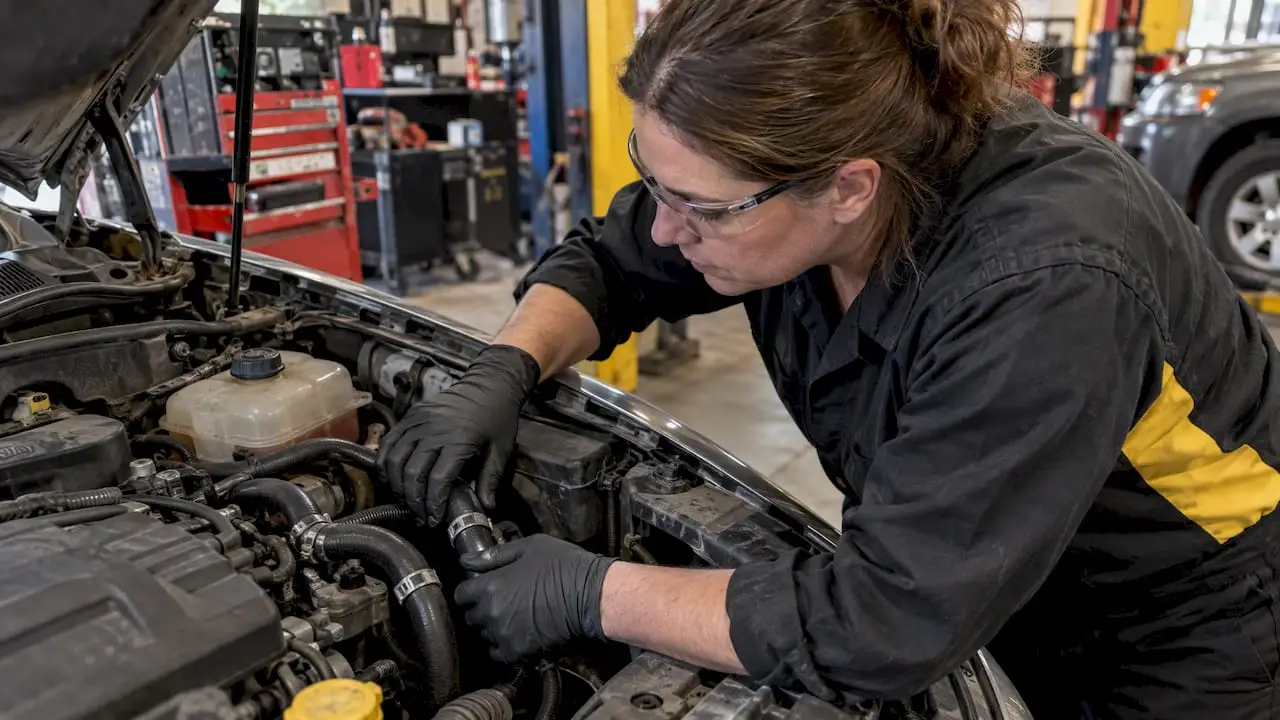
Deposits can build up inside the heater core and restrict coolant flow. A typical pattern is a heater that works at first, then fails to blow hot air after a stretch of driving. One hose to the core may feel hotter than the other. Technicians can confirm flow with a few simple tests during an inspection.
A blend door actuator that has failed
AAA describes a broken blend door actuator as one of the internal problems that keep warm air from reaching the cabin. The classic sign is a clicking or knocking sound behind the dash. You may also see erratic temperature control, or air that refuses to switch between vents.
This is usually the least dangerous cause on the list, because the engine is fine. It is still worth fixing, since a door stuck on the cold side leaves you without defrost heat on a frosty morning.
A failing water pump
The water pump moves coolant through the engine and the heater circuit. When it weakens, you can lose heat and also see overheating, a whining noise from the front of the engine, or coolant seepage. This is not a wait-and-see symptom.
Signs of a Leaking Heater Core
A leaking core is a different problem from a clogged one, and it deserves faster attention. Watch for:
- A sweet, syrupy smell inside the cabin. AAA’s winter guide lists this along with a damp floor as a sign of a damaged core.
- A damp or wet carpet on the front passenger side.
- Windows that fog up and leave a greasy film.
- Coolant level that drops with no puddle under the car.
Coolant is not something to breathe or leave on carpet. If you notice these signs, avoid long drives, keep the windows cracked to clear the glass, and book an inspection. If the temperature gauge is rising, pull over safely and shut the engine off.
What You Can Safely Check Yourself
These checks take about ten minutes and need no tools.
- Look at the temperature gauge. Drive for several minutes. A gauge that never reaches the middle suggests a thermostat problem. A gauge that rises past normal means stop driving.
- Check the coolant reservoir on a cold engine. Compare the level to the marks on the tank.
- Look under the car for fluid on the pavement, especially after parking overnight.
- Listen behind the dash when you change the temperature setting. Clicking points to an actuator.
- Test the fan. If the blower does not move air at any speed, think fuse, relay or blower motor instead of coolant.
- Sniff the cabin. A sweet smell is a clue worth reporting.
- Squeeze the hoses only when the engine is cold. Consumer Reports advises feeling hoses, not only looking for leaks. Hoses that are rock-hard, crunchy or sticky and soft are nearing failure even if they are dry.
If any of that turns up a leak, a burning or sweet smell, or a rising gauge, stop troubleshooting and call a shop.
Why Small Leaks Are Not Small
It is tempting to ignore a slow weep from a hose clamp, especially when the car still runs. Consumer Reports points out that a belt or hose failure can overheat the engine and, if a hose leaks coolant, leave the cooling system inoperable. A hose or gasket is a modest repair. A cooked engine is not.
Hoses can also fail from the inside. The same guidance warns about electrochemical degradation, where internal damage weakens a hose that looks fine outside, and suggests asking for ECR-labeled replacements.
If your heater went cold and your gauge started climbing, our guide to what to do when your engine overheats covers the immediate steps. A failing cooling fan can cause the same trouble, which we cover in 4 things that stop a radiator fan.
Do You Really Need a New Heater Core?
A heater core replacement is one of the bigger jobs on this list, because the core sits deep in the dashboard. Consumer Reports owner-reported data on climate system problems shows that heater system failures appear across many models, and some shops quote a replacement in the range of $1,000 to $2,500.
Before you agree to that, ask:
- Was flow actually tested, or is the core being blamed by elimination?
- Could a professional flush clear a clogged core?
- Have the thermostat, coolant level and actuator been ruled out?
- Can I see photos or video of what you found?
That last question is why we use Digital Vehicle Inspections. You get photos, video and technician notes on your phone, so you can see the condition of the vehicle and decide with confidence. We do not publish repair prices, so we quote after we inspect your specific vehicle.
Heater Not Working: Gas Car, Electric Car or Hybrid
The advice above applies to engines that make their own heat. Electric vehicles heat the cabin differently. The Department of Energy says cabin and battery temperature control is the biggest power drain after driving, and in cold weather the DOE says about two-thirds of the extra energy consumed goes to heating the cabin.
If you drive an EV, preconditioning the cabin while the car is still plugged in is the DOE’s recommended practice, as described in its winterizing guide. Heated seats and a heated steering wheel use less energy than blasting the main heater.
Our shop works on cars, SUVs and light trucks with traditional cooling systems. If you drive a gas or hybrid vehicle and the cabin stays cold, the checks above apply.
Getting Heat Sooner on a Cold Morning
Idling in the driveway is not the best way to warm the car. Engines generally warm up faster when you drive gently, and the Department of Energy notes that vehicles perform best when warmed up first, which for gas cars means moving rather than sitting. Gentle driving also gets the heater working sooner and avoids burning fuel in the driveway.
Irving winters are not harsh, but they do swing. Weather Spark reports that temperatures in Irving typically range from 38°F to 96°F and rarely drop below 26°F. That means many drivers do not notice a weak heater until the first real cold snap, when it is also hardest to get a quick appointment. Checking the heater in October or November, while it is still mild, avoids that.
Our Perspective: Why Heat Problems Deserve a Real Diagnosis
We see the same pattern every fall. A driver turns on the heat for the first time in months, gets cold air and assumes it is a comfort issue that can wait until spring. Often the heater is the first warning that the cooling system needs attention.
The heater is connected to the same coolant that protects your engine. So when we look at a heater complaint, we do not start with the dashboard. We start with coolant level, hoses, the thermostat and how the engine reaches temperature. Then we narrow down to the core and the blend door.
We also believe you should see what we see. Our Digital Vehicle Inspections send photos, video and technician notes straight to your phone, so a recommendation is never just a sentence over the counter. If a flush or a smaller repair solves the problem, we want you to know that before anyone talks about a major job. Our work is backed by a 24-month/24,000-mile warranty, and our technicians are ASE-certified.
— Kwik Kar
Heater Repair and Cooling System Service in Irving
If your heater is blowing cold air, our A/C, Heating & Cooling service is the place to start. We inspect the cooling system, find out why the heat is missing and show you the result before you approve work. If a warning light is also on, an engine diagnostic helps us see the whole picture.
We offer same-day service availability, which helps if you are commuting through Irving every day and cannot leave the car for long. Contact us through our website to schedule a visit.
If you are also handling other seasonal items, a heater visit is a good time to ask about factory-scheduled maintenance and a battery test, since cold weather is hard on weak batteries. See our battery testing and replacement page for details.
When to Stop Driving and Call
Book a visit the same day, and do not keep driving, if you see any of these:
- The temperature gauge in the red zone, or a hot-engine warning light
- Steam from under the hood
- A strong sweet smell with fogging windows
- Coolant puddles under the car
- A heater that fails together with a whining or grinding noise from the engine
If the car overheats on the road, pull over, turn it off and call for help. Our overheating checklist explains what to do, step by step.
A heater that is merely weak, with no overheating and no smells, can usually wait a few days. It should not wait months.
FAQ
Why is my car heater blowing cold air?
The most common causes are low coolant, a thermostat stuck open, a clogged heater core and a failed blend door actuator. Low coolant and a stuck thermostat are cooling system problems, so they are worth checking early. A technician can tell them apart with a cooling system inspection.
Can I drive with the heater not working?
If the temperature gauge is normal and there are no leaks or smells, you can usually drive short distances to a shop. If the gauge is rising, you smell coolant, or you see steam, stop and shut off the engine. Driving an overheating car can cause damage that costs far more than the original repair.
What are the symptoms of a bad blend door actuator?
You may hear clicking or knocking behind the dash, get temperatures that do not match your settings, or find that air will not switch between vents. The engine itself usually runs normally. The fix is usually less involved than a heater core job, but the location of the part depends on the vehicle.
How do I know if my heater core is clogged or leaking?
A clogged core tends to produce a heater that fades after a while on the road. A leaking core usually brings a sweet smell, a damp floor and fogged windows. Both need professional inspection, and a leak needs it sooner.
Why is my AC working but my heater isn’t?
The A/C and heater share the blower and the blend doors, but heat comes from engine coolant while cold comes from refrigerant. If the AC is fine and the heat is cold, the problem is usually coolant, the thermostat, the heater core or the blend door. If you have the opposite problem, see our guide on AC that is not blowing cold.
Sources
- Car Overheating: 8 Causes and Solutions, AAA
- Tips for Winter Ready Vehicles, AAA Oregon/Idaho
- How to Inspect Car Belts and Hoses, Consumer Reports
- 2011 BMW 3 Series Reliability, Consumer Reports
- Winterizing Your Electric Vehicle, U.S. Department of Energy
- Average Weather in Irving, Texas, Weather Spark