A radiator fan that will not turn on almost always traces back to one of four things: a blown fuse, a failed relay, a dead fan motor, or a coolant temperature sensor that never tells the engine control unit to switch the fan on. If your temperature gauge is climbing or you see steam under the hood, pull over now and shut the engine off before you do anything else. Once the car is safe, a fuse check and a relay swap solve a surprising share of these cases in minutes.
TL;DR:
- A blown fuse, failed relay, dead fan motor, or malfunctioning coolant temperature sensor are the main causes of radiator fan failure.
- Overheating at idle or in traffic indicates issues with fan operation, especially if the temperature normalizes at highway speed.
- Safely pull over and shut off the engine immediately when signs of overheating, avoiding driving with a known bad fan to prevent engine damage.
- Troubleshooting should follow a step-by-step process: check fuse, test relay, run AC-on test, jumper the motor, then scan for diagnostic codes.
- Professional diagnosis includes electrical load testing, wiring inspection, and system pressure checks to identify the root cause accurately.
Table of Contents
- Symptoms That Point to a Radiator Fan Problem
- What to Do Right Now if Your Engine Is Overheating
- Radiator Fan Troubleshooting: A Step-by-Step DIY Checklist
- How the Sensor, Thermostat, and ECU Actually Work Together
- When to Stop Troubleshooting and Call a Shop
- Why We Test Every Fan Circuit the Same Way, Every Time
- Get Your Cooling System Checked at Irving
- Helpful Resources for Cooling System Safety
- Sources
- FAQ
Symptoms That Point to a Radiator Fan Problem
A radiator fan malfunction has a pretty distinct signature, and it’s usually not subtle. The classic pattern: your temperature gauge creeps up while you’re idling at a red light or crawling through traffic, then settles back down once you get moving on the highway. That happens because airflow from driving cools the radiator on its own, masking a fan that never spins up. The moment you slow down again, the needle starts climbing.
Watch for these fan-specific warning signs:
- Engine temperature rises at idle or in stop-and-go traffic, but normalizes at highway speed
- Air conditioning blows warm when you’re stopped, then cools again once moving
- Grinding, clicking, or wobbling noises coming from the fan shroud area
- A burning smell, which can mean a seized motor bearing or melted wiring insulation
- A check engine light tied to a cooling-fan circuit fault
Common radiator fan issues include overheating at idle, A/C that turns warm at a standstill, unusual noise from the fan assembly, and a check engine light triggered by the vehicle’s computer when it detects a fan circuit fault. If you’re noticing more than one of these at once, you’re probably not imagining it.
What to Do Right Now if Your Engine Is Overheating
Safety comes before diagnosis. If the temperature gauge is pegged, you smell coolant, or steam is rolling out from under the hood, treat it as an emergency and act in this order — and for help diagnosing unusual smells in your vehicle, see this guide to diagnose the source first to stop car odour for good.
- Turn on your hazard lights and pull safely onto the shoulder or into a parking lot.
- Shut off the engine completely. Do not let it idle “to cool down.”
- Pop the hood latch from inside, but leave the hood itself closed for a few minutes to let heat vent slowly.
- Wait before touching anything under the hood. AAA recommends waiting 15 to 30 minutes before opening the radiator cap since pressurized hot coolant can cause serious steam burns.
- Call for a tow or roadside assistance if the gauge stays pinned or you see coolant pooling underneath.
If you catch rising temps early and traffic allows it, running the heater on full blast can pull some heat off the engine block long enough to reach a safe spot. It’s a stopgap, not a fix, and it will make the cabin uncomfortable fast.
Pro Tip: Never drive on a known bad fan hoping to “make it home.” A car that’s already running hot with no fan can go from warm to boiling in a matter of minutes, especially in stop-and-go Irving traffic.
Radiator Fan Troubleshooting: A Step-by-Step DIY Checklist
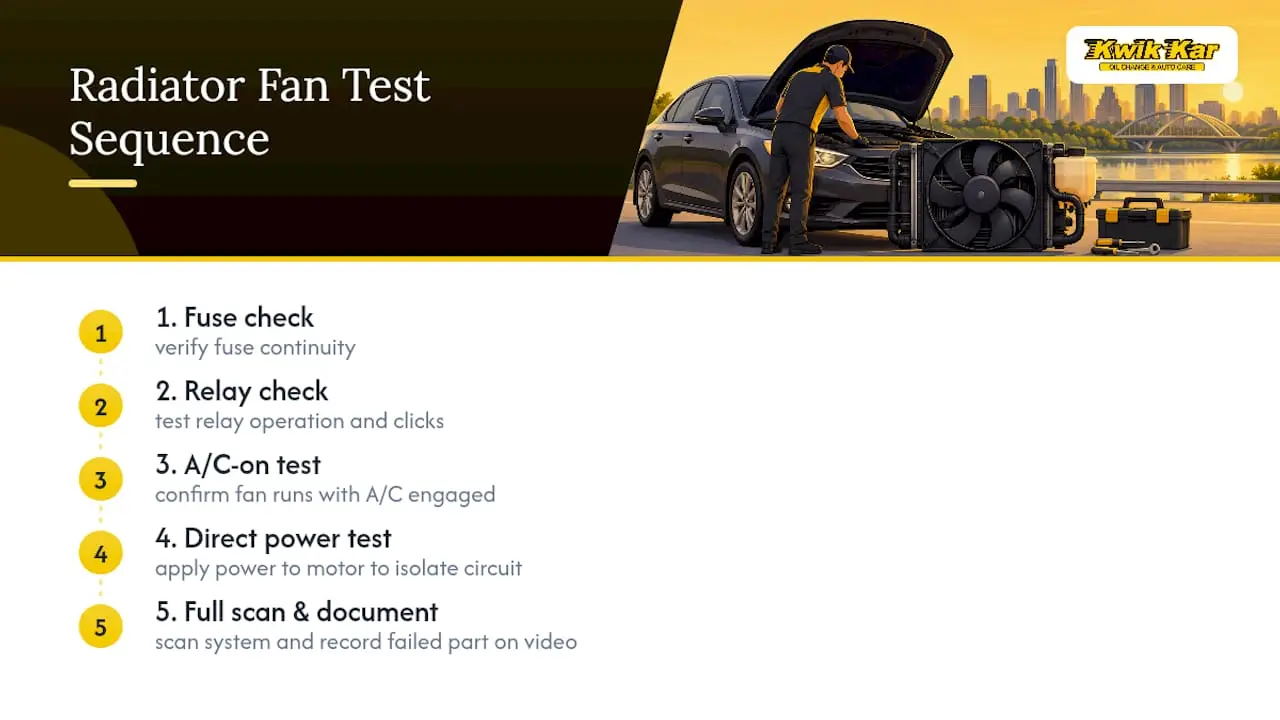
Work through this checklist in order. Each step rules out a cause and tells you where to look next, and it follows the same sequence that resolves most fan complaints without a shop visit: check the fuse, test the relay, try the AC-on test, jumper the motor, then scan for codes.
- Check the cooling fan fuse. Find it in your fuse box diagram, pull it, and inspect the metal strip inside for a break. Replace it with one matching the exact amp rating. A fuse that blows again right after replacement usually means a short somewhere downstream, not a bad fuse.
- Test or swap the fan relay. Relays fail more often than motors, and a relay failure is a small, inexpensive part that fixes fan problems quickly. If you don’t own a relay tester, swap it with an identical relay elsewhere in the fuse box, like the horn relay, and see if the fan comes to life.
- Run the AC-on test. Start the engine and switch the air conditioning to max. On most vehicles, the fan should kick on within 10 to 30 seconds because the AC compressor demands extra cooling. If it spins now, your fan motor and basic wiring are fine and the fault lies in the sensor or control logic.
- Do a direct 12-volt jumper test. With the engine off, disconnect the fan’s electrical connector and apply battery power directly to the motor terminals using jumper wires. If the fan does not spin with direct power applied, the motor is dead and the assembly typically needs replacing. If it does spin, the fault is somewhere else in the circuit.
- Scan for OBD2 codes. A basic scanner can pull codes in the P0480 family, which point to cooling fan control circuit issues. This narrows things down faster than guessing.
- Inspect wiring and connectors. Look for corroded pins, chewed insulation from rodents, or melted plastic near the connector housing. Engine bays run hot, and wiring damage here is more common than most owners expect.
How the Sensor, Thermostat, and ECU Actually Work Together
Radiator fan malfunction reasons often get pinned on the thermostat, but that’s usually the wrong suspect. The thermostat does not directly control the radiator fan; the coolant temperature sensor and the engine control unit handle that job together. The ECT sensor reads coolant temperature and reports it to the ECU, which decides when to command the fan on.
Where the thermostat comes in is trickier and often missed. A thermostat stuck closed can keep hot coolant from ever circulating past the ECT sensor on the radiator side, so the sensor reports cooler temperatures than what’s actually happening in the engine. The ECU never sees the trigger it needs and never turns the fan on, even though the engine itself may be running dangerously hot.
The thermostat does not directly control the radiator fan; the ECT sensor and ECU logic do. A stuck closed thermostat can indirectly prevent the ECT sensor from seeing hot coolant, which may stop the fan from being commanded on.
Practical signs that point toward sensor or thermostat trouble rather than a dead motor:
- Your AC-on test made the fan spin fine, but it never comes on during normal driving
- A scan tool shows a coolant temperature reading that seems too low compared to how hot the engine actually feels
- The heater blows cool air even after several minutes of driving, a classic stuck-closed thermostat clue
When to Stop Troubleshooting and Call a Shop
DIY testing has limits, and pushing past them risks turning a $200 fix into an engine rebuild. Stop and book a professional diagnosis if you notice any of these red flags:
- Coolant is visibly boiling, leaking, or pooling under the vehicle
- You see white, sweet-smelling exhaust smoke, a possible head-gasket warning sign
- The fuse keeps blowing no matter how many times you replace it
- You’ve run the jumper test and the AC-on test and still can’t pin down the cause
A shop diagnosis goes further than a home fuse check. Technicians typically run electrical load tests on the fan circuit, bench-test the relay under real conditions, and pressure-test the cooling system to rule out leaks the naked eye misses. Repair costs vary widely: many fan failures resolve with inexpensive relay or fuse swaps, while a failed motor or sensor pushes the bill higher, and letting the problem sit risks engine damage that costs far more to fix.
Why We Test Every Fan Circuit the Same Way, Every Time
Guessing at radiator fan issues wastes money on parts that were never broken. Our ASE-certified technicians follow the same sequence you just read: fuse, relay, AC-on test, direct power test, then a full scan, and we document every step with a Digital Vehicle Inspection so you see the actual failed part on video, not just a verbal explanation. A fair estimate should always show you what failed and why before you approve the repair.
Get Your Cooling System Checked at Irving
You’ve run the fuse check, maybe even the AC-on test, and you’re still not sure whether it’s the motor, the relay, or something upstream in the sensor circuit. That’s exactly where a proper diagnosis earns its keep instead of a guess that costs you two unnecessary parts. Digital Vehicle Inspections are run on every cooling-system visit, with photos and video sent straight to your phone so you can see the failed relay, corroded connector, or dead motor before you approve any work.

Technicians run the same fuse, relay, AC-on, and jumper test sequence outlined above, then back it with electrical load testing and a coolant system pressure check most home garages can’t replicate. If a scan turns up a P0480-family code or the wiring shows heat damage, our engine diagnostic service pinpoints it in one visit. Book a heating and cooling inspection at our Irving shop today, and drive away with a written estimate, a clear repair timeline, and a technician who can show you exactly what’s wrong on video before you agree to anything.
Helpful Resources for Cooling System Safety

For deeper reading beyond this checklist, AAA covers broader causes of engine overheating, AutoZone details the full fan troubleshooting sequence, and EngineerSkill.blog breaks down thermostat versus ECT sensor behavior in more technical detail.
Sources
- Prevent overheating — AAA
- What to Do If Your Radiator Fan Is Not Working in Your Car — AutoZone
- Bad radiator fan signs, causes and testing guide (2026) — FridayParts
FAQ
Can I drive a car if the radiator fan is not working?
Short trips at highway speed may be fine since airflow cools the radiator without the fan’s help, but idling or stop-and-go traffic can send the engine into an overheat within minutes. If the gauge climbs past the normal range, pull over and shut off the engine rather than risk engine damage.
How do I tell if my radiator fan is bad?
Look for overheating at idle that improves at highway speed, warm air conditioning at a standstill, or unusual noise from the fan shroud. A direct 12-volt jumper test on the fan motor is the most reliable way to confirm whether the motor itself has failed.
Can a bad thermostat cause the radiator fan not to work?
Yes, indirectly. A thermostat stuck closed can keep hot coolant from reaching the sensor that tells the engine control unit to turn the fan on, so the fan never gets its trigger even though the engine is overheating.
How expensive is it to fix a radiator fan?
Costs vary by cause: a blown fuse or failed relay is usually an inexpensive fix, while a failed fan motor or sensor pushes the repair bill higher. Oil Change & Auto Care provides a written estimate after a Digital Vehicle Inspection, so you know the exact cause and cost before approving any repair.