Your coolant is not evaporating. A cooling system is closed, so a falling level means fluid is escaping through an external leak too small to leave a puddle, or the engine is consuming it internally. If the engine is overheating, pull over safely and seek immediate professional assistance. White exhaust smoke or milky oil also warrants prompt professional assessment.
TL;DR:
- After the engine cools, inspect hose clamps and radiator seams for crust or damp tracks; a faint sweet smell after driving also points to seepage.
- White exhaust smoke, milky oil, or rough running can signal internal loss; technicians may use compression or combustion gas tests to confirm it.
- Check the reservoir’s cold marking only when the engine is cold, and never open a hot radiator cap; use a 50/50 premix if topping off.
- Record when the level drops, miles since the last top off, and any residue; these details help technicians choose where to test.
- Foggy windows, damp carpet, unusual cabin odor, or weak heat alongside a falling level can point technicians toward a heater core leak.
Table of Contents
- Why coolant disappears from a closed system
- Invisible external leaks: where coolant hides
- Internal coolant loss: head gaskets, cracks, and intake leaks
- Radiator cap and pressure problems
- Heater core leaks and cabin clues
- A safe checklist to run before you visit a shop
- When to see a professional and what to expect
- Maintenance that lowers your risk of hidden coolant loss
- Kwik Kar perspective: how we diagnose and document coolant loss
- Book a coolant-system diagnostic with us in Irving
- FAQ
- Sources
Why coolant disappears from a closed system
The cooling system is a sealed loop filled with a 50/50 mix of coolant and water. AAA explains that because the loop is closed, coolant loss is never normal, and a dropping level means fluid is escaping somewhere, even without a puddle. If your level keeps falling, the fluid is leaking outside the engine, where it can evaporate before hitting the ground, or inside it, where the engine consumes it.
So when you wonder why your coolant is low, think in two buckets:
- Invisible external leaks: seepage that dries on hot parts or vanishes as steam.
- Internal leaks: coolant drawn into the combustion chambers or mixed into the oil.
- Pressure problems: a weak radiator cap that lets coolant escape under pressure.
- Cabin leaks: a heater core that drips where you cannot see it from the engine bay.
Possible sources of coolant loss include hoses, the radiator, the water pump, the heater core, and the head gasket. Each one behaves differently, and the next sections walk through them so you can describe what you see before you ever pick up the phone.
Invisible external leaks: where coolant hides
An external leak does not always drip. Coolant can seep onto a hot engine surface and turn to steam, or dry into a crust that is easy to miss. Common hiding places include:
- Radiator end tanks: a leak here may be difficult to spot.
- Hose ends: seepage under a clamp leaves a dried ring instead of a drip.
- Water pump: a leak may be difficult to spot.
- Plastic tees and fittings: aging plastic cracks around connections.
Cold leaks can be difficult to spot. AAA notes that components contract as the car cools and tiny gaps open, so look for dried, crusty, or discolored deposits around hose connections and fittings. A faint sweet smell after a drive is another clue. Cars points out that coolant comes in green, yellow, pink, and orange and usually smells sweet.
Pro Tip: After a drive, park and let the engine cool, then shine a flashlight along hose ends and the radiator seams. Fresh crust or damp tracks tell you where the coolant has been going.
Internal coolant loss: head gaskets, cracks, and intake leaks
When there is no trace outside the engine, the coolant may be going inside it. A failed head gasket can let coolant seep into a cylinder, where it burns off, or mix into the engine oil. AAA’s Oregon club describes internal loss as a serious issue, often a blown head gasket, with symptoms that include poor running, white exhaust smoke, and milky oil.
Watch for these red flags:
- White exhaust smoke: often sweet-smelling, from coolant burning in the cylinders. Our guide to white smoke from your exhaust covers the causes.
- Milky or foamy oil: coolant mixing with oil, visible on the dipstick or under the oil cap.
- Misfires and rough running: these can accompany internal coolant loss.
- Overheating: the system loses fluid and pressure at the same time.
Similar symptoms can have different causes, so a professional diagnosis is needed. They are harder to tell apart by eye, which is why guessing is a bad plan.
Diagnosis needs equipment. AAA says confirming internal loss often takes a professional compression test or combustion gas test.
A professional can determine which tests are appropriate to investigate suspected internal coolant loss.
Radiator cap and pressure problems
A faulty radiator cap may contribute to coolant loss. A technician can check whether the cap or another part of the cooling system is responsible.
A low reservoir or overheating can have several causes. Have the cooling system checked to identify the source.
Check the cap and reservoir only when the engine is cold. Cars.com advises checking the radiator only when it is cool. A technician can inspect the cap and reservoir for signs of a problem. If you are unsure, ask a shop to diagnose the cooling system.
Heater core leaks and cabin clues
A heater-core leak is one possible explanation for coolant loss when no leak is visible under the hood.
If you notice an unusual smell, foggy windows, damp carpet, or weak heat along with falling coolant, mention these symptoms when seeking service.
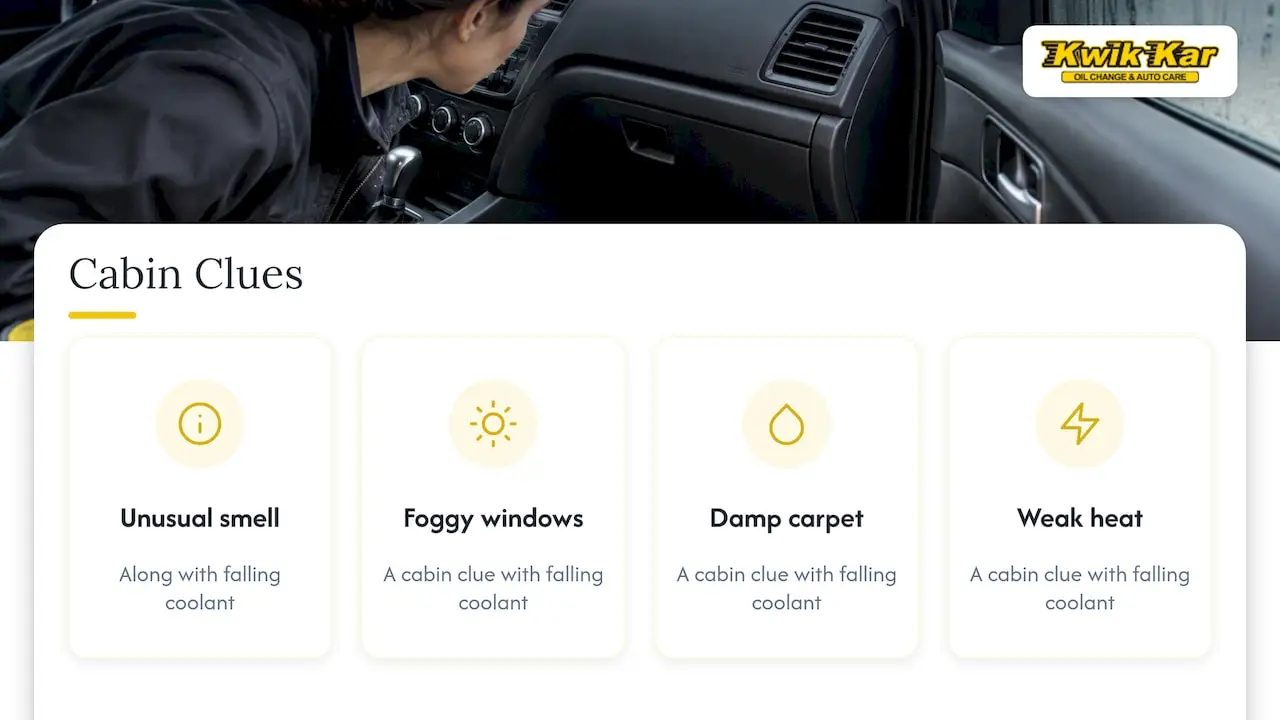
A heater-core problem may be difficult to identify from the engine bay. If you notice these signs along with a falling reservoir, mention them when you book. Heater core work is part of our A/C, heating and cooling service.
A safe checklist to run before you visit a shop
Good notes make diagnosis faster. Work through these steps with the engine cold:
- Check the reservoir level against the “cold” marking. Consumer Reports notes that coolant contracts in cold weather, so always add coolant when the engine is cold and use the cold-level markings.
- Note the color and smell. Note the fluid’s color and smell, then share what you observe with a technician.
- Inspect hoses and clamps for dried deposits, crusty rings, or damp spots.
- Look for steam after a drive. Steam from under the hood can indicate a cooling-system problem.
- Peek at the oil. Milky oil on the dipstick or under the cap can be a sign of an internal problem.
- Record the pattern: when the level drops (after highway driving, after idling, or steadily) and how many miles since your last top-off.
Never open the radiator cap on a hot engine. Consumer Reports warns against opening it until the engine cools. If you must top off, Cars.com recommends a store-bought 50/50 premix when you do not know the exact ratio.
Pro Tip: Snap a photo of the reservoir level and any residue you find, with the date. Photos can help a technician understand what you observed.
When to see a professional and what to expect
If the engine is overheating, pull over safely and seek immediate professional assistance. White exhaust smoke, milky engine oil, or a sudden coolant drop also call for prompt professional assessment.
Consumer Reports explains that overheating can come from a leaking hose or radiator, a bad water pump or thermostat, a worn belt, or electrical trouble, and that professional diagnosis is usually needed. If your engine is already overheating, our steps for stopping engine damage when it overheats can help you stay safe.
At the shop, a technician typically works through these steps:
- Pressure-test the cooling system to find slow external leaks
- Run a compression test and a combustion-gas test if internal loss is suspected
- Scan the engine for stored codes with an engine diagnostic service. For background on one related code family, see this engine coolant temperature sensor reference.
- Inspect hoses, the water pump, the radiator, and the heater core
Repairs depend on the cause of the coolant loss. Have the problem diagnosed before deciding what work is needed.
Maintenance that lowers your risk of hidden coolant loss
Most hidden leaks start small, and routine care catches them:
- Inspect hoses and clamps. Consumer Reports advises checking for softness, hard or crunchy spots, swelling, and dried deposits, and replacing deteriorated hoses.
- Flush on schedule. Follow your owner’s manual for coolant flush intervals. A coolant flush removes worn-out fluid that a top-off never will. Cars that coolant deteriorates and should be tested or flushed per the manufacturer.
- Use the right coolant. Match the type your vehicle calls for, or a 50/50 premix when topping off.
- Ask for a pressure test if you keep topping off the reservoir. Repeated top-offs are a symptom, not a fix.
Kwik Kar perspective: how we diagnose and document coolant loss
We believe a coolant problem should be proven, not guessed. Our team can discuss your cooling-system concerns and explain any service recommendations.
— Kwik Kar
Book a coolant-system diagnostic with us in Irving
If your coolant keeps dropping and you cannot find the leak, bring it to us. We offer engine diagnostics and A/C, heating and cooling service. Contact us to ask what inspection or diagnostic services are available for your cooling-system concern. If the engine is overheating, pull over safely and seek immediate professional assistance. If you see white smoke, arrange prompt professional assessment.

FAQ
Why is my coolant level dropping without a leak?
A closed cooling system should not lose coolant, so a dropping level means a leak you cannot see or internal consumption. Small external leaks can evaporate on hot parts, and a head gasket problem can burn coolant in the cylinders or mix it into the oil. A pressure test helps find the cause.
How much coolant loss is normal in a year?
None. AAA says coolant loss is never normal in a closed system, so a level that keeps falling deserves attention. Coolant levels can vary with temperature, so compare readings under consistent conditions and have a consistently falling level checked.
Can coolant drain without a leak?
Not truly. Coolant can disappear without a puddle when it leaks onto hot engine parts, drips inside the cabin from the heater core, or enters the engine internally. The leak exists, it is just hidden.
Does losing coolant mean head gasket?
Not always. Hoses, the radiator, the water pump, the radiator cap, and the heater core can all lose coolant. A head gasket becomes more likely with white exhaust smoke, milky oil, or overheating, and a compression or combustion-gas test confirms it.
Sources
- Signs of a Coolant Leak | AAA Club Alliance
- Info
- How to Inspect Car Belts and Hoses – Consumer Reports