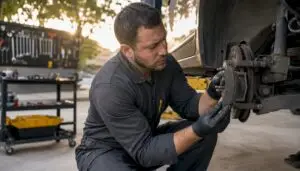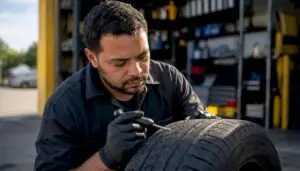
A sticking brake caliper means the pad never fully releases from the rotor, so friction and heat build up even when you’re off the pedal. If you notice pulling to one side, a burning smell, or a wheel that’s hot to the touch, stop highway driving right away. Get the vehicle to a shop or arrange a tow if the wheel is smoking. Don’t ignore it.
TL;DR:
- A sticking brake caliper causes constant pad pressure, raising rotor and fluid temperatures beyond safe limits and risking brake fluid boiling.
- Symptoms include vehicle pulling to one side, a burning smell, or a hot, discolored wheel indicating abnormal friction.
- The most common cause is corroded slide pins, which can often be fixed by simple cleaning and re-greasing, making it the cheapest repair option.
- Costs vary from $80 to $120 for slide-pin service to $300–$500 per axle for caliper replacement, with early detection saving money.
- Regular brake fluid changes and proper maintenance of slide pins, boots, and parking brakes can prevent caliper sticking and prolong brake system health.
Table of Contents
- What Is a Sticking Brake Caliper and Why Is It Dangerous?
- What Are the Symptoms of a Sticking Caliper?
- What Causes a Brake Caliper to Stick?
- How Do Technicians Diagnose a Sticking Caliper?
- What Does It Cost to Fix a Sticking Caliper?
- How Can You Prevent a Sticking Caliper?
- Do Front and Rear Calipers Stick Differently?
- Do Fixed and Floating Calipers Stick for Different Reasons?
- What Tools and Materials Do You Need for Caliper Maintenance?
- Kwik Kar: How We Inspect, Document, and Fix Sticking-Caliper Issues
- Book a Brake Inspection at Kwik Kar in Irving
- Sources
- FAQ
What Is a Sticking Brake Caliper and Why Is It Dangerous?
A caliper works by pushing a piston against the brake pad, which clamps the rotor. When you release the pedal, the piston and slide pins are supposed to retract, letting the pad float free. A sticking brake caliper fails at that last step. The pad stays pressed against the rotor, generating constant friction.
That constant drag raises rotor and fluid temperatures far beyond normal operating range. Push it hard enough, and the brake fluid can boil, creating compressible vapor in the lines that leads to a soft, fading pedal exactly when you need stopping power most. Warped rotors and scorched pads often follow. Catching a stuck caliper early, before it eats through a rotor or damages the hose, is the difference between a cheap fix and a much bigger repair bill.
What Are the Symptoms of a Sticking Caliper?
Most drivers notice a sticking brake caliper before a mechanic ever gets involved. The signs tend to show up gradually, then all at once.
- Pulling under braking: The car drifts toward the side with the dragging caliper because that wheel is slowing down faster than the other.
- Drag while coasting: If the car feels like it’s fighting you at low speed with your foot off the gas, one wheel may be partially braked at all times.
- Burning smell or smoke: A hot, acrid odor after a drive, especially from one wheel, points to friction that shouldn’t be there.
- Visibly hot wheel or rim: Touching the wheel (carefully, after it’s cooled slightly) or spotting discoloration on the rim is a red flag.
- Uneven pad wear: Peek through the spokes. One pad worn down to a sliver while the others look thick is a classic seized-caliper symptom.
Rotor temperature is the most reliable field test. A dragging caliper can run 50 to 100°F hotter than the opposite side after even a short drive. An infrared thermometer confirms it in seconds, but a careful hand-hover near the wheel (never touch it directly) will often tell you the same thing. Pair that with a quick pad-thickness comparison, and a short, slow test drive to see if the pull or drag repeats.
What Causes a Brake Caliper to Stick?
Several mechanical failures can leave a caliper stuck in the “applied” position. Most trace back to age, moisture, or debris rather than a single dramatic failure.
- Seized or gummed slide pins: On floating calipers, the pins let the caliper body slide back and forth. Dried-out grease or a torn rubber boot lets dirt and moisture in, and the pins bind up.
- Corroded caliper piston: Old, moisture-laden brake fluid corrodes the piston bore over time, and a pitted piston won’t retract smoothly.
- Collapsed brake hose: A deteriorated flexible line can trap pressure like a one-way valve, keeping the caliper clamped even after you’ve let off the pedal.
- Parking brake cable issues: On rear calipers with an integrated parking brake, a rusted or frozen cable can hold the pad against the rotor.
- Rust-bonded pads or debris: Pads left sitting too long can bond to the rotor surface, and road debris lodged near the piston can jam its travel.
Slide pins that have lost lubrication are the single most common cause of early-stage caliper drag, which is good news. It’s usually the cheapest problem to fix.
How Do Technicians Diagnose a Sticking Caliper?
A shop visit starts with the same checks you can do in the driveway, then moves into tests that require a lift and some tools.
- Wheel-off visual inspection. Techs pull the wheel to check pad thickness, look for scoring on the rotor, and inspect the slide pins and boots for damage.
- Manual piston pushback. A technician tries to compress the piston with a C-clamp during pad service. If it won’t budge, the piston is likely seized and the caliper usually needs to be replaced rather than repaired.
- Bleeder-valve pressure test. To separate a bad hose from a seized piston, a tech cracks the bleeder valve while an assistant holds the pedal down. If fluid releases immediately, the problem is a collapsed hose trapping pressure; if nothing releases, the piston itself is stuck.
- Infrared temperature comparison. After a short test drive, comparing rotor temperatures side to side confirms drag and shows how severe it is.
Technicians usually start with the cheapest, least invasive checks, slide pins, boots, and pad wear, before moving to hose and piston tests, since most sticking issues resolve at that first stage. If a wheel is smoking or the pedal feels dangerously soft on the way in, expect the shop to recommend towing rather than driving it in yourself.
Pro Tip: If you’re checking pad wear yourself, don’t eyeball just one spot on the pad. Rotate the wheel slightly and look at both edges. A caliper that’s dragging unevenly can wear one corner of a pad faster than the rest, and a quick glance might miss it.
What Does It Cost to Fix a Sticking Caliper?
Repair paths vary depending on how long the caliper has been sticking and what it’s damaged along the way.
- Slide-pin service (clean, regrease, replace torn boots) is the cheapest and most common fix. Estimates for this alone run $80 to $120.
- Caliper rebuild or replacement becomes necessary when the piston is corroded or won’t retract. Caliper replacement with new pads typically runs $300 to $500 per axle.
- Brake-hose replacement is needed when the bleeder test shows trapped pressure rather than a seized piston.
- Rotor and pad replacement gets added when dragging has already scored the rotor or cooked the pad. Combined caliper, rotor, and pad work due to damage can run $450 to $650 per axle, depending on the vehicle.
Shops often recommend servicing both calipers on an axle at once, since the good side has usually seen the same age and mileage as the sticking one. A brake fluid flush commonly follows caliper work, too, clearing out the old, moisture-contaminated fluid that likely contributed to the problem in the first place. Catching a slide-pin issue before it turns into a caliper-and-rotor job is where most of the savings live.
How Can You Prevent a Sticking Caliper?
A little routine maintenance goes a long way toward keeping calipers moving freely.
- Change your brake fluid on schedule. Brake fluid absorbs moisture over time, and that moisture is what corrodes pistons and seals from the inside. A fluid change roughly every two to three years keeps corrosion risk low.
- Grease the slide pins at every pad change. Whoever services your brakes should pull the pins, clean off old grease and grit, and repack them. Replace any boot that’s cracked or torn.
- Use your parking brake regularly. Letting it sit unused for months, especially on rear calipers with a cable-actuated parking brake, invites the cable to seize.
- Exercise the brakes after long storage. A car parked for weeks can develop rust bonding between pad and rotor. A few gentle stops after sitting helps break that bond before it becomes a stuck caliper.
Pro Tip: If your vehicle sits for more than a few weeks at a time, parking with the brake released instead of set can prevent rust-bonding on the rear pads, especially in humid Texas summers.
Do Front and Rear Calipers Stick Differently?
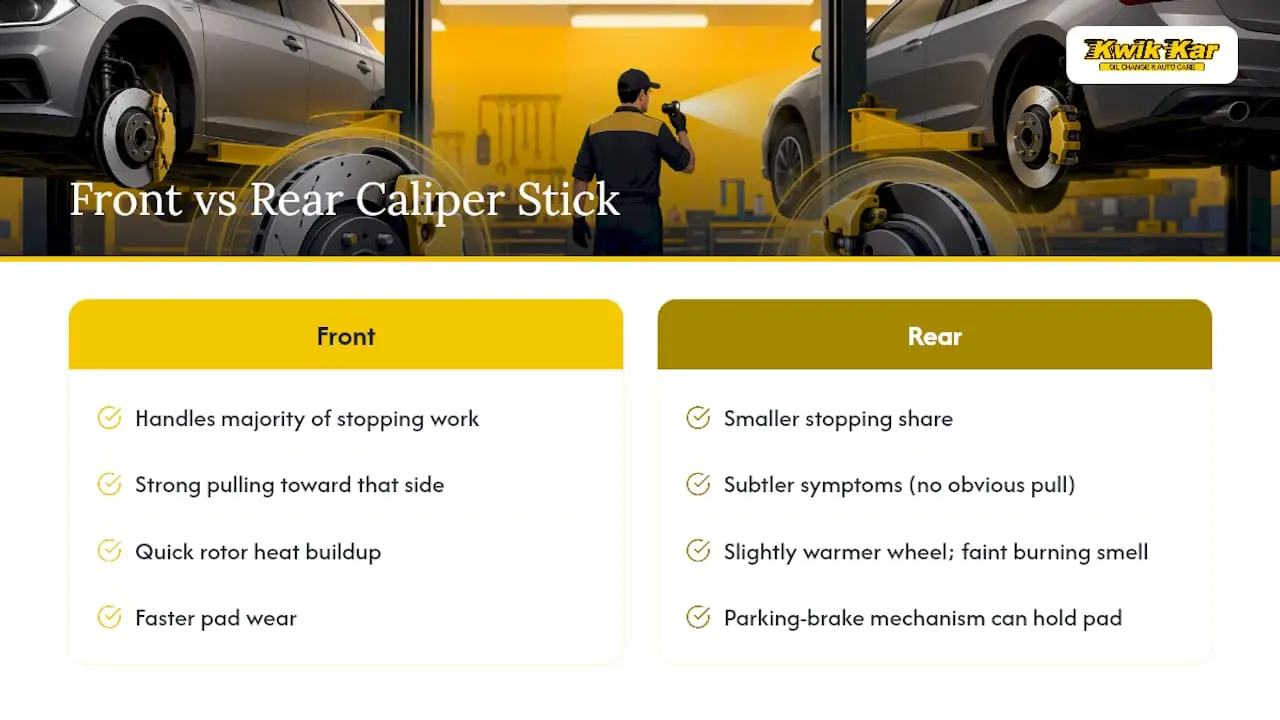
Front calipers do more of the stopping work, so a sticking front caliper tends to announce itself fast. Expect stronger pulling toward that side, quicker rotor heat buildup, and faster pad wear, since front brakes handle the majority of weight transfer under braking. A dragging front caliper on a highway commute can cook a rotor in a matter of days if nobody catches it.
Rear calipers stick for a slightly different set of reasons. Many rear calipers integrate the parking brake mechanism, either through a cable-actuated lever or a screw-type piston design. That adds a failure point front calipers don’t have: a rusted parking brake cable or a corroded adjuster screw can hold the pad against the rotor even when the hydraulic side of the caliper is fine. Symptoms are often subtler, too. Rather than an obvious pull, you might just notice slightly reduced fuel economy, a faint burning smell on longer drives, or a rear wheel that’s warmer than its partner after a short trip.
Repair approaches differ accordingly. A sticking front caliper usually points straight to slide pins, the piston, or the hose. A sticking rear caliper adds the parking brake mechanism to the diagnostic list, and on rear calipers with a screw-type piston, a technician needs a special tool to wind the piston back in rather than simply pushing it with a C-clamp. That’s one more reason rear caliper work often takes a bit longer in the shop than the equivalent front job.
Do Fixed and Floating Calipers Stick for Different Reasons?
Most daily-driven cars and trucks use floating calipers, where the caliper body itself slides on a pair of guide pins to center the pads against the rotor. That sliding action is exactly why slide-pin corrosion is the number one cause of sticking on these vehicles. Dry out the grease or tear a boot, and the whole caliper body binds instead of floating freely.
Fixed calipers, more common on performance and heavy-duty vehicles, mount rigidly to the bracket and use pistons on both sides of the rotor rather than sliding the whole housing. They eliminate the slide-pin failure point entirely, but that doesn’t make them immune to sticking. With two or more pistons per caliper, a fixed design just shifts the risk toward piston seal wear and corrosion, since each piston has its own seal that can fail with age. A fixed caliper with one corroded piston out of four can still drag unevenly, sometimes in a way that’s harder to diagnose because the other pistons are still doing their job.
The upshot for maintenance: floating-caliper vehicles benefit most from regular slide-pin service, while fixed-caliper vehicles need closer attention to piston seals and brake fluid condition over the long run. Either way, the underlying fix, whether it’s a pin, a boot, or a seal, comes back to keeping moisture and corrosion away from moving parts.
What Tools and Materials Do You Need for Caliper Maintenance?
You don’t need a fully equipped shop to handle basic caliper upkeep, but a few specific tools make the difference between a clean job and a guessing game.
For inspection, an infrared thermometer is the single most useful addition to a driveway toolkit. It turns “does this wheel feel hot?” into an actual number you can compare side to side. A flashlight and a small mirror help you see pad thickness through the wheel spokes without pulling the wheel at all.

For hands-on service, you’ll want a C-clamp or a dedicated caliper piston tool (rear calipers with integrated parking brakes often need a cube-shaped or windback tool rather than a simple clamp), a set of slide-pin grease formulated specifically for high-temperature brake use, and fresh rubber boots sized to your caliper. A torque wrench matters too, since caliper bracket bolts have specific torque values that keep the whole assembly aligned correctly.
One material rule matters more than any tool: never spray general-purpose lubricants like WD-40 near the pads or rotor. Contaminating the braking surface with lubricant drastically reduces stopping power and turns a sticking problem into a much more dangerous one. Keep lubricant strictly on the slide pins and hardware, never the friction surfaces. For general cleanup around the wheel, partner guidance on safe brake dust removal is worth a look before you reach for a random cleaner.
Kwik Kar: How We Inspect, Document, and Fix Sticking-Caliper Issues
Our ASE-certified technicians run through the full diagnostic sequence, slide pins, piston pushback, bleeder test, rotor temperatures, and document every finding with photos and video through our Digital Vehicle Inspection. You see exactly what we see before any work begins. Once you approve a repair, the typical path is diagnosis, options with DVI evidence, the repair itself, a fluid flush where needed, and a retest to confirm the drag is gone. You leave knowing what was fixed and why, with clear documentation of the service.
— Kwik Kar
Book a Brake Inspection at Kwik Kar in Irving
Kwik Kar Oil Change & Auto Care gives you something a guessing game at home can’t: an ASE-certified technician physically testing your caliper, backed by DVI photos and video so you see the actual problem before paying for a fix.
If a wheel is smoking or your pedal feels dangerously soft, don’t try to drive across town. Have the vehicle towed to us instead. Otherwise, bring it in for a full brake inspection, and right now you can save $20 off brake replacement at our Irving location. Our team will check slide pins, pistons, and rotor temperatures, walk you through the DVI findings on your phone, and give you a clear repair plan with no surprises. Schedule your brake inspection today, or ask about our brake service the next time you’re in for routine maintenance.
Sources
The diagnostic steps and repair guidance in this article draw on established repair references, including AutoZone’s caliper troubleshooting guide, RepairPal’s symptom breakdown, DirectBrakes’ cost and diagnostic data, and CarParts.com’s safety warnings on caliper contamination risks.
- Brake Caliper Sticking: Causes, Signs, and What to do Next
- Signs of a Stuck Brake Caliper: Symptoms, Causes & Fixes
- Sticking Brake Caliper: Causes, Symptoms, and What It Costs
- Carparts
FAQ
Can WD-40 Fix a Stuck Brake Caliper?
No. Spraying WD-40 or similar lubricants on a caliper, pad, or rotor contaminates the braking surface and drastically cuts stopping power. A stuck caliper needs mechanical service, cleaning slide pins, freeing or replacing the piston, not a lubricant spray.
Can You Drive a Car With a Sticking Brake Caliper?
You can drive short distances carefully, but you shouldn’t take it on the highway or drive it for long. A sticking caliper generates heat that can boil brake fluid and cause brake fade, so get it inspected as soon as possible and tow it if a wheel is smoking.
Is It Expensive to Fix a Stuck Brake Caliper?
It depends on how early you catch it. Slide-pin service alone often runs $80 to $120, while a full caliper replacement with pads runs $300 to $500 per axle. Waiting until the rotor and pads are also damaged pushes costs higher. Kwik Kar Oil Change & Auto Care provides a full DVI-backed estimate before any repair begins, and current brake service pricing is available on our brake repair page.
Why Is My Caliper Not Releasing?
The most common reason is a seized or gummed-up slide pin from dried grease or a torn boot. Other causes include a corroded piston, a collapsed brake hose trapping pressure, or a rusted parking brake cable on rear calipers. A shop can pinpoint the exact cause with a piston pushback test and a bleeder-valve pressure check.